University College Cork is an Irish institution separate from INTIAU. Its qualifications register identifies CK301 with the Honours Bachelor of Civil Law, BCL (Hons).
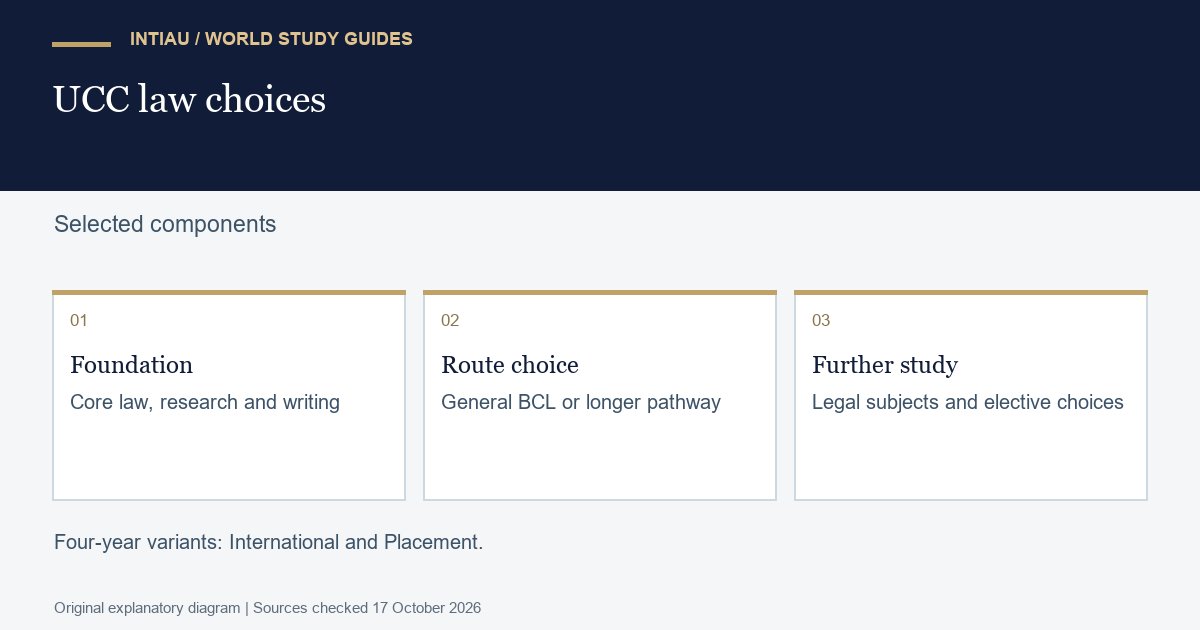
The course page distinguishes a three-year BCL from four-year International and Placement variants, with a pathway application after first year.
Compare a law degree by the kind of reasoning it requires, not just by the number of topics on its website. Reading a rule, identifying a disputed fact and explaining a conclusion are different tasks. A strong comparison asks where you would practise each task and how a change in evidence could alter your argument. It also separates an academic qualification from any later professional requirements you may need to investigate independently.
Selected curriculum and decision points
| Stage | Selected direction |
|---|---|
| First year | Constitutional, contract and criminal law; legal research and writing |
| After first year | Pathway decision |
| Later general BCL | Further legal study and electives |
For your notes, keep a route decision separate from a module choice. “I want to investigate environmental rules” describes an intellectual interest. “I want a placement” describes a different feature of study. One need not substitute for the other. Compare the evidence for both before putting them together in a preferred degree plan.
A real module, with a clear evidence boundary
UCC’s 2026/27 teaching record lists LW1156 Legal Research and Writing. That confirms a named module in the current teaching edition; it does not supply its complete syllabus or assessment scheme.
Full records: Programme Catalogue and Book of Modules.
Use those records for full requirements when accessible. This guide does not replace an unavailable detailed outline with guessed weekly content. The selected module is a starting point for a precise question about how legal sources and written arguments are taught.
Worked exercise: interpret a fictional club rule
This exercise is original and concerns no real law. A fictional library club adopts the rule: “Loaned equipment must be returned to the desk by 17:00, unless the desk is closed.” A member arrives at 16:55 with the equipment. The desk has a sign saying “Back in ten minutes”, and the member leaves the equipment beside it. Decide which facts matter before deciding whether the rule was followed.
There are at least two issues. Does “closed” include a temporary absence? Does “returned to the desk” require a person to accept the item, or merely delivery to the stated place? The sign does not settle either definition. Write one argument for treating the temporary absence as closure and one against. In each, quote only the relevant words from the fictional rule and explain the connection to the facts.
Now add a new fact: a posted instruction says that equipment may never be left unattended. This could change the interpretation of an acceptable return without answering whether the desk was closed. Avoid blending the two issues into a single impression that the member “probably did enough”. State which conclusion the additional instruction affects and which uncertainty remains.
A useful short answer follows four moves: identify the issue, state the relevant wording, apply it to the facts, and give a qualified conclusion. For example, the unattended equipment instruction weakens the claim that leaving the item completed a return. It does not prove that the member could have handed it to someone before 17:00. A conclusion can therefore be reasoned and still acknowledge a missing fact.
Repeat the exercise with a changed rule: “Return equipment to a staff member before 17:00.” Compare how much ambiguity the revision removes and whether it creates a practical difficulty when staff are absent. This tests your interest in careful distinctions and competing interpretations. It is neither legal advice nor an institutional admissions task.
Keep an evidence log beside your answer. In one column place an observed fact, such as the temporary closure sign; in another place an inference, such as the member’s intention. This prevents a plausible motive from silently becoming established evidence. Comparing the two columns can reveal exactly where reasonable readers disagree, rather than disguising disagreement with a confident conclusion.
Application scope
CK301 directs relevant applicants to CAO and those outside the EU/EFTA/UK to UCC Apply. Check the intended entry-year calendar.
Questions about this guide
Is every pathway three years?
No. International and Placement take four years.
Does the teaching record publish the full LW1156 syllabus?
No. It verifies the module’s current teaching listing.
Does the exercise interpret Irish law?
No. Both the club and its rule are fictional.
For INTIAU’s separate information, visit Courses and Contact.
Related guides
View the study diagram