The University of Cape Town (UCT) is separate from INTIAU; its Bachelor of Science (Eng) in Civil Engineering is a UCT programme. The department overview describes a four-year route spanning structures and materials, water, transport, urban engineering and geotechnical study.
To compare civil engineering programmes, start with a service rather than a landmark building. A street, drainage channel or retaining wall raises questions about loads, ground conditions, water movement, users and maintenance. Ask which of those questions you want to investigate, then use the curriculum to see how the necessary tools are built.
A dated curriculum map with a cohort boundary
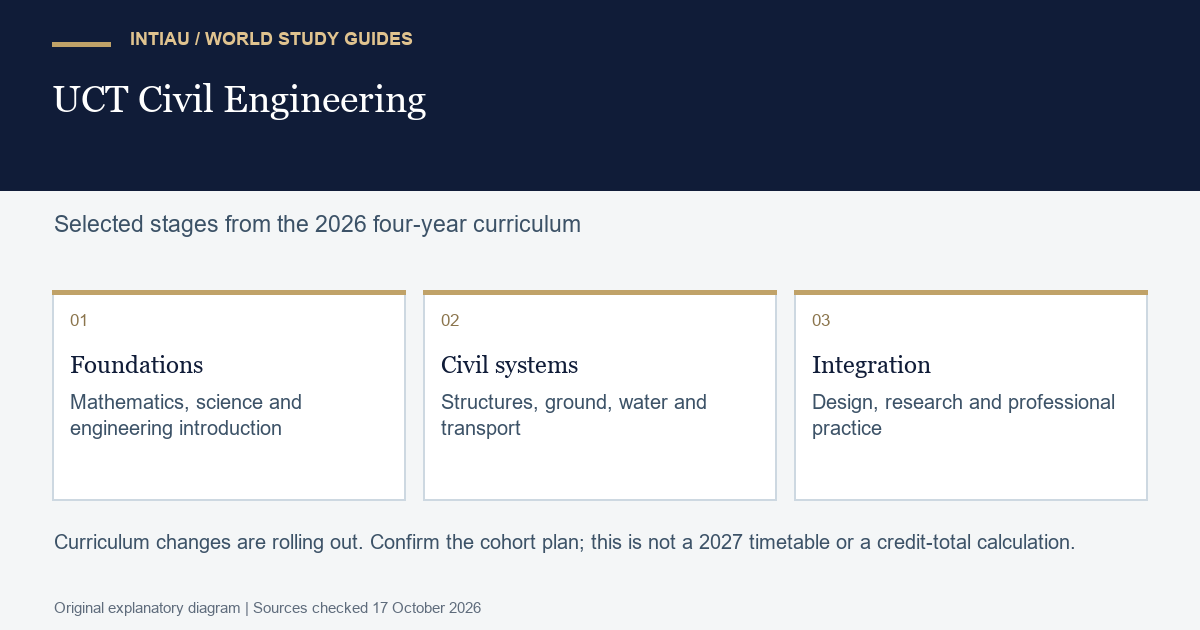
UCT’s 2026 EBE Undergraduate Handbook records a rolling curriculum change from 2025. Its academic plan depends on the anticipated graduation year. The selected four-year stages below therefore summarise the published handbook, not an assured 2027 timetable.
| Year | Examples |
|---|---|
| 1 | Mathematics, physics, drawing, mechanics and introductory civil engineering. |
| 2 | Materials, geotechnics, transportation, hydraulics and structural analysis. |
| 3 | Hydrology, water services, structural design and transport planning. |
| 4 | Design Project, Research Project and Professional Practice. |
Do not add the table’s rows as if they were a credit checklist. For a personal comparison, retain the university’s original course codes and record whether your reference belongs to an earlier or newer plan. That prevents a changed module appearing in two handbook years from becoming an invented extra requirement.
What a course outline tells you
One actual example is CIV1008F, Introduction to Civil Engineering, on printed page 106. Its outline links practical measurement and quantitative presentation with introductory computing, modelling and professional communication. Detailed participation and assessment requirements are referred to the official course handout. This selected outline is not the complete degree syllabus.
When reading that example, distinguish the topic from the output. “Water” is a topic; a clearly labelled measurement table is an output you can inspect. Create separate columns for concepts, practical methods and communication. A programme that names the same topic may still develop it through different work, so a course-name match alone is weak evidence for comparison.
An original infrastructure decision exercise
This exercise is created for this guide and is not a UCT assignment. Imagine a pedestrian route beside a small stream. After heavy rain, the path becomes muddy and access is difficult. Compare three possible responses on paper: changing the surface, changing the route, or improving drainage. Do not calculate a construction design or treat the exercise as advice for a real site.
Draw a simple diagram for each response. List what you know, what you have merely assumed, and what measurement would help. Consider the direction of runoff, the available width, the kind of ground and who needs to use the path. Add a maintenance question to every option. A cheap initial intervention may create a different problem if nobody can inspect or maintain it.
Then write a 150-word recommendation that names the most important missing evidence and explains why it could change your choice. Review your work by asking whether each conclusion follows from an observation or an assumption. Keep the diagram and recommendation together: they reveal whether your interest lies in mathematical behaviour, field evidence, design trade-offs or communicating a decision.
The 2027 application window has passed
UCT’s official key dates state that applications for 2027 undergraduate admission opened on 1 April 2026 and closed on 31 July 2026. That closing date was already past when this guide was checked on 17 October 2026. The page says late application requests are not considered. Do not reinterpret a later supporting-document date as a fresh application window.
The faculty’s Apply to EBE instructions direct applicants through UCT’s online application process and identify the 2027 undergraduate prospectus. This is the route for checking programme-specific entry information, including the treatment of different school qualifications. Read the applicable official prospectus before comparing your subjects with an entry requirement; this guide does not substitute a generic mark threshold for that assessment.
For a future cycle, create a short evidence file containing the publication year, qualification route, curriculum edition and unresolved questions. Leave an unannounced deadline blank. You can still compare academic interests while waiting for the university to publish the next calendar, without turning an old date into a prediction.
Frequently asked questions
Is this table a complete 2027 study plan?
No. It selects stages from the 2026 handbook during a curriculum transition.
Was 2027 undergraduate application still open on 17 October 2026?
No. UCT published a 31 July 2026 closing date.
Where should I check the official application route?
Use the faculty’s Apply to EBE page and its linked UCT undergraduate application and prospectus instructions.
INTIAU’s separate information is available through Courses and Contact. UCT makes its own admission and curriculum decisions.
Related guides
View the curriculum diagram