UiT The Arctic University of Norway is separate from INTIAU. Its Arctic Outdoor Life and Nature Guiding bachelor is a three-year, 180-credit route based in Alta and Svalbard.
Read the actual location and study progression
The 2026–2029 plan gives the English name Bachelor’s degree in Arctic Friluftsliv and Nature Guiding. Its selected progression is:
| Year | Published components |
|---|---|
| 1, Alta | Friluftsliv practices and methods; winter field study; guidance and learning |
| 2, Svalbard | Nature guiding as a profession; Arctic risk; value-based guiding; applied field leadership |
| 3 | Elective autumn; leadership, research method and bachelor’s thesis in spring |
The plan requires the first year to be completed and passed before the second begins. The third-year elective semester is 30 credits. This table selects components rather than reproducing every unit and requirement.
That sequence distinguishes learning a personal skill from facilitating another person’s learning. When comparing programmes, ask how a practical activity is connected to explanation, reflection and leadership. The fact that an activity takes place outdoors does not identify what is being assessed. A course may require a reasoned account of a decision as well as participation in the activity itself.
Teaching is mainly Norwegian in years one and three, with specified English units; year two is English-language.
The language pattern matters when reading an international-facing course description. A selected English unit can be open to exchange students while the complete degree still requires study in Norwegian. Use the degree’s language requirements and the actual course record together, rather than treating a translated title as proof of an entirely English route.
A current named unit has substantive learning aims
The spring 2027 FRI-1040 description, Winter friluftsliv and field safety, specifies ten credits at Alta and English teaching and examination. It is compulsory in this bachelor. Its themes include winter conditions, equipment, outdoor leadership, group dynamics and reflective learning. Practical excursions, preparation and debriefing are part of the learning design.
The record requires approved participation, fieldwork, preparation and follow-up, alongside skill tests and other assignments, before examination. A public description of these requirements is not a substitute for instruction or a qualification to lead an activity.
For a prospective student, the useful question is how experience becomes evidence of learning. A diary that only lists what happened differs from an explanation of why a choice was made, what information was available and what might be done differently. A good reflection can acknowledge an uncertain outcome while still examining the quality of the reasoning.
Check the actual programme admissions route
Applications use Samordna opptak and require general university-entry eligibility. The page gives an annual 15 April deadline, without a verified 2027 cycle here.
Check the instructions for your actual qualification and the programme’s language and practical requirements before applying. An individual English course and the full bachelor are different application scopes.
Try an original reflection exercise on paper
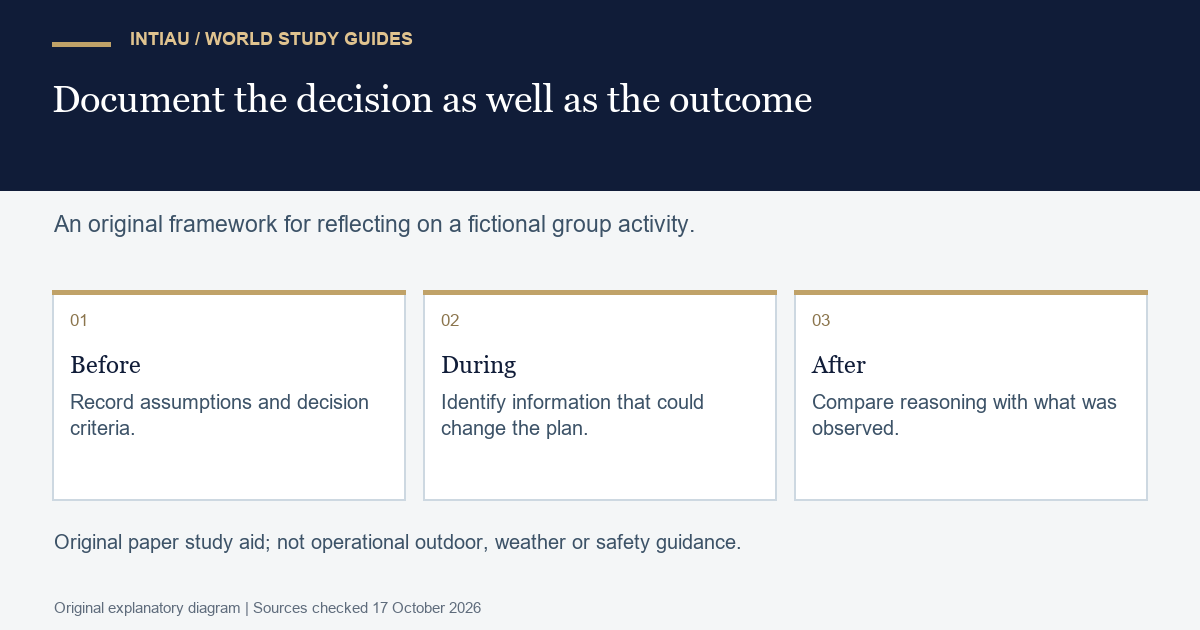
A fictional student group must choose between two classroom presentation formats. It selects A because every member expects it to be easier to follow. After the presentation, the audience reports that B would have been clearer. Does that prove that the original decision was unreasonable?
Not by itself. Examine what evidence the group had, whether it considered alternatives and whether a small trial could have challenged the shared expectation. Conversely, a favourable result would not prove that the decision process was sound. Record the reason, the evidence available at the time and one improvement to the process.
This deliberately indoor example keeps the reflective task separate from outdoor operations. It is original, carries no assessment status and supplies no advice about weather, terrain, equipment or real group safety.
Questions about this bachelor
Is the second year based on Svalbard?
Yes. The plan places year two in Longyearbyen.
Is the entire degree English-language?
No. The published language pattern includes substantial Norwegian teaching.
Is FRI-1040 a real named bachelor component?
Yes. Its spring 2027 record identifies it as compulsory in this programme.
Compare subjects through INTIAU Courses, or use Contact for INTIAU information-service enquiries.
Related guides
View the study diagram