Yonsei University’s Food and Nutrition undergraduate programme is in the College of Human Ecology, whose department is in Seoul. It is independent of INTIAU. Its departmental introduction connects food science, nutrient metabolism and foodservice management.
Academic identity and the applicable edition
The university’s 2025 degree table lists 식품영양학과 under 이학사, the Bachelor of Science category. That academic award description should be kept separate from any professional certification requirements.
The department encourages students to integrate knowledge across its scientific and management fields. It describes theoretical and practical learning and opportunities for field training. Those educational activities do not establish a guaranteed placement, professional licence or employment outcome.
From scientific foundations to applied subjects
The official 2026 major guide, printed pages 126–127, distinguishes entrants before 2018 from those entering from 2018 onward. For the latter specified single-major and related routes, it requires one listed chemistry course and one listed biology course. Read the permitted course alternatives and applicable route in the full guide.
| Published component | Selected subjects |
|---|---|
| Scientific foundations | Listed chemistry and biology alternatives for the specified routes |
| Nutrition and biological study | Biochemistry; Human Nutrition; Nutrient Metabolism |
| Food and foodservice study | Food Chemistry; Food Purchasing; Foodservice Management |
| Applied learning examples | Dietetic Field Practice; Field Practice in High-quantity Food Production |
These are selected components, not a compulsory year-by-year timetable. A course map becomes more useful when you record what each subject builds on and how its work differs. Laboratory analysis, scientific explanation and managing a production quantity should not be treated as the same learning task.
Read the actual course descriptions
The department’s undergraduate course descriptions give Human Nutrition three credits and explain its attention to nutrient functions, physiological and biochemical processes, and determining requirements. Cooking Science Art and Practice examines food components and the physical and chemical changes associated with cooking, including reasoned selection of methods.
Quantity Food Production and Laboratory connects meal planning, purchasing, cost calculation and standard recipes with production, time management and service. These are concrete published learning themes, not a complete current assessment brief. The list is undated; verify the section and curriculum applicable to the intended year.
Original exercise: scale a fictional production quantity
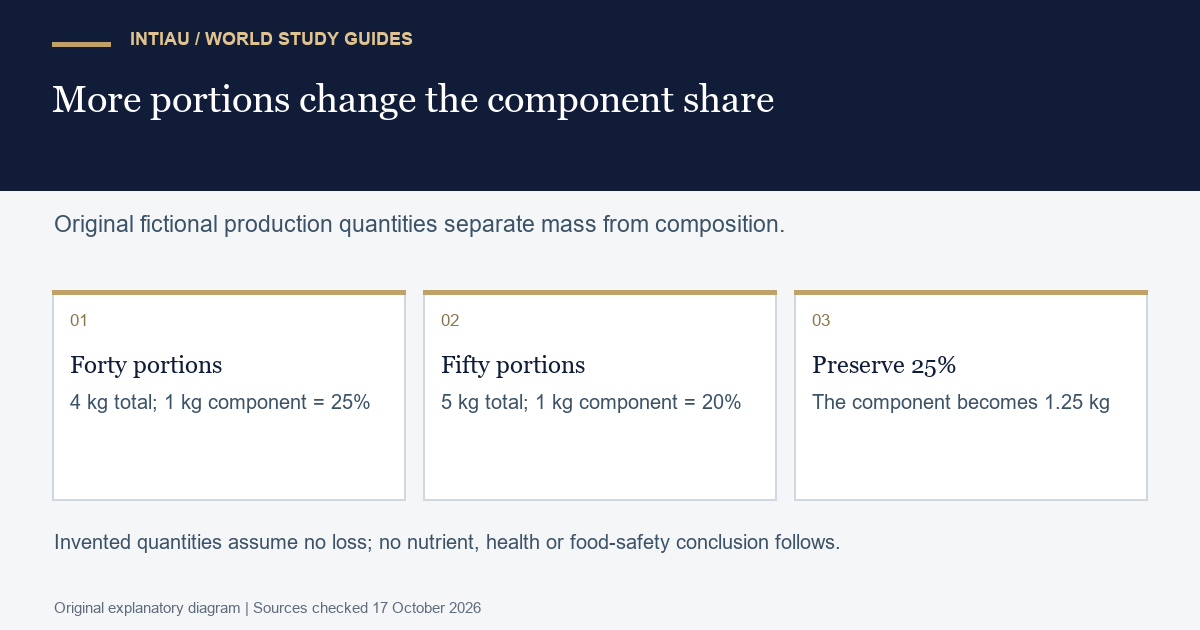
Suppose an invented planning sheet calls for forty portions of 100 grams each, a total of 4 kilograms. A stipulated component contributes 1 kilogram, or 25% of that total. If the plan changes to fifty equal portions while that component remains at 1 kilogram, the total becomes 5 kilograms and its share becomes 20%.
To keep the original 25% share at fifty portions, the component would need to contribute 1.25 kilograms. State whether your proposed revision preserves total mass, portion size or composition: these are different constraints. The arithmetic assumes no loss and consistent units. It gives no nutrient, health or food-safety conclusion. Use the fictional sheet only; there is no need to prepare food or collect anyone’s dietary information, and this is not a Yonsei assignment.
Applicant language and campus need their own check
The 2027 international student guide lists Food and Nutrition among its Korean-conducted undergraduate departments, with some English courses possible. For 2027 entrants it places the freshman year’s first and second semesters at the International Campus in Incheon. Its international track requires eligible non-Korean nationality for applicants and parents, a high-school qualification and specified language evidence.
Online applications ended on 17 September 2026 and document arrival was due on 30 September. Both dates are past on 17 October, despite the 2027 entry year. Language evidence accepted for application does not turn the programme into an English-only degree.
Explore subjects through INTIAU’s Courses or use Contact for general enquiries.
Three common questions
Is the table a fixed semester schedule?
No. It selects subjects from the guide rather than assigning every semester.
Are the course learning themes actually published?
Yes. The departmental entries describe the selected scientific and production topics.
Does an English application document imply English-only study?
No. The guide describes the programme’s Korean instruction separately.
Official sources checked 17 October 2026 are linked beside their claims.
Related guides
View the study diagram