Yale University is separate from INTIAU; its Psychology B.A. and B.S. are not INTIAU programmes or partnerships. This guide uses Yale’s 2026–27 standard-major rules, rather than the separate neuroscience-concentration requirements.
Start your comparison with a practical question: do you want to understand what a body of studies collectively suggests, or design a study that generates and tests new evidence? Neither question can be answered by the letters in a degree title alone. Look at the required work, the preparation it needs, and the kind of uncertainty you are willing to investigate. The published senior requirement makes this distinction especially useful here.
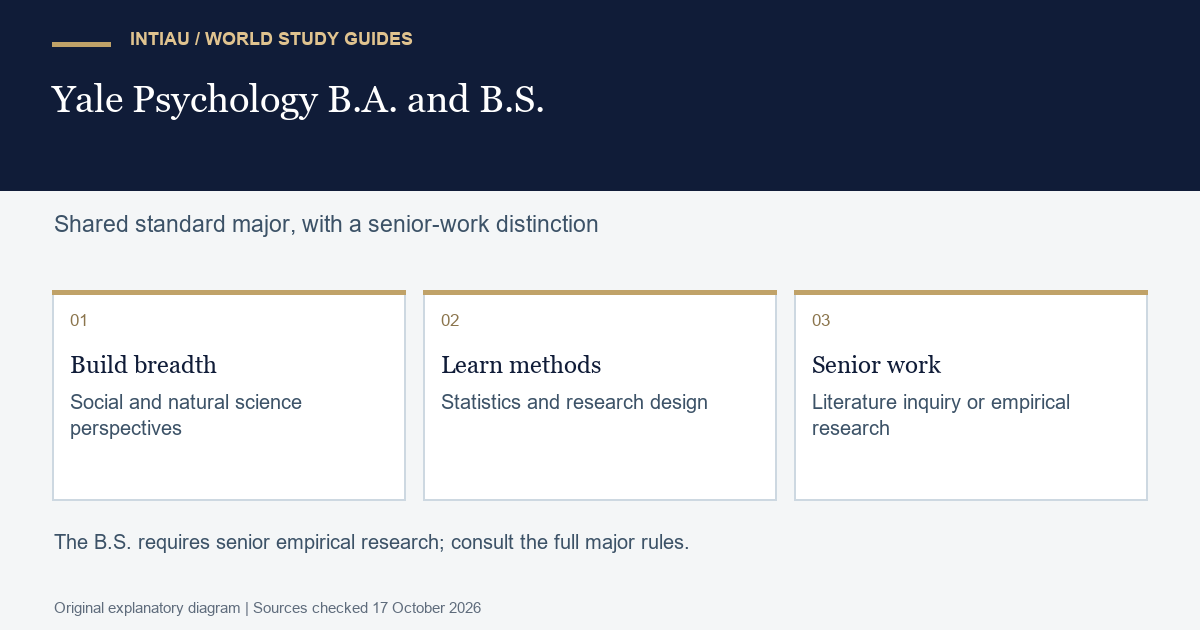
Shared preparation before the senior project
| Component | Published requirement |
|---|---|
| Entry preparation | PSYC 1100 or an accepted prerequisite waiver |
| Breadth | Two social-science and two natural-science courses, including a core in each group |
| Methods | Statistics and a research-methods course |
| Completion | Electives and senior work within twelve credits beyond the prerequisite |
Use this as a map for reading the official requirements. On a separate page, place the courses that introduce a perspective beside those that teach you how to investigate a question. That prevents an appealing topic title from hiding a gap in preparation. When comparing another university, use the same headings and leave a blank wherever the other institution has not published a clear answer.
The B.S. requires empirical research through PSYC 4990 in senior year; research methods must precede that year. The B.A. commonly involves a literature review, although Yale does not restrict its research format.
Inspect a real catalogue example
Yale’s 2026–27 Psychology course catalogue includes PSYC 1379, Thinking. The description examines reasoning and ways to assess it, including judgment under uncertainty, confirmation bias and causal reasoning. This is a named course example from the catalogue, not a promise of an unchanged future timetable or a reproduced syllabus.
You can use the description to ask a more precise question about your interests. When someone makes a confident claim, do you naturally want to inspect the evidence, find an alternative explanation, or understand how the person reached that conclusion? Try writing those responses separately. They may lead you to different questions even when the topic initially sounds the same.
Try reading a claim in two ways
This is an original comparison exercise, not a Yale assignment. Consider the fictional claim: “Students who keep a weekly planning notebook remember more lecture material.” First, outline a literature-review approach. List the definitions you would need to compare across published studies: what counts as a notebook, what counts as remembering, and how long after a lecture the measurement occurs. Explain why two apparently similar studies might not answer the same question.
Next, outline an empirical approach on paper. Specify one outcome measure, a comparison condition and an explanation that could compete with the notebook claim. For example, people who choose to keep notebooks may differ in their existing study habits. Identify what kind of study design would address that problem and what would remain uncertain. Keep the exercise hypothetical; it does not require collecting classmates’ personal information.
Finish by writing a cautious two-sentence conclusion for each approach. Avoid turning an association into a cause or presenting a proposed experiment as a result. Compare which task held your attention: reconciling different studies or deciding how a new measurement should work. The exercise supplies a concrete topic to discuss with an academic adviser.
Plan the senior work early
The official PSYC 4990 description presents the Senior Essay as independent research supervised by a faculty adviser, who sets requirements and monitors the work. The course can involve empirical research or a literature review; the degree-specific major rules determine which route meets the B.S. requirement.
When comparing possible study routes, write a short project question before writing a project title. Then note the evidence it would need and the preparation you currently lack. This keeps a future research ambition connected to realistic next steps. It also gives you a useful way to compare the support and course sequence described in each university’s own materials.
The application route and current cycle
Yale’s September 2026 admissions explanation states that students do not apply to a specific major. The undergraduate application is to Yale College.
The first-year application page, checked on 17 October 2026, accepts one application through Common Application, Coalition on Scoir or QuestBridge. It lists 1 November for Single-Choice Early Action and 2 January for Regular Decision; check the selected programme’s full conditions.
For the explicitly named 2026–27 application cycle, Yale’s August 2026 update requires ACT or SAT scores. Earlier descriptions of a broader test-flexible policy should not substitute for that update.
Questions readers often ask
Is the B.A. barred from empirical research?
No. The department FAQ permits a literature review or empirical study.
Is PSYC 4990 an unsupervised personal project?
No. A faculty adviser supervises it and sets the course requirements.
Does selecting Psychology create a separate departmental application?
No. Students apply to Yale College rather than to an individual major.
For INTIAU’s own material, browse INTIAU Courses or visit INTIAU Contact.
Related guides
View the curriculum diagram