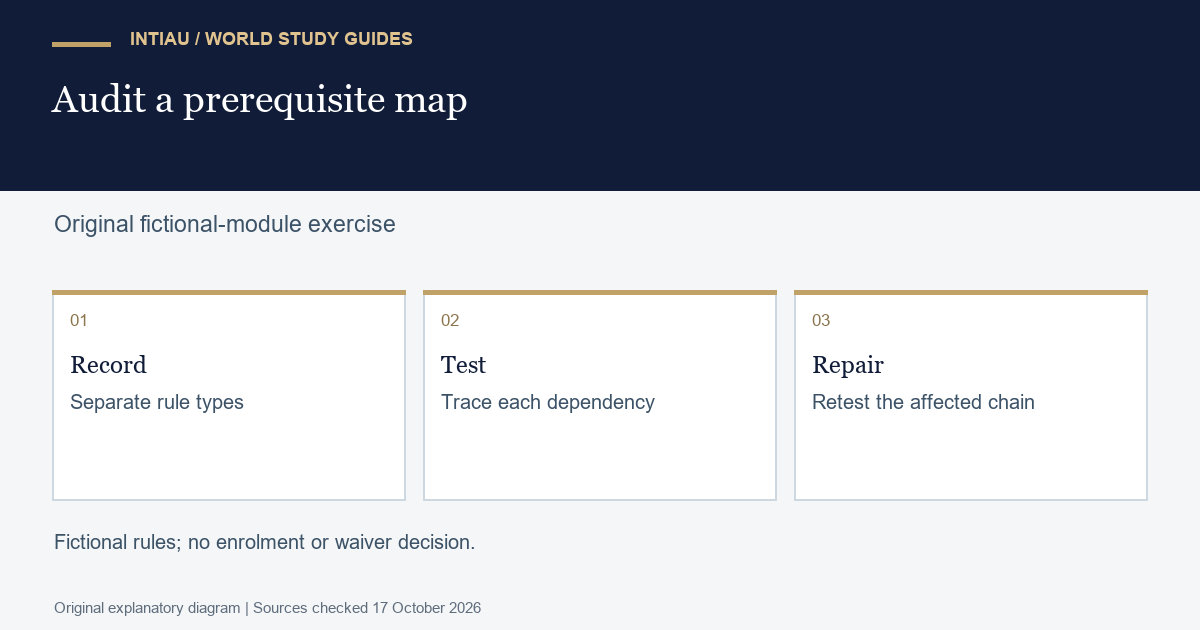
This self-guided prerequisite-map audit is an original learning activity, not a scheduled INTIAU class, university enrolment decision or credit-bearing qualification.
A course plan can look tidy while placing an advanced module before a required foundation. This workshop concentrates on finding that kind of defect. Your output is a dependency list, a tested term plan and a short exception log. All module codes, rules and student histories below are fictional; they do not describe any university’s curriculum.
Distinguish sequence from simultaneous study
The University of Melbourne’s Handbook guidance distinguishes prerequisites completed before a subject from corequisites taken in the same study period. Its definitions are a useful example; a real plan must follow its own institution’s rules.
For this exercise, an arrow means “must be completed before”. A double-ended link means “must be taken together”. AND requires every named condition; OR requires at least one. These are the rules of our fictional model, not a claim that every catalogue uses the same notation. Put the rule type beside each link so that an attractive drawing cannot hide an ambiguous assumption.
Build the fictional module register
| Module | Prerequisite rule | Other condition |
|---|---|---|
| F101: Foundations | None in this model | Available in term 1 |
| D110: Data Basics | None in this model | Available in term 1 |
| M210: Modelling | F101 AND D110 | Available in term 2 |
| R220: Research Design | F101 OR D110 | Available in terms 2 and 3 |
| C310: Capstone | M210 AND R220 | L310 taken in the same term |
| L310: Project Lab | No additional prerequisite in this model | C310 taken in the same term |
Copy each code once into a register. Add columns for completion status, proposed term and the exact rule you are testing. Keep “unknown” separate from “not completed”. A missing result is insufficient evidence for approval, but it is not proof of failure either. For practice, use invented completion labels rather than personal academic records.
Audit a deliberately defective plan
Assume F101 and D110 were completed in term 1. The draft places M210 in term 2, then R220, C310 and L310 together in term 3. Check one rule at a time. M210 has both foundations. R220 has an eligible foundation. The capstone’s R220 prerequisite, however, is not completed before the capstone starts. Taking the laboratory alongside it does not repair that earlier dependency.
Record the defect as a precise statement: “C310 starts in term 3 while required R220 is also in term 3.” Repair the model by moving R220 to term 2, where our invented availability rule permits it. Retest every rule after the change. The exercise demonstrates why moving one box on a chart is not enough; the revised plan needs a complete second pass.
Now change D110’s status to unknown. M210 can no longer be marked satisfied, because its AND rule needs both foundations. R220 can still satisfy its OR rule through completed F101. Write those two findings separately. Do not replace an unresolved requirement with a vague claim that the learner is “probably prepared”.
Check cycles, availability and exceptions
As a second test, invent a faulty rule saying F101 requires C310. Following prerequisite arrows now returns to an earlier node. That cycle prevents a valid completion sequence for the affected chain. Remove your invented fault after documenting it. Do not report the legitimate C310/L310 corequisite pair as the same problem: a simultaneous-study condition is different from a chain requiring prior completion.
Finish with an availability check and a three-column log: defect, supporting rule, next action. In a real catalogue, a possible exception should become a question for the authorised university office. It should never become a waiver that you grant yourself. Keep institutional permission, subject knowledge and timetable feasibility as separate entries.
Required workshop outputs
Produce one clean register, one labelled dependency map and a log containing the original term error, the unknown-result case and the artificial cycle. Add a short note explaining which rules you retested after each repair. A partner should be able to repeat the audit using your register without relying on an unrecorded conversation.
Frequently asked questions
Can I use this fictional map to enrol?
No. It is a logic exercise. Replace every invented item with verified institutional instructions before investigating a real plan.
Does an unknown result mean a prerequisite failed?
No. Mark the condition unresolved and identify the evidence or authorised decision needed to settle it.
Is the corequisite pair an impossible cycle?
Not under this model: the pair is taken together. The artificial prerequisite cycle demands earlier completion and prevents a valid sequence for the affected chain.
Explore INTIAU’s own Courses, or use Contact for questions about INTIAU provision.
Related guides
View the workshop diagram