The University of Auckland is separate from INTIAU; its Bachelor of Commerce (BCom) with Accounting as a major is an Auckland programme. The university lists a three-year, 360-point full-time degree. This guide reads that qualification through its official programme page, rather than treating Accounting as a stand-alone admission award.
A useful comparison begins with the kind of work you want to practise. Do you enjoy explaining why a transaction changes a business’s position, checking a numerical argument, or interpreting information for a decision? Keep those interests separate while reading the curriculum: they lead to better questions than asking whether a degree is simply “business-related”.
Read the shared core before the major
Auckland’s first-year enrolment guidance identifies six Stage I core courses: BUSINESS 111, 112, 114 and 115, INFOSYS 110, and STATS 100 or 108. It also directs prospective Accounting majors to ACCTG 102. Its standard full-time planning recommendation is four courses per semester. These are planning instructions, not permission to ignore prerequisites or a student’s own degree requirements.
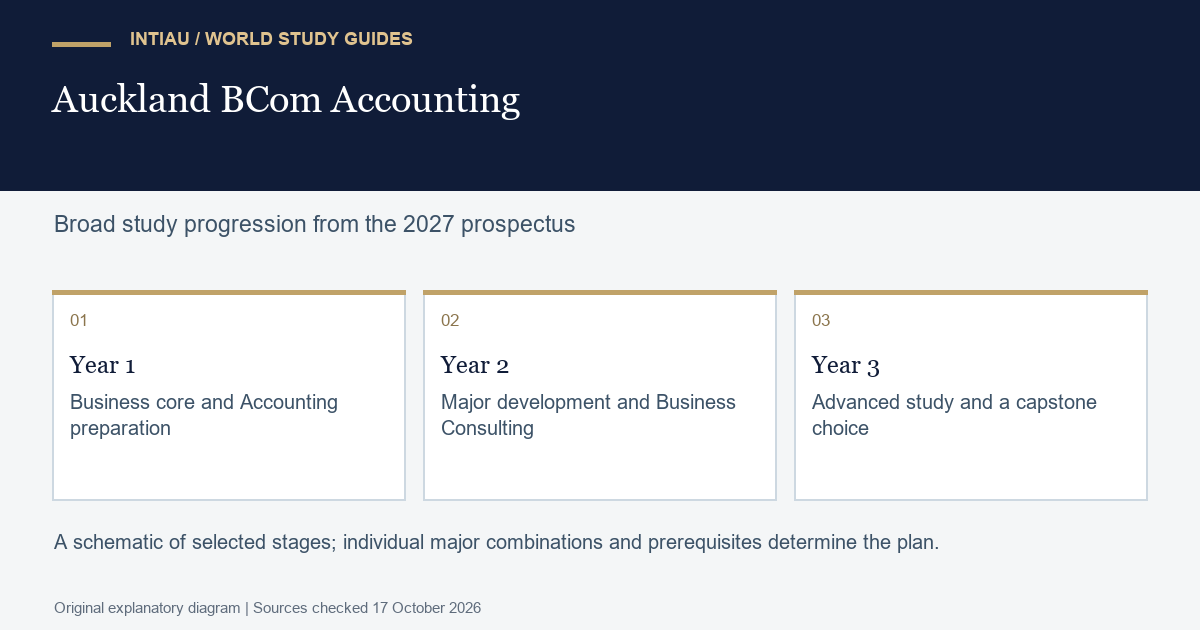
The 2027 Business School prospectus places Business Consulting in the second year and a capstone in the third. Published capstone alternatives include an industry project, business simulation and live case. The broad map below selects these connecting stages; it does not reproduce the full major schedule.
| Stage | Published emphasis |
|---|---|
| First year | Shared business foundations; ACCTG 102 for Accounting preparation. |
| Second year | Major study alongside Business Consulting. |
| Third year | Advanced major study and an applied capstone choice. |
One actual course example
The 2027 ACCTG 102 Accounting Concepts catalogue entry describes a move towards preparing accounting information, including how events are recorded and summarised in financial statements. It is a 15-point course with ACCTG 101 or BUSINESS 114 as its stated prerequisite. This is one course description, not a complete Accounting syllabus or a promise that every student’s first semester has the same sequence.
When comparing another institution, match the work rather than the code. Look for who prepares information, who uses it, what evidence supports an entry, and how a conclusion is communicated. Put an unresolved prerequisite in a separate column instead of assuming a familiar course title proves equivalence.
An original transaction comparison exercise
This optional exercise is created for this guide, not assigned by Auckland. Imagine a small repair business that buys equipment for 900 units, pays 300 immediately and owes the rest. It then completes a 250-unit job that the customer has not yet paid for. Make a simple event log with columns for what happened, cash movement, another resource or obligation, and the evidence you would request.
Now write two short explanations of the same events. Address the first to a person deciding whether the business can pay a bill tomorrow. Address the second to a person trying to understand what the business owns and owes. Do not invent a formal journal entry if you have not studied the conventions; mark that as a learning gap. Finish by identifying which task interested you more: tracing records, questioning evidence, or interpreting the result.
Use your answers to compare two published course descriptions. Record one specific skill each description addresses and one question it leaves unanswered. A list of attractive subject names becomes more useful when you can explain what you hope to do with the material.
Admission and course enrolment are separate steps
The programme page publishes 2027 closing dates of 8 December 2026 for Semester One and 4 July 2027 for Semester Two. Both were future dates when checked on 17 October 2026. It distinguishes applicant qualification routes and English-language requirements; applicants should read the route matching their actual school or tertiary record, rather than transfer a threshold from another category.
Begin with Auckland’s central Apply now page. It provides the application entry point, guidance on supporting documents and access to an existing application. Admission to a programme and subsequent selection of individual courses are different decisions. Keep the official application instructions with your curriculum notes so that a study plan is not mistaken for an offer.
Frequently asked questions
Is ACCTG 102 relevant to first-year Accounting planning?
Yes. Auckland’s first-year BCom guidance specifically identifies it for students planning an Accounting major.
Does ACCTG 102 have a published prerequisite?
Yes. The 2027 catalogue states ACCTG 101 or BUSINESS 114; check the live entry before enrolment.
Are the dates in this guide for 2027 entry?
Yes. They are the programme’s published 2027 dates, checked on 17 October 2026.
For INTIAU’s own information, see Courses or Contact. Questions about Auckland admission or course selection belong with Auckland.
Related guides
View the curriculum diagram