
The University of Alberta offers a Bachelor of Science with Major in Geology; it is an independent university programme separate from INTIAU.
Checked 17 October 2026. 2026–2027 admission page; August 2024 archived worksheet; current course records checked 17 October 2026.
Keep three editions of evidence distinct
The degree page labels admission information 2026–2027 and lists Major and Honors options. This guide follows the Major. Degree and entry page.
The official worksheet is dated 7 August 2024: a structural example, not a 2026–2027 graduation audit. Archived worksheet.
The key research habit is to preserve an edition rather than silently update its label. A current recruitment page can establish a degree’s identity without validating every requirement in an older worksheet. Ask the faculty to confirm the governing calendar before turning an example sequence into a registration plan.
Trace foundations into advanced study
| Study layer | Published examples | Planning purpose |
|---|---|---|
| Foundation | EAS 100, EAS 105, chemistry, calculus and physics. | Establish the quantitative and physical starting point. |
| Methods | Mineralogy, stratigraphy, GIS and geologic structures. | Compare ways of describing geological evidence. |
| Integration | Geochemistry, hydrogeology and petrology. | Connect a material to a process. |
| Advanced work | Field schools and 400-level EAS choices. | Check prerequisites before constructing a sequence. |
The current EAS catalogue describes EAS 222 through sedimentary materials, environments and stratigraphic interpretation. EAS 336 extends sedimentary study into petrography and depositional analysis, using EAS 222 and EAS 232 as prerequisites. Some records separately display changes effective September 2027. EAS catalogue.
That example shows why a module title is only the start of comparison. Read the prerequisite chain and the effective date together. Do not combine an older prerequisite statement with a future-effective version of the same course and present the result as one current rule.
Prepare the right admission questions
The Faculty’s May 2026 prerequisites page lists Chemistry 30 and Physics 20, or equivalents, for Geology course preparation, with Physics 30 recommended. These are course-readiness requirements, distinct from the full admission decision. Science prerequisites.
List your school-system course names beside the university’s terminology. Leave any equivalence unresolved until an official decision or published equivalency supports it. Record whether your question concerns admission, entry to a particular course or transfer credit. Those questions may require different evidence even when they involve the same transcript.
Original exercise: an observation and interpretation log
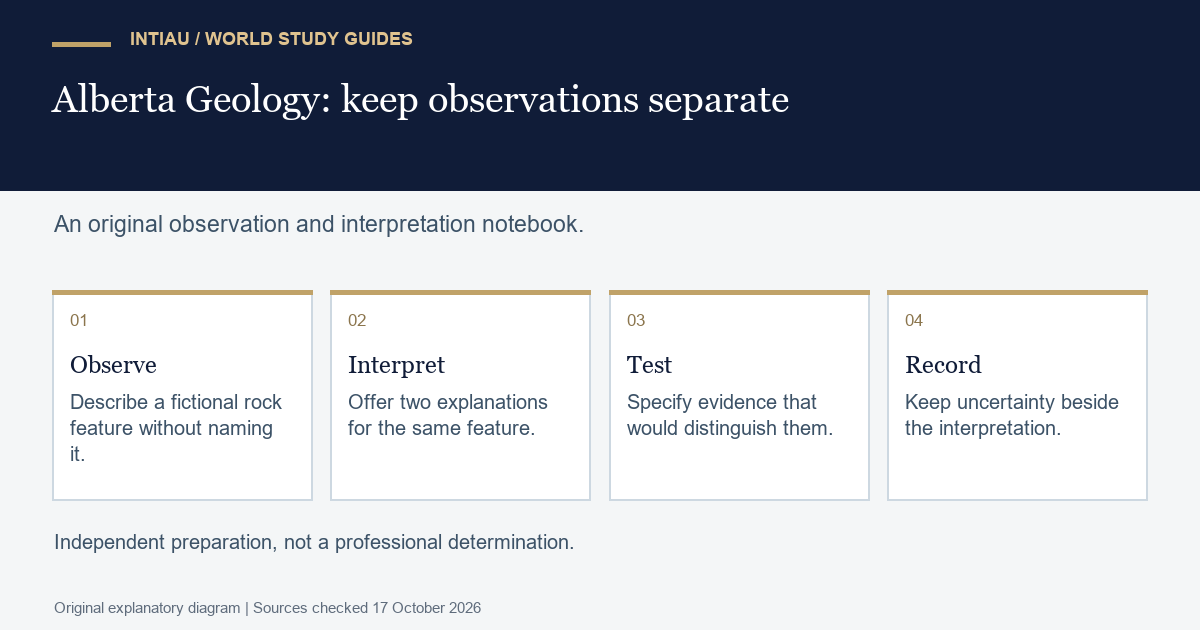
Imagine a drawing of a fictional exposure containing three coloured bands. The lowest band is coarse, the middle is fine and the upper band contains rounded fragments. Add a line crossing all three bands. Write five observations that describe what is visible without naming the deposit, assigning an age or asserting how it formed.
Next, propose two explanations for the crossing line: a later fracture and an apparent boundary produced by the drawing. State what additional observation would help distinguish them. Keep the imagined feature separate from the real-world evidence you would need; the exercise supplies no basis for an actual geological identification.
Create a four-column log: observation, interpretation, confidence and next test. Use plain confidence labels such as tentative or unresolved, and explain what would change each label. If you add a measurement, give its unit and identify whether it was observed, estimated or invented. This prevents a precise-looking number from concealing a weak premise.
Finally, write a short account that another reader could audit. Link each conclusion to a numbered observation and retain at least one alternative explanation. A useful comparison of geology degrees can then ask which published learning tasks develop observation, laboratory interpretation, quantitative analysis and communication, without assuming that similarly named modules deliver identical experiences.
Frequently asked questions
Is the archived worksheet the current graduation checklist?
No. It is an explicitly dated structural example; obtain the calendar and advice applicable to your cohort.
Why mention 2027 course changes?
The catalogue labels some future-effective versions separately. Use the version applicable to the term you plan to study.
Do school prerequisites establish admission or licensing?
No. They address readiness for relevant courses. Admission and any later professional decision require their own applicable evidence.
View the curriculum comparison map
Official sources and further comparison
Continue your independent comparison through the INTIAU Courses directory, or use INTIAU Contact for a general enquiry. The university controls its programme and admissions decisions.