The London School of Economics and Political Science (LSE) is separate from INTIAU; its BSc International Relations is an LSE degree. The 2027/28 programme page identifies a three-year course at Houghton Street, London, with UCAS code L250.
Start a comparison by distinguishing three tasks: describing an international event, explaining why it happened, and arguing for a response. You can be interested in all three while needing different evidence for each. Keep that distinction visible when a course title seems to promise a direct answer to a current controversy.
Read the stages and the edition together
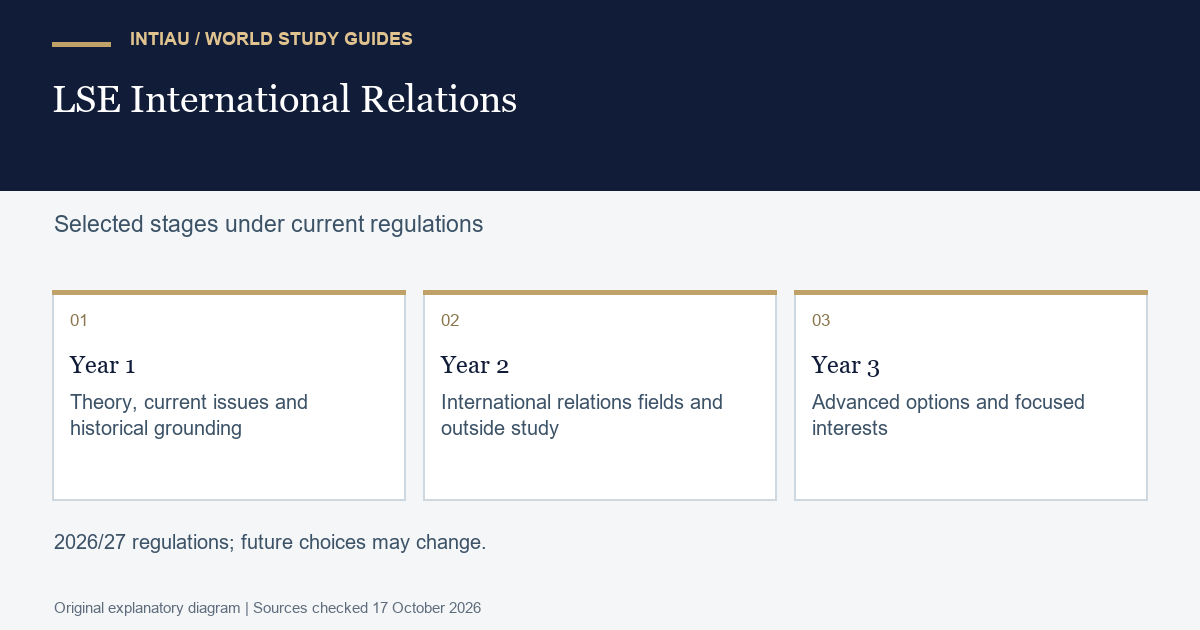
The 2026/27 programme regulations combine compulsory foundations with later choice. Optional places can depend on prerequisites and timetabling. The table selects stages rather than reproducing every paper or promising the same options to a future entrant.
| Year | Published structure |
|---|---|
| 1 | IR100, IR101, historical study, an approved outside course and LSE100; unassessed IR102. |
| 2 | Choices across political ideas, foreign policy, organisations, security and political economy. |
| 3 | Advanced international relations options and an additional approved choice. |
When reading an option list, mark a required course differently from a possible topic. Then add a column for the question you hope to investigate. A preference for “security” may mean studying institutions, strategic choices or the experiences of affected people; the label alone does not explain which approach interests you.
A selected course that connects analysis and policy
The 2026/27 IR101 guide, Contemporary Issues in International Relations, describes an applied policy focus alongside critical analysis of current affairs. Its formative work includes presentation preparation and a policy memo. This is one dated course guide, not the whole degree syllabus or a guarantee of an unchanged assessment pattern in 2027.
Use that example to compare the purpose of written work. A memo needs an identifiable audience and a decision; an analytical essay needs a defensible question and argument. Neither format is improved merely by adding more facts. Ask how evidence changes the reasoning, and whether the proposed audience can understand what remains uncertain.
Original exercise: explain a shared agreement
This exercise is created for this guide, not assigned by LSE. Imagine that three neighbouring states negotiate a shared river-monitoring agreement. Write three possible explanations for cooperation: shared material interests, pressure from an institution, and changing public expectations. Treat them as hypotheses rather than findings about a real country.
For each explanation, identify one observation that would support it and one that would make you reconsider. For example, a change after a public campaign might matter, but it would not by itself establish that the campaign caused the agreement. Record what else changed at the same time and what evidence you would need to separate the explanations.
Now write a short note for a fictional negotiator deciding whether to expand monitoring. Give one recommendation, one reason and one important uncertainty. Keep the recommendation separate from your explanation of the original agreement. A plausible account of the past does not automatically determine the best future action.
Review the two outputs side by side. Which task demanded more from you: building an explanation, locating useful evidence or making a bounded recommendation? Use the answer to choose two course descriptions for closer reading. Write a specific question about the methods or written work each develops, instead of treating a preferred topic as proof of programme fit.
The undergraduate application route
LSE’s application guidance says undergraduate applications go through UCAS and direct applications are not considered. For September 2027 entry, it publishes 13 January 2027 at 18:00 GMT for full and equal consideration. That date was future when checked on 17 October 2026. Read the entry-year programme requirements with those instructions.
Keep a small application evidence sheet containing the exact award, entry year, qualification route and questions for the university. If your school qualification is not the one used in an example, leave the comparison unresolved until the relevant official guidance answers it. An attractive curriculum map is a research aid, not an offer of admission.
Frequently asked questions
Does this guide concern the online degree?
No. It concerns LSE’s three-year Houghton Street BSc International Relations.
Are all listed optional courses guaranteed?
No. The regulations qualify access by availability, prerequisites and timetabling.
Can I apply directly to LSE for this undergraduate route?
No. LSE directs undergraduate applications through UCAS.
See INTIAU’s own Courses or Contact information. LSE controls its degree and admissions decisions.
Related guides
View the curriculum diagram