
The University of Texas at Austin offers undergraduate Geophysics through the Jackson School of Geosciences; this guide describes that independent programme, not an INTIAU programme or partnership. School programme guide.
The 2026-2028 undergraduate catalogue names the award Bachelor of Science in Geosciences, with Geophysics as the major. Degree catalogue.
That distinction is useful when recording a qualification: an award title, a major and a school may each appear in different places. Preserve the official wording before making a comparison. For the subject itself, ask how an observation supports an interpretation and what alternative model might explain the same observation.
Entry cycle and curriculum edition
The school’s Fall 2027 notice lists 1 November 2026 for Early Action. School admissions notice. This conflicts with central admissions guidance.
The central international-freshman page instead lists 15 October for Early Action, already past on 17 October 2026, and 1 December for regular applications. Confirm your applicant checklist; do not treat the school’s conflicting later date as an open Early Action window.
The school guide tells high-school applicants interested in Geophysics to select Geological Sciences in the application. Existing UT students follow a separate internal-transfer process.
A curriculum edition is not an application cycle. Keep the 2026-2028 catalogue label separate from Fall 2027 entry and check the relevant applicant checklist for supporting material. Do not assume that meeting a deadline establishes selection, or that an internal-transfer route has the same conditions as first-year admission.
Selected study progression
| Layer | Selected published content | Preparation question |
|---|---|---|
| Early tools | Calculus, chemistry and mechanics | Can I retain units through a calculation? |
| Breadth | Solid Earth Processes; Earth and Planetary Processes Through Time; Climate, Water, and the Environment | Which interacting process matters? |
| Quantitative choice | GEO 325G Computational Applications in the Geosciences or other listed analysis options | How would I check a computed result? |
| Specialisation | Continuum Mechanics, Physics of Earth and advanced geophysics choices | Which observation would distinguish models? |
The school stresses confirming the required courses with an advising coordinator for the student’s catalogue year. This table is selective and does not fix a personal semester sequence.
Worked exercise: an invented inverse problem
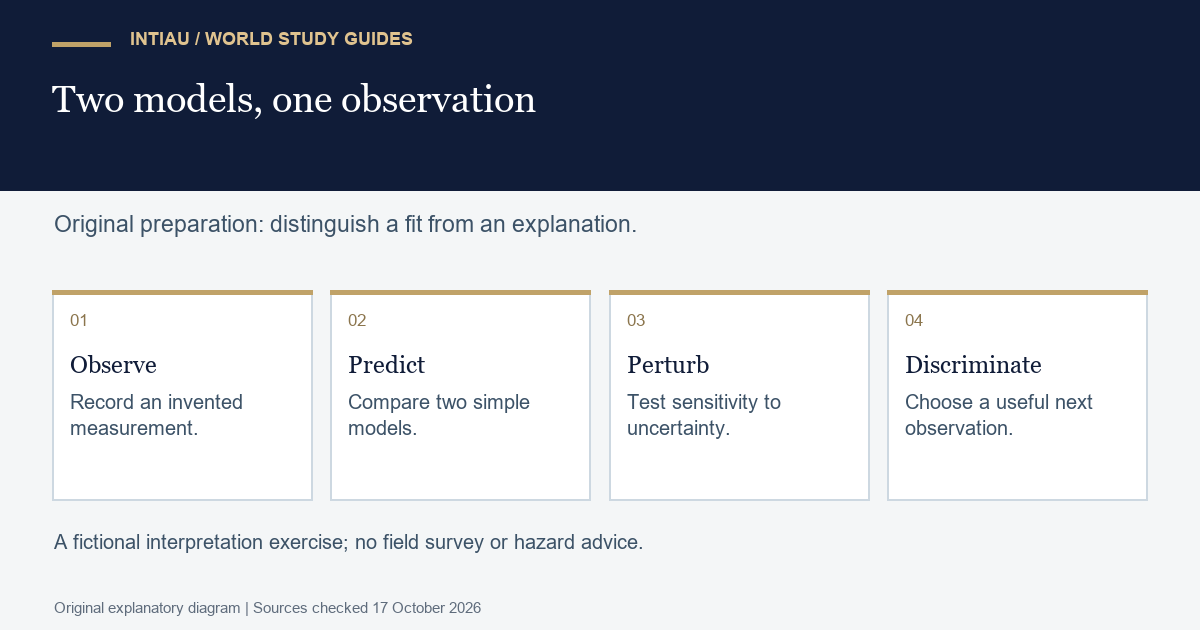
Imagine an observation with a value of twelve arbitrary units. Model A predicts ten and model B predicts thirteen. The absolute discrepancies are two and one, so B fits this single invented observation more closely. Write out those differences. Then add the crucial limitation: a closer fit to one observation does not prove that a model describes the real subsurface.
Introduce an uncertainty band of plus or minus two units around the observation. Both predictions now lie within that band. Record how this changes your language: you can describe their numerical differences, but the available observation does not sharply discriminate between them. Do not choose a precise real-world material, depth or hazard interpretation for these invented values.
Next, invent a second measurement location where A predicts five and B predicts nine. Suppose your imagined instrument could distinguish differences greater than two units. That second location may be more informative than repeating the first comparison. Explain why, while keeping the proposed measurement separate from data you actually possess.
Build a four-column notebook: observation, prediction, discrepancy and unresolved assumption. Add a fifth column for the next useful observation. If a later imaginary reading is eight, calculate each new discrepancy and explain whether you would revise your preference. A revision is a strength when it follows evidence rather than defending the first answer.
Finish with a short statement separating model fit, uncertainty and physical explanation. The exercise is deliberately too simple to model a field survey. Its purpose is to make a reasoning chain inspectable before more demanding mathematics, computation and measurement enter the problem.
Prepare a responsible comparison
Use the notebook to identify a learning goal: translating units, plotting residuals, describing uncertainty or checking a small program. Keep both the initial and revised interpretation. When researching courses, distinguish a quantitative option from an obligation shared by every student. When comparing previous study, collect course descriptions and assessment evidence rather than relying on a matching title.
Before contacting an adviser, state your applicant route, intended entry term and catalogue question. A concise request is easier to answer than a list that mixes admission, transfer credit and future professional ambitions into one implied approval.
Frequently asked questions
Is the award simply called BSc Geophysics?
The cited catalogue names Bachelor of Science in Geosciences and identifies Geophysics as its major.
Which entry choice does the school describe?
Its guide directs interested high-school applicants to select Geological Sciences. Internal transfer is a separate route.
Does the exercise predict a real subsurface feature?
No. All numbers and models are invented. It supports careful reasoning and gives no field interpretation, hazard conclusion or professional advice.
View the study diagram
Official sources
For other independent study comparisons, see INTIAU Courses; general enquiries can use Contact. The named university decides its own admissions and academic requirements.