Tohoku University is a separate institution; its Mechanical and Aerospace Engineering pathway is not an INTIAU programme or partnership. The regular four-year Japanese-taught route awards the Bachelor of Engineering. Undergraduate IMAC recruitment has ended.
The engineering school is based in Aobayama, Sendai; this does not locate every common first-year class.
Mechanical systems bring together physical behaviour, measurement and decisions about how a system should respond. Start your curriculum comparison with a question that connects those parts. A sensor can produce a number without establishing the right action. Ask where a programme develops the ability to interpret a measurement, model a response and explain the limits of the resulting decision.
Read the department’s progression
| Stage | Published emphasis |
|---|---|
| From the first year | Fundamental and specialised knowledge, practical training and reporting. |
| From the third year | Laboratory affiliation and research with more senior students. |
| Specialised directions | Seven courses include Mechanical Systems, Robotics, Aerospace Engineering and Mechanical/Biomedical Engineering. |
These stages do not reproduce every departmental credit requirement. Keep a track, a laboratory and a degree award as separate fields in your notes. A research interest can guide your reading without guaranteeing a particular allocation. Compare the way a programme develops a question and a method, rather than treating the largest number of named specialisms as the strongest evidence of personal fit.
Identify real practical subjects
The department’s public teaching overview identifies experiments, practical training, planning and drawing. This describes subject areas, not a new 2027 syllabus.
The linked official course-code list identifies Fluid Mechanics I (流体力学Ⅰ), semester three, and Mechanical/Aerospace Experiments I (機械知能・航空実験Ⅰ), semester five. Check the annual syllabus for detailed scope and assessment.
The 2026 entrant-map guidance explicitly says its arrows indicate desirable learning order, not graduation requirements or course restrictions. Check the actual handbook and annual syllabus for those rules.
When a course map uses an arrow, write down what that arrow means according to the publisher. Your own idea of a sensible sequence may differ from a formal prerequisite. For a practical subject, ask what is measured, how results are checked and how the report connects evidence to a conclusion. Do not infer a procedure, equipment permission or assessment percentage from a public subject label.
Worked exercise: inspect a simulated threshold
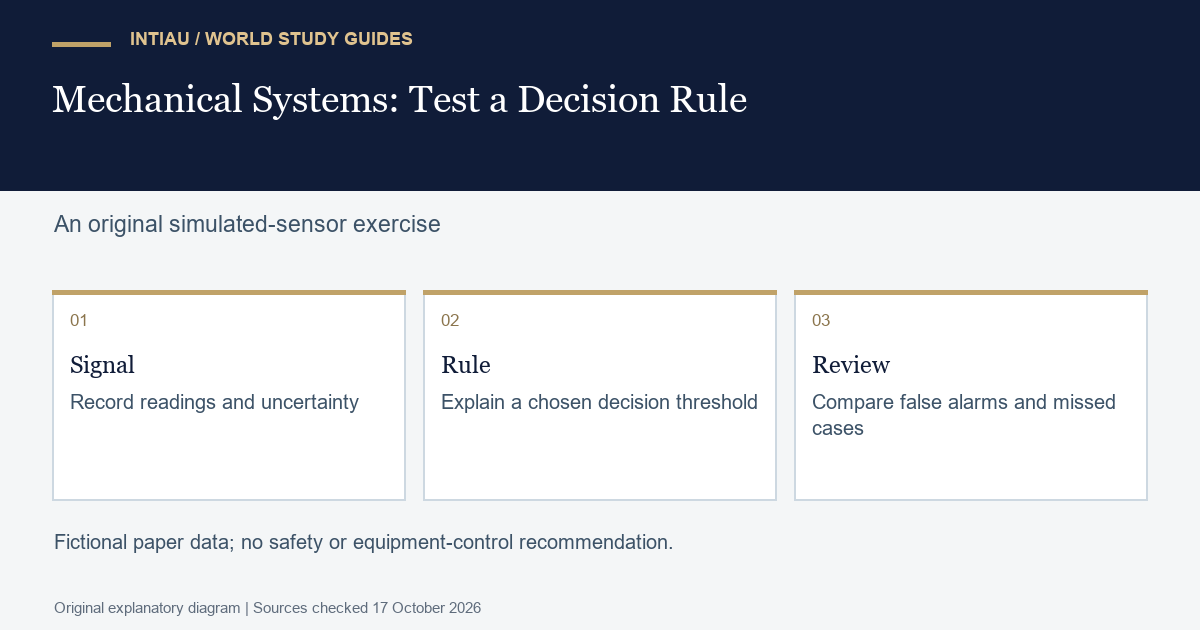
Create a fictional sensor sheet with readings of 3, 4, 7, 8 and 9 in abstract units. Invent a decision rule that flags readings at 8 or above. Mark the data and rule as simulated. Count two flagged cases. This count describes your rule’s output; it says nothing yet about whether those cases actually represent a condition needing action.
Add a second fictional column identifying cases that genuinely need review: the readings at 7 and 9. Under your first rule, the reading at 8 becomes a false alarm and the reading at 7 is missed. Lower the threshold to 7 and compare the result. Explain which errors change and why choosing a threshold requires a stated purpose, not only arithmetic.
Now attach an uncertainty of one unit to each reading. Identify cases near the threshold whose classification could change. Propose what additional observation would be useful, without designing a real safety control. A neat binary label can hide uncertainty in the input. Keep the exercise on paper and do not connect it to actual machinery, health measurements or operational alarms.
Produce the annotated data sheet, two rule outcomes and a short decision memo. Ask a peer to identify a hidden cost assumption about false alarms or missed cases. Revise your recommendation to state that assumption openly. This original activity prepares questions for a curriculum comparison; it is not a Tohoku assignment or an engineering validation.
Distinguish the current international routes
Checked on 17 October 2026, the privately financed international undergraduate route is Japanese-taught, begins in April and uses the EJU framework. Consult the institution’s current eligibility and selection instructions; this guide does not provide an unverified 2027 application deadline.
The school directs prospective English-medium applicants toward Gateway College. That separate route should not be described as new direct IMAC admission.
Create distinct route records rather than combining the attractive features of several admissions pages. Record teaching language, entry period, academic background and the exact programme being considered. Then attach the curriculum edition that actually belongs to that route. A general school location or research page does not settle the location of every first-year class.
Three route-and-evidence questions
Is IMAC recruiting new undergraduates here?
No. The school explicitly states that undergraduate recruitment has ended.
Are map arrows formal prerequisite rules?
No. The guidance distinguishes learning order from restrictions and graduation requirements.
What should a threshold comparison reveal?
The assumptions behind the rule, the errors it produces and the effect of uncertain readings.
Official source trail
- Engineering undergraduate routes
- Mechanical department overview
- Mechanical teaching examples
- 2026 entrant-map guidance
- Mechanical course-code list
- Privately financed international route
For INTIAU information, visit INTIAU Courses or INTIAU Contact. These links do not apply to the separate institution discussed above.
Related guides
View the study diagram