The University of Waikato is a separate institution; its Bachelor of Environmental Planning is not an INTIAU programme or partnership. The BEP is a four-year, 480-point degree at Hamilton. Its three streams address Science and the Environment, Society and the Environment, and Te Ara Taiao: Māori and the Environment.
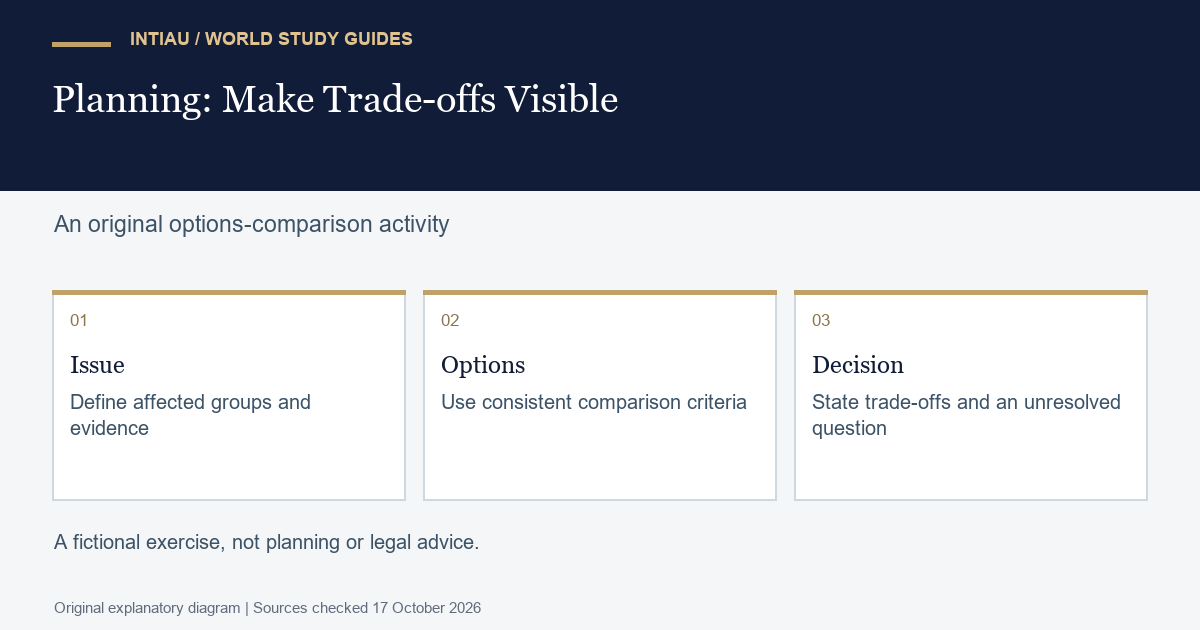
Planning questions usually involve several legitimate needs rather than a single technical target. Start with a place-based issue and list who may be affected, what evidence is available and which choices remain open. A curriculum comparison becomes more useful when you ask how a programme connects those parts, rather than counting how often its description uses the word sustainability.
Trace the specified programme
| Level | Illustrative requirements |
|---|---|
| 100 | ENVPL100; ENVPL101; MAORI102. |
| 200 | ENVPL201; ENVPL203; GEOGY209; GEOGY219; GEOGY228. |
| 300 | ENVPL300; ENVPL302; ENVPL303; ENVPL306; ENVPL309. |
| 400 | Advanced planning requirements, directed study and stream completion under the full regulations. |
The selected codes are a starting map, not a complete personal programme. Keep stream rules beside compulsory papers and check how many choices remain once those requirements are met. When a paper combines several fields, read its description before assigning it to a category of your own. Your comparison categories can be useful without becoming official classifications.
Inspect a current resource-management paper
ENVPL201 Introduction to Resource Management introduces law and policy relevant to environmental planning and management in Aotearoa New Zealand. Its 2027 page lists a 15-point, 200-level, in-person Hamilton offering in A Trimester. A full paper outline should be checked when available.
That example invites a useful distinction: understanding the rules that frame a decision is different from measuring an environmental condition. In a reading sheet, give each its own row. Ask how evidence is interpreted, whose values are represented and what the decision-maker is empowered to decide. Avoid inventing a legal conclusion from a short academic course description.
Worked exercise: a fictional riverside path
Imagine a town considering a new walking path beside a fictional stream. Option A follows the shortest line. Option B uses an existing disturbed corridor but adds distance. Invent a simple map and label every environmental and community detail as simulated. Define the problem without assuming that building either path is already the right answer; retaining the current arrangement can be a third option.
Create four comparison criteria: access, disturbance, maintenance and uncertainty. Write a short evidence statement for each option under each criterion. For example, A may shorten a trip by a simulated three minutes, while B may avoid an invented sensitive area. Do not combine minutes and descriptive ecological concerns into a precise total unless you explain and defend the weighting method.
Add two fictional viewpoints, one from a frequent path user and one from a nearby resident. Identify a disagreement that more measurement could resolve and another that involves values. Propose a respectful consultation question for the second. Keep actual people, addresses and personal records out of the exercise. A plausible invented viewpoint is not evidence about a real community.
Your output is an options matrix and a one-page recommendation that names its strongest assumption. Now change one condition, such as a higher maintenance burden, and test whether the recommendation changes. If it does, explain why; if it does not, show which criteria remain decisive. The purpose is to make a judgment inspectable, not to produce a mock consent approval.
Check applicant requirements separately
Waikato requires international applicants to meet academic and English requirements, using country or qualification-specific criteria. It explicitly says the admission guidelines do not guarantee programme entry.
Checked on 17 October 2026, the international application process directs applicants to check those requirements before applying. This guide does not infer a universal 2027 closing date.
Keep the applicant checklist separate from your paper plan. Use the exact qualification you hold, record the entry period and revisit the published curriculum for the cohort you eventually join. A broad subject page and a degree-specific regulation should support each other; neither should be silently substituted for the other.
Three planning questions
Is this the Environmental Planning major in a BA?
No. This guide concerns the separate four-year BEP.
Does the table reproduce every requirement?
No. Read the full specified programme and chosen stream together.
What makes the options exercise useful?
Consistent criteria, visible assumptions and a decision that can respond to changed evidence.
Official source trail
- BEP programme overview
- 2027 subject regulations
- ENVPL201, 2027
- International entry requirements
- International application process
For INTIAU information, visit INTIAU Courses or INTIAU Contact. These links do not apply to the separate institution discussed above.
Related guides
View the study diagram