Waseda University is a separate institution; its English-based Bachelor of Arts in Political Science is not an INTIAU programme or partnership. Applicants choose a degree programme when applying. The English-based route admits in September without a Japanese-language admission requirement.
The school is at Waseda Campus in Shinjuku, Tokyo.
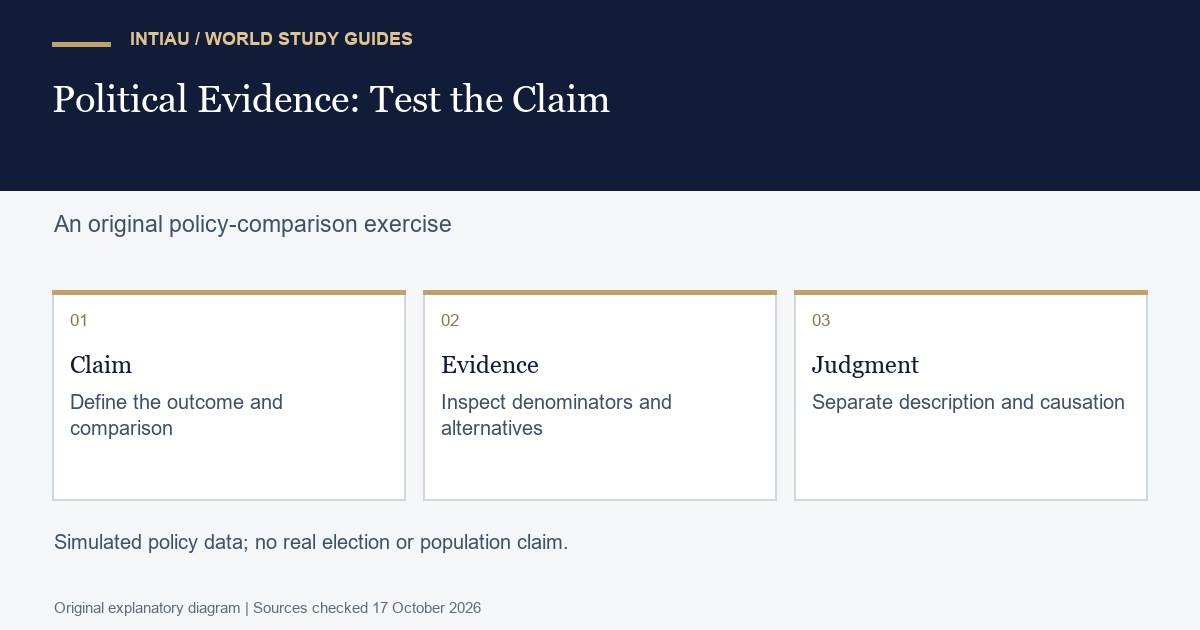
Political science comparison becomes more useful when an opinion is turned into a question about evidence. What changed, compared with what, and how could competing explanations be examined? Start there before choosing a familiar policy topic. A curriculum can combine substantive knowledge and methods without making a statistical association into a demonstrated political mechanism.
Keep the older map and new cohort separate
| Stage or function | Examples in the published map |
|---|---|
| Introduction | Political Science; Economics; Methodology; Foundation Seminar. |
| Foundation | Political Analysis; International Relations; Public Philosophy; Microeconomics; Macroeconomics; Statistics. |
| Specialisation | Comparative Politics; Public Policy; Political Thought and Political History. |
| Independent integration | Advanced Seminar and Thesis. |
Waseda has announced a new curriculum for students entering in 2027 and later, excluding earlier cohorts. The published changes include a required English-taught Foundation Seminar bringing Japanese-based and English-based students together, and stronger data-analysis education. The selected 2026 map above must not be relabelled as the final 2027 requirements.
Use two columns in your comparison record: confirmed current material and announced change. Add the cohort beside each. This avoids an appealing but inaccurate composite curriculum made from several editions. When a future element is still being explained, ask a specific question rather than assuming a complete credit allocation or timetable from a news announcement.
Follow a real course example to its annual entry
The school’s course information page links its AY2026 course list and updates separately from the syllabus search. Use the named Political Analysis or Public Policy examples in the dated map as a starting point, then verify the actual offering and syllabus before asserting detailed scope.
For a syllabus comparison, record the question being studied, the method used and the form of evidence expected. A similar title can conceal different levels of preparation or different kinds of assessment. Leave unpublished weights blank. You can compare the intellectual progression without reproducing a full syllabus or pretending that every named example runs unchanged for each entrant year.
Worked exercise: inspect a policy-success claim
Invent two fictional districts considering a library reminder programme. Before the programme, A records 40 returned items out of 100 due, while B records 30 out of 50. Calculate rates of 40 and 60 percent. Write the difference using both counts and proportions, and explain why saying that A has more returns does not establish that its rate is higher.
Now invent a later period in which A returns 60 of 100 and B returns 40 of 50. Both proportions rise by 20 percentage points. Suppose only A used the reminder programme. Explain why A’s improvement alone cannot show that reminders caused the change: B also improved, and the fictional comparison provides no information about other differences between periods or districts.
List two alternative explanations and identify evidence that would help distinguish them. One might concern a changed mix of items, another a different group of users. Do not fabricate a random assignment that the scenario never supplied. Write a narrower conclusion stating what the data describe and what causal question remains open.
Your output is a calculation sheet, an annotated claim and a short evidence request. Ask a peer to identify the denominator in every percentage and any sentence that moves from a pattern to a cause. Revise the claim accordingly. This original exercise is not an admissions essay, a Waseda assignment or evidence about actual library users.
Check the English-based applicant route
As checked on 17 October 2026, the school links its AO application guide for September 2027 entry. Keep that English-based admissions route separate from the Japanese-based April route. Follow the guide matching your education system; no score or sample curriculum in this article guarantees admission.
Make a timeline only after identifying the correct guide and degree choice. Keep the curriculum reform notice beside, rather than inside, the admissions checklist. A change to teaching structure does not mean that the two admission systems have merged, and a future cohort label does not establish an unpublished deadline.
Three political-science questions
Can the 2026 map be called the final 2027 curriculum?
No. Waseda has announced a separate reform for 2027 entrants onward.
Is this the Japanese-based April admission route?
No. The English-based programme admits in September.
What should the policy exercise produce?
A claim that respects denominators, comparison periods and the difference between description and causation.
Official source trail
- SPSE English-based admissions
- 2026 English programme map
- Announced 2027 curriculum change
- Annual course and syllabus links
- SPSE campus location
For INTIAU information, visit INTIAU Courses or INTIAU Contact. These links do not apply to the separate institution discussed above.
Related guides
View the study diagram