Eindhoven University of Technology is separate from INTIAU; its Bachelor of Science in Industrial Design is an English-language, three-year degree in Eindhoven. It concerns interactive systems, products and services.
Begin a design comparison by identifying a decision that needs evidence. A prototype can communicate an idea, reveal a difficulty or test an assumption, but one prototype rarely does all three equally well. Record its purpose before choosing a material, interface or visual style. That makes later feedback more useful than asking whether a design simply looks finished.
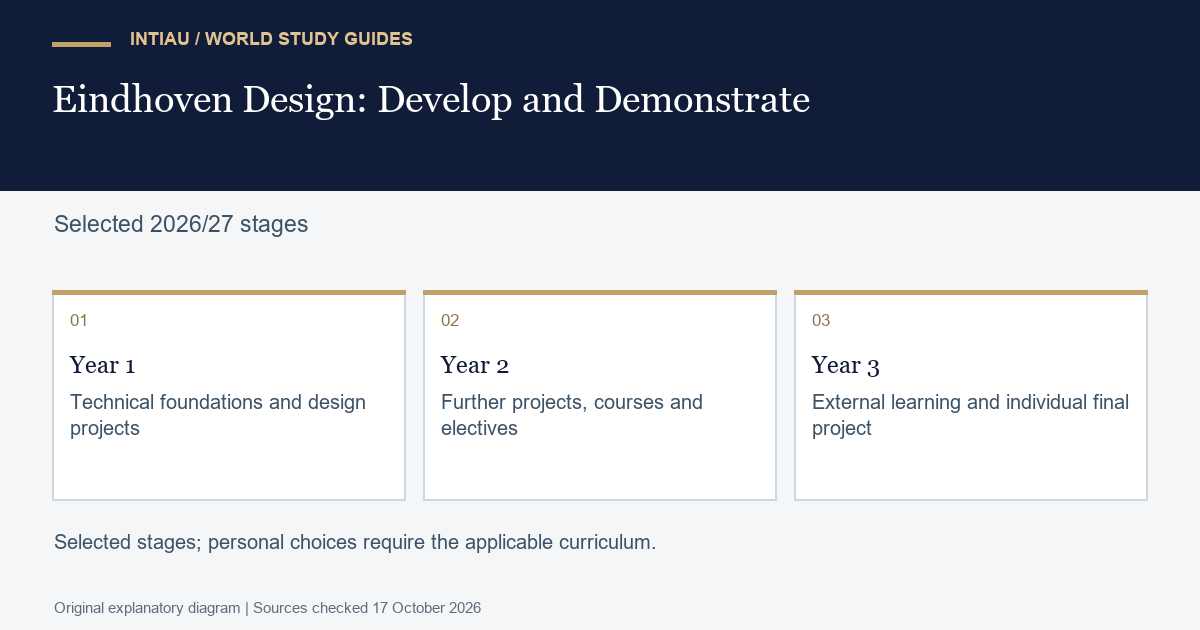
Read the current learning sequence
| Year | Published components |
|---|---|
| 1 | Technical foundations, design projects and professional identity. |
| 2 | Further projects, design courses and electives. |
| 3 | External learning and individual Final Bachelor Project. |
The degree-structure page identifies this overview with 2026/27. It combines core study with personal development and choices. The table selects broad stages rather than prescribing an approved personal timetable.
Build a comparison sheet that separates a learning goal from an activity. “Understand a user’s difficulty” is a goal; an interview, observation or prototype session is an activity that might help. Explain why it is suitable and what evidence it would produce. A course title alone does not prove that every project uses the same process.
A real final-project outline
The official Final Bachelor Project outline describes individual work, an iterative design process, functional prototyping and attention to stakeholder experience. Students demonstrate and reflect on their design competence. This selected outline is not the complete bachelor syllabus or a new assessment schedule for every future cohort.
When reading an individual-project description, ask what remains shared: supervision, evidence standards and the need to communicate a defensible process. Independence does not mean working without feedback. Record the points where a project could change direction and the information that would justify the change.
Original worked exercise: compare two feedback records
This exercise is created for this guide, not assigned by Eindhoven. Imagine a paper control panel for a fictional shared bicycle store. Version A receives eight simulated comments: five people cannot find the return step, two dislike the colour and one asks about opening hours. Version B receives three simulated comments about the return step.
Do not conclude that Version B is better until you know how many people saw each version and what they were asked to do. If eight people saw A and only three saw B, the counts describe different opportunities to observe difficulty. Write the denominator beside each number before calculating any proportion.
Now create a fairer fictional record with eight walkthroughs of each version, identical tasks and a clear definition of a successful return. Suppose A produces five incomplete returns and B two. The simulated proportions are 62.5 percent and 25 percent. They support a description of this tiny exercise, not a universal claim about all users.
Inspect what the counts conceal. Perhaps B reduces one difficulty but makes a cancellation less visible. Add a second criterion and explain why it matters. Do not combine the two criteria into a precise score unless you can defend the weighting. A transparent trade-off is more informative than an unexplained total.
Finish with both sketches, a short task script, the two records and one reasoned revision. Ask a peer to identify a decision that the evidence does not settle. Your output should show what changed and why, including one unresolved accessibility question. It is an original paper comparison, not a validated usability study, portfolio requirement or university assessment.
Use the entry-year and qualification selector
The official admission page says its information applies to 2027/28 and directs prospective students through programme and prior-education choices. Use the route for your actual diploma; this guide does not infer a single deadline from the selector.
The source was checked on 17 October 2026. Record the award, intended entry year, school subjects and language evidence together. Keep any application condition separate from your preferred design theme or project squad. A convincing exercise demonstrates how you think; it does not establish formal eligibility or guarantee a place.
Before relying on a later course combination, revisit the applicable education guide. Record which details are confirmed, which are your preferences and which require advice. That small distinction helps you make a coherent comparison without turning personal ambitions into assumed programme requirements.
Frequently asked questions
Is this a Bachelor of Science?
Yes. The official programme uses that award.
Is the final-project example individual work?
Yes. The published outline identifies an individual project.
Does the admissions selector cover 2027/28?
Yes. It explicitly labels that application year.
For INTIAU’s own information, see Courses and Contact. Eindhoven determines its admission and study requirements.
Related guides
View the study diagram