Erasmus University Rotterdam is separate from INTIAU; its International Bachelor Economics and Business Economics leads to a BSc. The English-taught, three-year programme has 180 EC and is based at Campus Woudestein.
A useful economics comparison asks which question a number answers. An average describes a particular summary; it does not automatically explain a distribution or settle a policy judgement. Keep a distinction between calculating a measure, interpreting it and arguing that it should guide a decision. Those are connected tasks with different demands on evidence.
A future overview with an explicit qualification
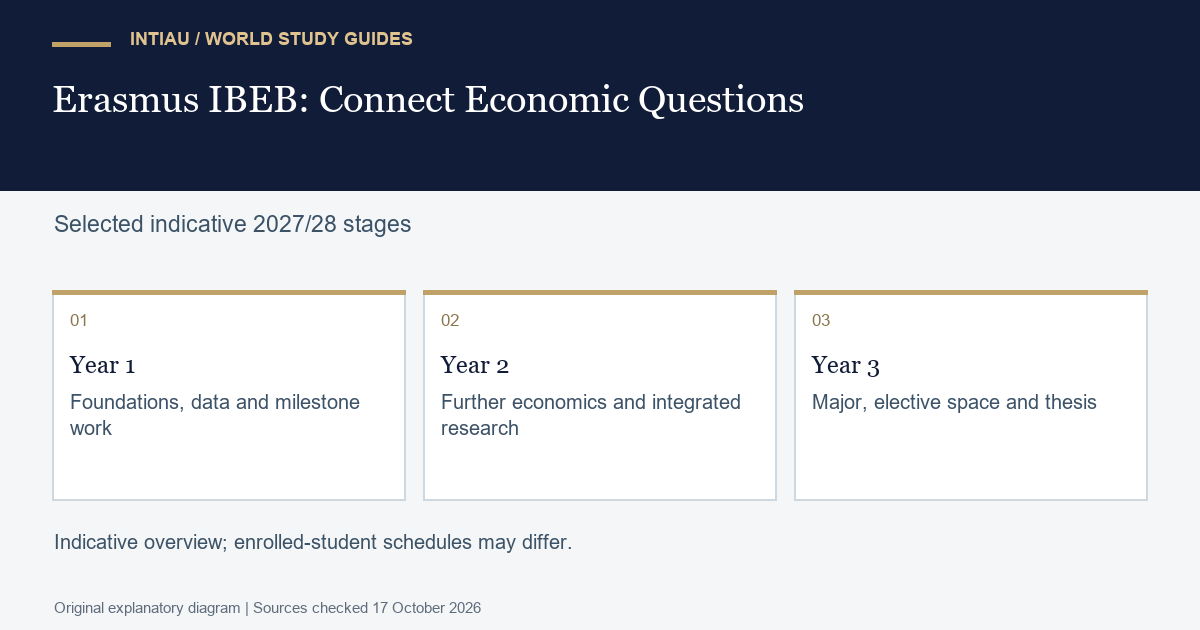
| Year | Published components |
|---|---|
| 1 | Economic foundations, data, mathematics and milestone work. |
| 2 | Further economics, econometric methods and integrated project work. |
| 3 | Major, elective space and bachelor’s thesis. |
The overview labels its 2027/28 structure indicative and changeable, rather than a current enrolled-student timetable.
When comparing another degree, map an activity as well as a topic. Next to data analysis, ask what question the data address. Next to economic theory, ask which assumptions make the explanation work. Next to a seminar, ask how students test an argument against another interpretation. Keep these as questions where a public outline does not provide enough detail.
One real project component
Milestone Project and Skills 1 is a named first-year component applying economic knowledge to practical challenges; no assessment pattern is inferred.
Read a project outline for the connection between the problem, the method and the output. Group work is more informative when each proposed conclusion has a traceable basis. A team can agree on a recommendation while still recording uncertainty or disagreement about how much weight to place on a particular observation.
Original worked exercise: two equal averages
This exercise is created for this guide, not assigned by Erasmus. Imagine two fictional groups of five households. Group A has monthly incomes of 30, 30, 30, 30 and 30 units. Group B has 10, 10, 20, 40 and 70. Both total 150 units, and both have a mean of 30.
Calculate the middle value in each ordered group. The medians are 30 for A and 20 for B. State what changed between the two summaries and what did not. Do not declare one measure wrong: the mean and median describe different features. The arithmetic is a starting point for a question about distribution.
Now introduce a fictional allowance of five units per household. Add it to every value and recalculate both summaries. Explain why the same absolute addition has a different proportional meaning for a household starting at 10 than for one starting at 70. Keep the calculations distinct from any claim about how a real household would behave.
Ask what the exercise omits. Household size, prices, wealth and access to services could alter the interpretation, but listing them is not the same as measuring them. Choose one missing factor and propose a clearly defined observation. Explain which claim it could help assess and which larger judgement would remain open.
Finish with the two ordered lists, the calculations and a short note presenting two possible interpretations. Ask a peer to find any sentence that treats a descriptive measure as a complete account of welfare. Revise the sentence to identify its boundary. This is an original comparison using invented values, not a policy recommendation or a finding about an actual population.
Use the dated selection information
The 2027/28 admission page identifies IBEB as numerus fixus and specifies 15 January for application. Eligibility considers previous education, mathematics and English; qualifying for selection is distinct from receiving a confirmed place.
The January 2027 date was future when checked on 17 October 2026. Follow the programme’s linked application guide and the EUR Admission Portal instructions for your own qualification. Record the entry year beside every condition, rather than combining a current grade requirement with an older selection description.
Keep a separate curriculum note for the major or topics you might pursue later. It can explain your interests, but it does not replace an entry requirement. Before accepting an actual study plan, revisit the current course catalogue and clarify any difference from the indicative recruitment overview.
Frequently asked questions
Is IBEB taught in English?
Yes. The programme page states English.
Is the overview an enrolled-student timetable?
No. It is explicitly indicative.
Does minimum eligibility guarantee a place?
No. The programme has a separate selection process.
INTIAU’s own Courses and Contact pages provide its separate information. Erasmus controls its admission and academic decisions.
Related guides
View the study diagram