KU Leuven is a Belgian institution separate from INTIAU. Its Bachelor of Engineering Technology is a three-year, English-taught academic bachelor at Group T in Leuven. This guide concerns that programme rather than treating every campus and language route as interchangeable.
When comparing engineering degrees, ask how scientific explanation and practical representation meet. A calculation describes a relationship, a drawing communicates geometry, and a project tests whether an interpretation survives contact with constraints. Keep a separate note for each. Finding a familiar subject name is useful, but the way several subjects are brought together may matter just as much to your preferred way of studying.
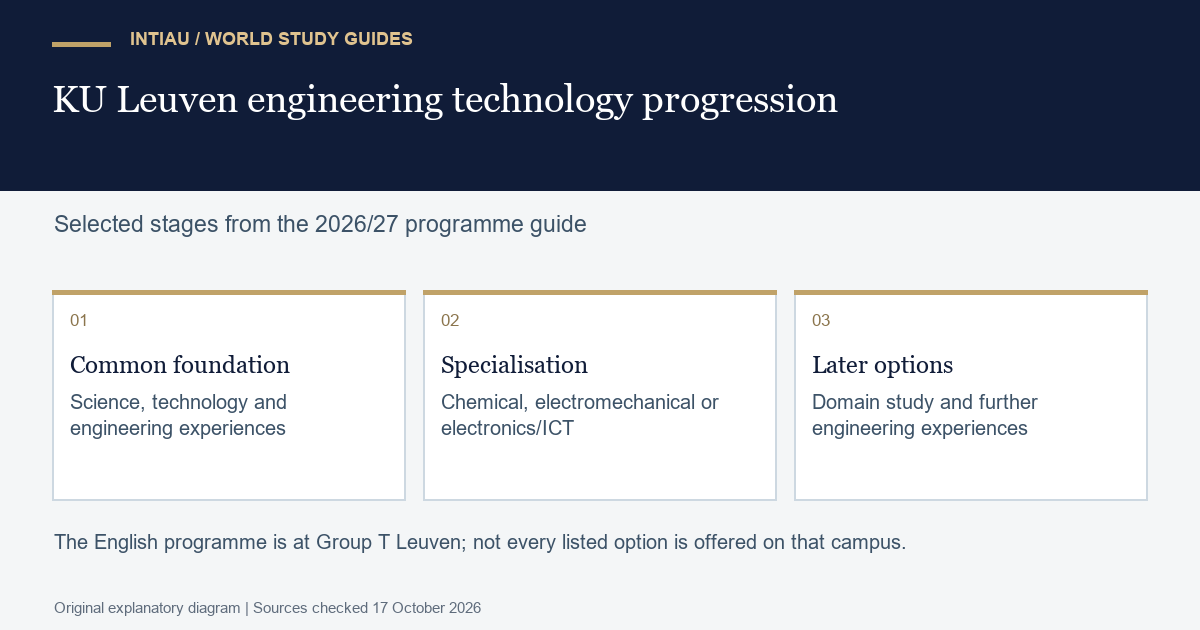
Selected structure in the current programme guide
| Stage | Selected direction |
|---|---|
| Shared foundation | Mathematics, sciences, technology and Engineering Experience 1 |
| Specialisation | Chemical, electromechanical, or electronics and ICT engineering |
| Later study | Domain-specific options and further engineering experiences |
The official structure specifies stages, credits and campus restrictions. This selection is not the full requirement list.
Use the structure to compare when you would make an informed choice. A shared foundation can help you discover whether you prefer material behaviour, chemical processes or electronic systems, but those interests are starting questions rather than guaranteed outcomes. Read the detailed option record before assuming that an appealing title belongs to the English Leuven route.
A real integrated course example
The 2026/27 Engineering Experience 1 outline, B-KUL-T1AIB2, combines technical and professional competencies. Its activities include spatial insight and CAD, project work and reporting. The drawing component concerns interpreting and representing technical objects; this is a selected example, not the complete course specification.
Worked exercise: what a drawing leaves unknown
This original paper exercise uses a fictional object. Its front outline is a rectangle 100 millimetres wide and 50 millimetres high. A side outline is 40 millimetres deep and 50 millimetres high. A plan outline is 100 by 40 millimetres. These views are consistent with a rectangular block, but they do not prove that the inside is solid.
List what you can establish from the stated dimensions: an overall width, height and depth. Then list what remains unknown: internal cavities, material, surface treatment and permitted dimensional variation. Avoid filling those gaps with the first object that comes to mind. A plausible interpretation is not the same as a fully specified object.
Next, draw the front view at a scale of one to two. On paper its width becomes 50 millimetres and height 25 millimetres. The object dimensions remain 100 and 50 millimetres. Confusing the drawing size with the object’s size would create a factor-of-two error even though the rectangle still looks correctly proportioned. Label the scale and dimensions separately.
Now suppose the object must fit through a fictional opening exactly 100 millimetres wide. The nominal width alone does not establish a reliable fit. You need information about the opening, object variation and the conditions of assembly. Do not invent a tolerance or recommend manufacturing settings; simply identify the missing specification and explain why it affects the decision.
Write a short handover note to another reader of your sketch: “These views describe the external envelope only. They do not establish internal geometry or a fit allowance.” The note makes the scope of your evidence explicit. It is more useful than an unexplained claim that the object “should fit”.
Use the exercise to compare your study preferences. Do you enjoy moving between numbers, a spatial representation and a precise explanation of uncertainty? Which step required the most care? Those answers can guide questions about project teaching without claiming that this small task represents an institutional assessment or a safe real-world design.
Application and edition boundary
Applicants with qualifications obtained outside the Flemish Community follow an admission process before registration. The official requirements address mathematics, English and qualification eligibility, and include specific 2027/28 guidance. Check the section for your cycle and category; meeting an individual proof requirement does not guarantee admission. Sources were checked on 17 October 2026.
Questions about this programme
Is the selected Leuven route taught in English?
Yes. The programme guide identifies English as its teaching language.
Can every listed option be assumed available at Group T?
No. The catalogue identifies options offered on other campuses.
Does the drawing exercise specify a manufacturable part?
No. It deliberately leaves material, internal geometry and tolerances unspecified.
INTIAU’s separate information is available through Courses and Contact.
Related guides
View the study diagram