Trinity College Dublin is an Irish institution separate from INTIAU. Its English Studies Single Honours route, TR023, is a four-year B.A. Honours Bachelor Degree at NFQ Level 8. This guide concerns that route in Dublin, rather than assuming that Joint Honours combinations have identical requirements.
For a prospective literature student, “I enjoy reading” is a useful starting point but an incomplete comparison. Ask what happens after the first impression: how a claim about a text is supported, how a passage relates to a larger form, and how historical context changes an interpretation. A productive course comparison records the forms of argument you want to practise, alongside the periods or authors that attract you.
From broad reading to a sustained inquiry
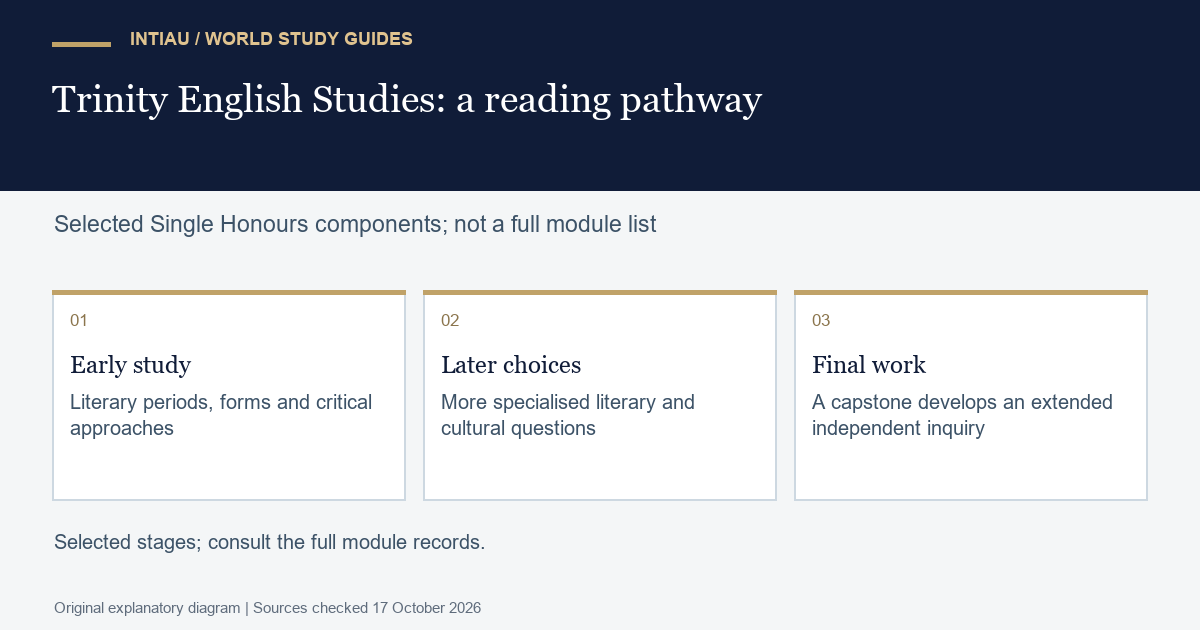
| Stage | Broad curriculum direction |
|---|---|
| First year | Literary forms, historical periods and approaches to interpretation |
| Second year | Further period study, theory and wider literary contexts |
| Third and fourth years | Specialised options and a final-year capstone |
Trinity’s module overview describes several capstone forms, including a dissertation, Open Collections work or a creative writing portfolio. The table selects stages; it is not an exhaustive module or pathway checklist.
When comparing this structure with another degree, separate breadth from freedom. A broad early curriculum can expose gaps in your reading preferences; a later option list can support a narrower question. Neither tells you that every topic will be available in every year. Record an example question you could pursue in each stage, then verify the current module outline before treating it as a firm choice.
A dated module example
The 2026/27 Genre: An Introduction to Literary Studies outline examines poetry, drama and prose fiction through their forms and contexts. This is evidence for a particular teaching edition, not a promised reading list for 2027 entrants.
Use an outline to ask how the same reading habit would work in different forms. A claim that depends on a narrator may need revising when the words become dialogue. A detail that looks incidental on the page may become unavoidable on a stage. That is a useful question to bring to any literature programme, without assuming that one genre is more serious or difficult than another.
Worked exercise: change the form, retain the event
The following miniature passage is original: “Mara put the unopened letter beside the cup. She had waited all morning, but now she washed the spoon.” First describe only what can be observed. A letter remains unopened, and washing interrupts the expected reading. Then offer two interpretations: hesitation about its contents, or a deliberate attempt to recover control through an ordinary action. Neither interpretation is a fact stated by the passage.
Convert the scene into a short stage direction: “Mara sets a sealed letter beside a cup. She picks up a spoon and washes it.” The event remains recognisable, but the explicit information about waiting has disappeared. To restore it, you would need dialogue, another visible action, or a different theatrical device. Each choice adds something; none simply transfers the original narrator without alteration.
Now write a two-sentence comparison. A weak version says that both passages concern a letter. A stronger version explains that the prose supplies a duration and an interior expectation, while the stage direction leaves an audience to infer significance from a sequence of actions. Support the comparison with a precise feature rather than declaring one version “more emotional”.
Finally, challenge your preferred interpretation. Could washing the spoon be a practical task rather than avoidance? What additional detail would distinguish those readings? Keep that missing evidence visible. This exercise helps you assess whether you enjoy revising a claim when its textual support changes. It is not a Trinity assignment and uses no text from the module’s reading list.
Application scope checked on 17 October 2026
Trinity’s current application guide distinguishes CAO applications for Irish/EU applicants from direct applications for non-EU/international applicants, with fee-status classification governing the route. Check the intended entry year’s requirements and calendar; this guide does not carry an older deadline forward.
Questions about English Studies
Which route does this guide cover?
Single Honours English Studies, TR023, rather than every Joint Honours combination.
Is the example outline dated?
Yes. It is the published 2026/27 Genre module outline.
Is the short scene taken from a course text?
No. The passage and comparison exercise are original.
INTIAU’s separate information is available through Courses and Contact.
Related guides
View the study diagram