Wageningen University and Research is separate from INTIAU; Food Technology is its BSc programme. The published brochure describes an English-language bachelor with 180 ECTS over three years, based in Wageningen.
To compare food technology degrees, separate an ingredient’s properties, a processing choice and the evidence for a finished product. A desirable texture does not establish nutritional value or safety. Begin with a defined question and ask which observation would help answer it. This keeps product enthusiasm connected to scientific reasoning rather than an attractive label alone.
Read the scientific and applied stages together
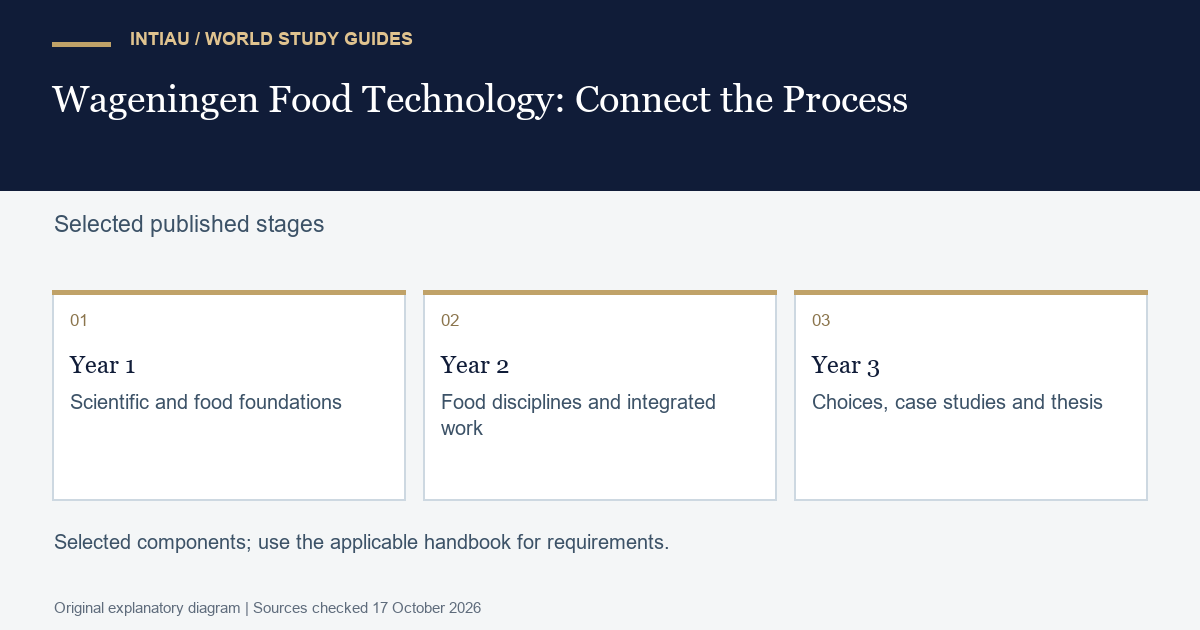
| Year | Selected components |
|---|---|
| 1 | Mathematics, chemistry, biology, physics and food foundations. |
| 2 | Food chemistry, microbiology, engineering and integrated product work. |
| 3 | Electives, Case Studies and graduation thesis. |
The 2026/27 BFT handbook provides the programme framework and learning outcomes. This selected table is a reading aid, not the complete set of required combinations or a future entrant timetable.
On a comparison sheet, put a content question beside an evidence question. Next to chemistry, ask what a measurement would reveal about the material. Next to engineering, ask what changes when a process is scaled. Next to product development, ask how competing criteria are made visible. These are your analytical prompts, not additional university requirements.
A real case-study example
The programme overview describes Case Studies as team work on industry problems drawing on food-technology disciplines. It also identifies a supervised graduation thesis. These selected examples do not supply an unseen laboratory manual or guarantee a particular company brief.
Read an applied course by following the decision it asks students to make. A problem brief may contain a target, constraints and incomplete information. Ask how evidence would allow a team to choose among alternatives, and what remains uncertain after the choice. A successful presentation is not a substitute for a reproducible account of the reasoning.
Original worked exercise: a fictional concentration balance
This exercise is created for this guide, not assigned by Wageningen. Imagine a fictional mixture weighing 100 kilograms, of which 10 kilograms is a dissolved solid and the rest water. Under a simplified assumption that only water is removed, taking away 20 kilograms leaves 80 kilograms containing the original 10 kilograms of solid.
The solid fraction changes from 10 percent to 12.5 percent by mass. Show both calculations and state the assumption about what leaves the mixture. A percentage can rise while the absolute amount of a component remains unchanged. That distinction matters before interpreting any claimed improvement in a product.
Now introduce a complication: two kilograms of solid are lost with the removed material. The remaining mixture contains eight kilograms of solid in 80 kilograms total, or 10 percent. The revised accounting describes a different process. Keep the original model and the revised one side by side rather than quietly editing the first conclusion.
Ask what measurements a real investigation would need. You might want the mass and composition of both output streams, not only the final container’s weight. Identify a possible recording error and explain how it would affect the balance. Do not use the fictional numbers to infer taste, stability, microbiological safety or nutritional benefit.
Finish with a flow sketch, a small input-output table and a paragraph explaining the difference between mass, fraction and interpretation. Ask a peer to locate every assumption that made the simple model work. This paper exercise is a way to compare quantitative interests; it is not a recipe, food-processing procedure or assurance that a real product is suitable to consume.
Use the application instructions for your diploma
Wageningen’s bachelor guidance starts with Studielink. Applicants without a Dutch VWO diploma then complete the university’s OSIRIS submission. The guidance distinguishes an application, the assessment of credentials and later admission documents.
The route was checked on 17 October 2026. This guide does not turn an undated deadline list into a verified 2027 calendar. Record the intended year, nationality category and actual school qualification before acting. Check the current subject and English requirements, then keep questions about later electives or thesis topics separate from entry conditions.
For a final comparison, select one official course description and one uncertainty from your worked exercise. Explain why the course interests you, using a specific activity rather than a broad claim that the subject is useful. Save the official link and edition beside that explanation.
Frequently asked questions
Is this an English-language bachelor?
Yes. The brochure identifies English.
Is Case Studies a real programme component?
Yes. It appears in the published overview.
Does a Studielink request complete every application?
No. Follow the applicable OSIRIS instructions.
INTIAU’s separate information is available through Courses and Contact. Wageningen decides its own requirements.
Related guides
View the study diagram