The University of Bonn is a German institution separate from INTIAU. Its Agricultural Sciences BSc is a six-semester, German-taught route beginning in winter. The faculty’s Bonn-based teaching and practical venues should be checked for the relevant offering.
Agricultural study brings together biological processes, environmental conditions and economic decisions. A useful comparison starts by separating those questions. The composition of a sample, the response of a crop and the cost of an intervention require different evidence. Write one question in each category before reading course titles. This helps you recognise whether a broad foundation is preparing you for the later profile you want to investigate.
Common foundations and later profiles
| Component | Published allocation |
|---|---|
| First three semesters | 90 ECTS of compulsory foundations |
| Specialisation | 78 ECTS for individual profile development |
| Completion | 12-ECTS bachelor thesis |
The faculty progression page identifies plant sciences, animal sciences, agricultural economics and general agricultural sciences as focus areas. The full module rules remain necessary.
Read a profile as a structured direction rather than a free collection of appealing subjects. Compare the common scientific preparation, the selected focus and any remaining choices separately. A broad early course may help you ask a more precise question later, but that intellectual connection should not be mistaken for a formal prerequisite unless the catalogue says so.
A real soil-science module
The handbook for winter 2025/26-onward entrants includes Allgemeine Boden- und Standortkunde, AGR-009. It addresses soil properties, formation, classification and relationships with site conditions. This is a selected scope illustration, not a reproduced laboratory protocol.
Use the example to compare observation with interpretation. Recognising a property is different from explaining its origin or deciding how a site should be used. Put those tasks in separate rows when reading an outcome list. A descriptive measurement does not by itself settle a management choice, particularly when other environmental and economic information is missing.
Worked exercise: percentages need a defined mixture
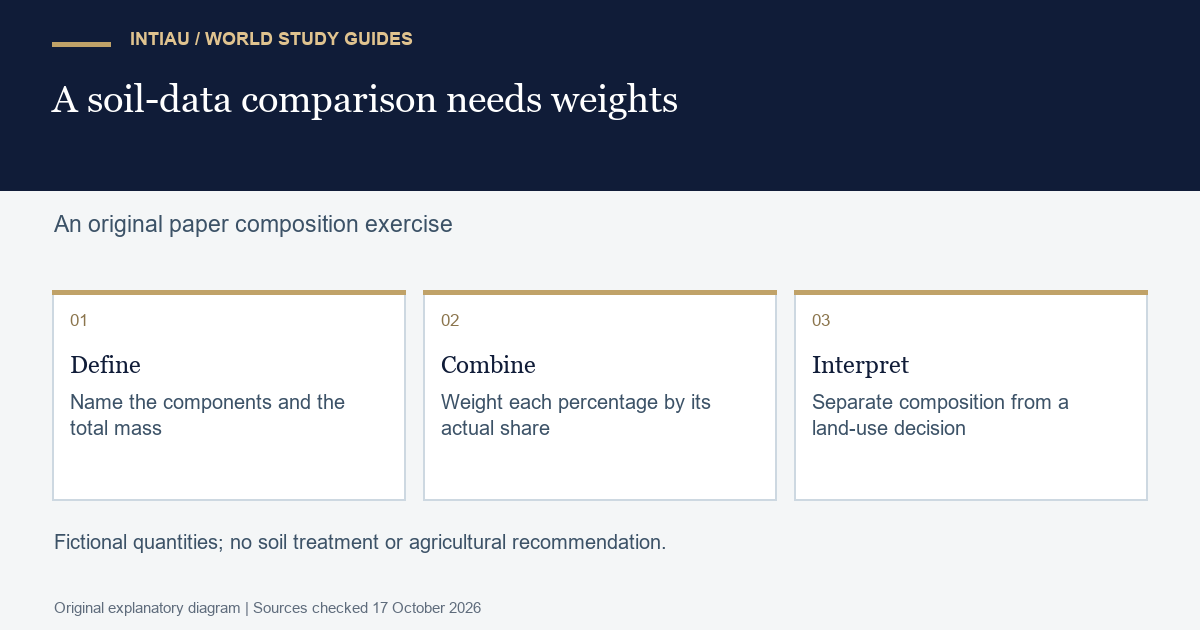
This original paper exercise uses invented components labelled sand, silt and clay, without handling soil or prescribing any treatment. Fictional material A consists of 50 percent sand, 30 percent silt and 20 percent clay by mass. Material B has 30 percent sand, 50 percent silt and 20 percent clay. Confirm first that each description sums to 100 percent.
Combine equal masses of A and B. Because the masses are equal, the new sand fraction is the average of 50 and 30 percent: 40 percent. Silt is also 40 percent, and clay remains 20 percent. Check the sum again. The result describes composition under the stated assumptions, not how a real mixed material would behave.
Now combine two mass units of A with one of B. The sand contribution is two times 0.50 plus one times 0.30, or 1.30 mass units. Dividing by the total mass of three gives about 43.33 percent sand. Silt contributes 1.10 mass units, or about 36.67 percent, and clay contributes 0.60 mass units, or 20 percent. An unweighted average would answer the wrong mixture question.
Keep the intermediate masses beside the final percentages. If you round the two repeating percentages, the displayed total may differ slightly from 100; that is a rounding issue rather than evidence that material has disappeared. Distinguish numerical display from the underlying fraction before trying to “correct” a component by intuition.
Next, ask what you cannot conclude. The sheet does not establish water movement, nutrient availability, biological activity, suitability for a crop or the effect of adding any material. Those require further definitions and evidence. A component proportion is one description of a system, not a universal quality score.
Create an output sheet containing both mixtures, their mass totals and a short limitation statement. Ask a reader to identify which weight belongs in each calculation. Then change the proportions to one unit of A and two of B and predict the direction of change before calculating. Sand falls to about 36.67 percent, while silt rises to about 43.33 percent. This check tests whether the arithmetic matches the meaning of the mixture.
Application route and cycle scope
The faculty’s entry guidance directs applicants to the university’s central application, admission and enrolment instructions. Follow the category matching your qualification and language evidence. Checked on 17 October 2026, this guide does not infer a future application deadline from a module handbook.
Maintain separate notes for qualification eligibility, language requirements and the curriculum edition. A preferred profile does not establish recognition of prior study, and a course name shared with another university does not establish approved transfer credit.
Three agricultural-study questions
Is the programme taught in English?
No. German is its listed teaching language.
Which entrant framework supports the module example?
The handbook covers entrants from winter 2025/26 onward.
Does the mixture calculation recommend a land-use decision?
No. It calculates fictional composition only.
For INTIAU’s separate information, visit Courses or Contact.
Related guides
View the study diagram