The University of Bordeaux is a French institution separate from INTIAU. Its Licence mention Psychologie has first-, second- and third-year study, with later entry and observation requirements described separately by the faculty.
The faculty’s location page places it on Bordeaux’s Victoire campus. Confirm actual teaching venues. A programme-wide teaching-language statement was not established in the sources checked here; obtain confirmation and applicable language-evidence requirements from the faculty. An English website interface would not supply that confirmation.
When comparing psychology study, distinguish a description of behaviour from the rule used to categorise it and from an explanation of why it occurred. Those steps can require different evidence. A useful preparation task makes the observation rule explicit and lets another reader reproduce the classification, without treating a label as a diagnosis or an account of a person’s motives.
Current catalogue and the limits of the module evidence
The current public catalogue identifies the 2026/27 Psychology licence as six semesters and 180 ECTS.
| Stage | Verified scope |
|---|---|
| L1 | Indexed cognitive-psychology component in semester 2 |
| L2 | Progression after validated L1; external transfers require examination |
| L3 | Observation placement with university follow-up and written reflection |
The official indexed first-year listing names Psychologie cognitive, three credits. The current portal was identified, but its full component outline was not extracted. This is a real named component, not a verified complete syllabus, assessment description or reconstructed lecture sequence.
For L3 observation, the faculty describes 100 hours with a professional, university follow-up and submitted documents. It distinguishes this licence activity from psychology-master placements. Read the complete current instructions before planning an actual placement; the short summary here does not replace them.
Use those different evidence levels honestly in a comparison sheet. Place a named component in one column, an actually published learning description in another and an unresolved question in a third. An empty outline field is a reason to seek information, not permission to fill the gap with topics that sound plausible.
Worked exercise: compare fictional coding decisions
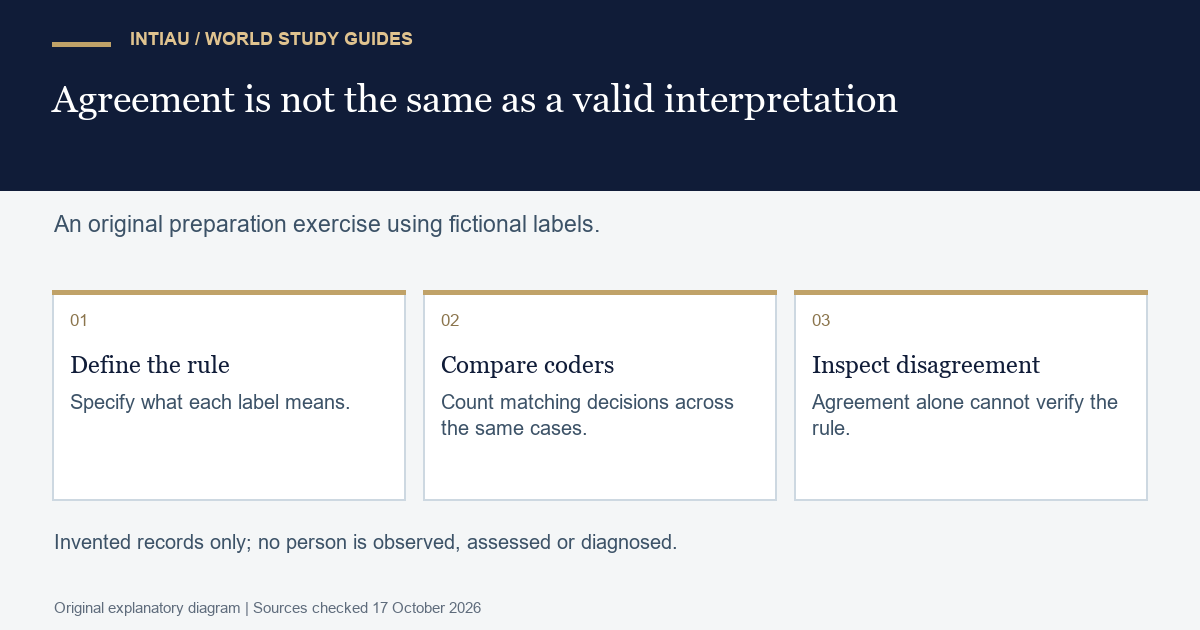
This original task uses four invented case labels, A to D, and two fictional coding records. A rule assigns “request” only when a case contains an explicit request for help; otherwise it assigns “other”. The cases are abstract text descriptions, not real conversations, observations or personal records.
Suppose coder one assigns request, request, other, other to cases A through D. Coder two assigns request, other, other, other. They agree on A, C and D and disagree on B. Raw agreement is three matching cases divided by four, or 75%. Both the count and the denominator should be reported.
That result does not establish that the rule is useful or that either coder is correct. They could agree because both interpret an ambiguous instruction the same way. They could also agree on many “other” cases simply because requests are rare in the invented set. Agreement concerns matching decisions under a rule; validity asks a different question about what the rule captures.
Now inspect the disputed case B. Imagine its entire text is “I cannot find the form.” It states a difficulty but does not explicitly ask for help. Under the stipulated rule, “other” is the consistent answer. This resolves the exercise’s rule application without claiming that a real speaker intended nothing or would not welcome assistance.
Revise coder one’s B label to other and raw agreement becomes four out of four, or 100%. Keep the initial record in the worksheet alongside the revision and explain why it changed. Silently replacing it would hide the distinction between initial agreement and agreement after clarification.
Finally, change the rule to include an explicit statement of difficulty. B would then be request under the new rule. This is a new coding definition, not merely correction of the old one. State the version used for each calculation so a reader can see why two apparently inconsistent classifications can follow different instructions.
Produce a small worksheet containing the rule, four cases, two coding columns and the initial and revised agreement values. End with a limitation: this tiny fictional example supplies no diagnosis, population estimate or causal explanation. It illustrates careful operational definition and transparent revision.
Application route and checked date
The faculty application guidance, updated 5 February 2026, directs L1 applications to Parcoursup and explains the assessed expectations. For a foreign qualification or a different entry level, confirm the applicable university procedure. Checked on 17 October 2026, this guide does not invent a future application deadline.
Three psychology questions
Which catalogue edition supports the duration stated here?
The 2026/27 public programme catalogue.
Has the full cognitive-psychology syllabus been reproduced or verified here?
No. The verified scope is the named indexed component and its listed credits.
Does 75% agreement prove a coding rule is valid?
No. It describes matching decisions in the four-case exercise only.
For INTIAU information, use Courses or Contact.
Related guides
View the study diagram