The University of Zurich is a Swiss institution separate from INTIAU. Its faculty bachelor framework lists Biochemistry as a 180-ECTS mono programme with Biomolecular and Chemical tracks. The normal bachelor framework is three years, or six semesters.
The programme page identifies Campus Irchel in Zurich. Check actual class and practical-course arrangements in the current catalogue.
The university’s bachelor admission guidance says German is generally the main teaching language, although individual modules may use English or another language. It requires applicable foreign-language applicants to demonstrate C1 German, subject to its detailed language rules. This guide does not describe Biochemistry as an entirely English-taught bachelor.
For a meaningful biochemistry comparison, connect a molecular question with the measurement or model used to investigate it. A curve can summarise observations without identifying the mechanism behind them. A useful study plan should help you distinguish a quantitative description from the experimental and conceptual evidence needed to explain it.
A current guide, with its authority stated
The study guide dated August 2026 names the award Bachelor of Science UZH in Biochemie. It says the guide is orientating; the regulations are legally binding.
| Stage | Published emphasis |
|---|---|
| Semesters 1–4 | Chemistry, biochemistry, physics, mathematics, molecular biology, physiology and practical foundations |
| Semesters 5–6 | Further biochemistry and experimental study, ending with a research-group bachelor thesis |
BCH 303, Methods in Biochemistry, is a real 18-ECTS fifth-semester module listed in that edition. This identifies a selected component, not its complete syllabus or a reproduced laboratory protocol.
The department overview describes theoretical concepts deepened through practical courses, with scientific reasoning and presentation among the general skills. Those are programme-level aims; they should not be treated as an invented detailed assessment outline for the named module.
Worked exercise: read a saturating relation carefully
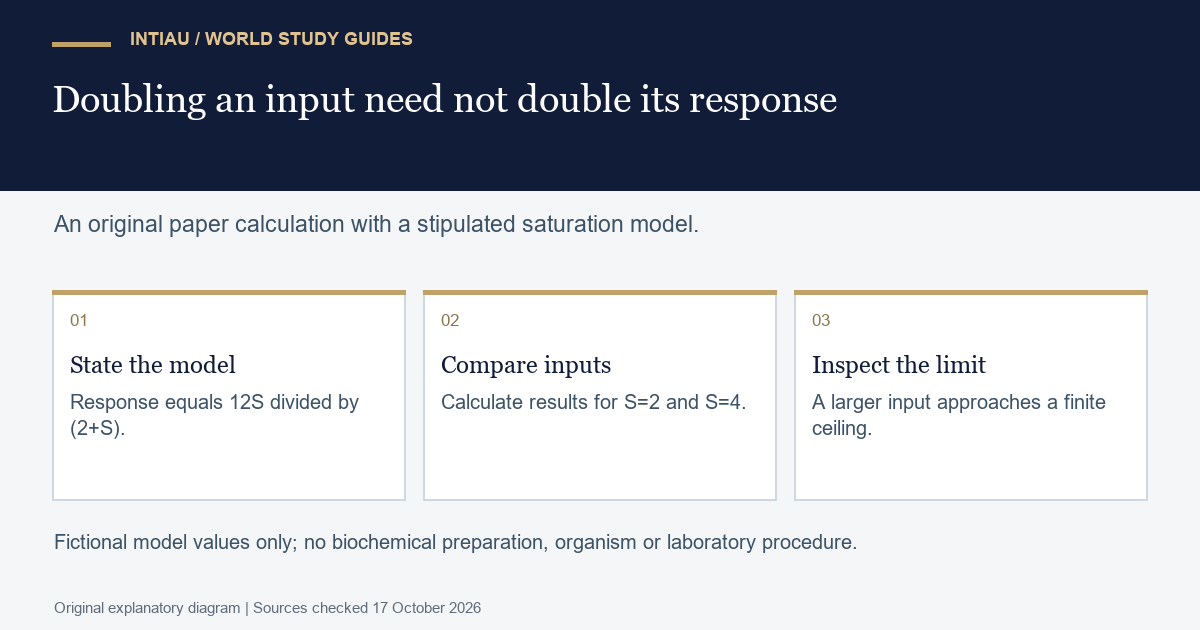
Use the stipulated relation response equals twelve times S divided by two plus S, with the denominator explicitly grouped as (2+S). Let S be a nonnegative abstract input. This original exercise uses invented model quantities only. Calculate the response at S equal to two, four and six, then compare the effect of doubling the first input.
At S equal to two, the response is 24 divided by four, or six. At four it is 48 divided by six, or eight. At six it is 72 divided by eight, or nine. Doubling the input from two to four therefore raises the response from six to eight, rather than from six to twelve.
The grouping matters. Twelve times S divided by (2+S) differs from twelve times S divided by two, then adding S. Write the grouped denominator before substituting values. A graph built from a misread expression could look smooth and still represent a completely different relation.
Now compare S equal to two and twenty. At twenty, response is 240 divided by 22, approximately 10.91. A tenfold increase in input has produced less than a twofold increase in response. Within the stated model, the denominator also grows with the input; the relation is therefore not proportional across this range.
For large S, divide numerator and denominator by S. The expression becomes twelve divided by (2/S+1). As S grows, 2/S approaches zero, and the response approaches twelve. It remains below twelve for any finite positive S in this stipulated relation. That is a mathematical limit, not a claim about an actual biological system.
Prepare a small table of the four input values and calculated responses. Add a sketch with labelled axes, keeping the units explicitly abstract. Then write one sentence that the numbers support: doubling input from two to four increases the modelled response by two. Add a limitation: these calculations do not establish which molecular mechanism, if any, a measured curve would represent.
A practical comparison could require controls, repeated measurements and attention to alternative explanations, but those are absent here. Do not infer a mechanism merely because the imagined curve resembles a familiar pattern. The exercise tests careful modelling and interpretation without involving chemicals, organisms or laboratory activity.
Applications and year-specific requirements
Use the central bachelor admission route and its application portal. Non-Swiss qualification requirements depend on the certificate and country; the page says published country requirements apply to their stated year. Checked on 17 October 2026, this guide does not supply an unverified future deadline.
Keep track choice, entrance qualification and language evidence in separate planning fields. A preferred advanced module does not establish eligibility or a credit-transfer decision. Save the applicable regulation and entry-cycle information before preparing a final application.
Three biochemistry questions
Is Biochemistry listed as a standard major/minor combination?
No. The faculty lists it as a mono programme.
Which edition identifies the selected methods module?
The August 2026 study guide.
Does doubling S from two to four double the worked response?
No. It changes from six to eight under the stated relation.
For INTIAU information, use Courses or Contact.
Related guides
View the study diagram