The University of Pisa offers the three-year Laurea in Informatica, class L-31 R, in Pisa and in Italian. This guide concerns that independent programme, not an INTIAU qualification or partnership. Official programme record.
A useful computer-science comparison asks how a proposed solution is specified, why it works and what happens when an assumption fails. Do not judge fit only by the presence of a fashionable technology. Start with a small problem, explain its inputs and expected output, then identify the mathematical and practical skills needed to reason about it.
Read the entrant plan as a progression
The university publishes the following selected components for 2026/27 entrants. Programmazione e algoritmica carries fifteen credits in year one; later work includes systems, programming paradigms and a final activity. This is a selection, not the entire plan.
| Stage | Published example | Comparison question |
|---|---|---|
| Year one | Fondamenti dell’informatica; Programmazione e algoritmica; Laboratorio I | Can I explain a procedure precisely? |
| Year two | Architetture e sistemi operativi; Paradigmi di programmazione | Which assumptions depend on the execution model? |
| Year three | Final activity and complementary choices | How will I demonstrate a bounded result? |
The department warns that the placement of complementary subjects in Alice can reflect system limitations rather than the actual rules. Choices must follow the relevant regulation; some free-choice selections require approval. Study-plan guidance.
Keep the original Italian course name beside your selected English explanation. For example, distinguish a programming laboratory from an entire software-engineering specialisation. Ask whether a component is required, complementary or freely chosen, and retain that distinction in your notes. Do not silently turn a catalogue option into a promise that you will take it.
Initial assessment and application are separate tasks
The department’s entrant page lists the first-year teaching and directs students to the current timetable and Alice services. Its opening event on 14 September 2026 was already past when checked on 17 October. Entrant information.
Admission is open access but includes a non-selective preparation check. The department’s test route explains TOLC-S and additional learning obligations; follow the rule applicable to your entry year rather than treating open access as the absence of an assessment. Assessment route.
Build your applicant notebook around three questions: which qualification route applies, which action must be completed and which source establishes its timing? Check the programme’s linked enrolment instructions for your actual situation. A timetable or an account-registration page does not itself establish that an application has been accepted. No future admission cycle is inferred here.
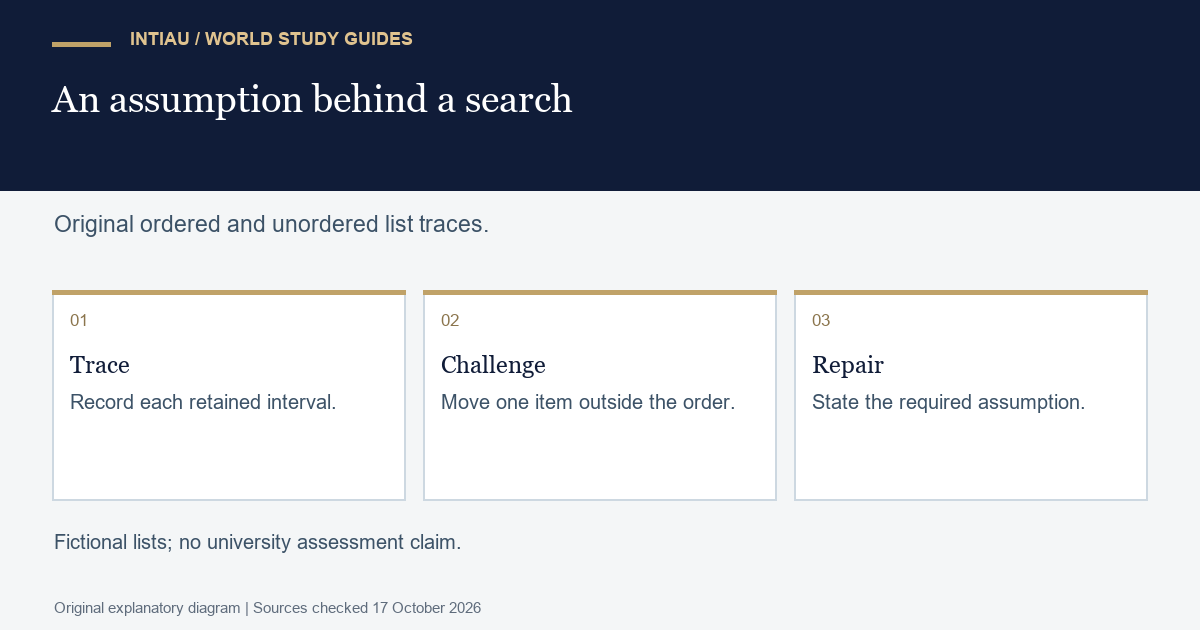
Original worked exercise: an assumption behind a fast search
This independent paper exercise uses an invented ordered list: 2, 5, 9, 12, 18, 21, 27. Search for eighteen by checking the middle item and discarding the half that cannot contain the target. Use zero-based positions and round the midpoint down. The first middle position is three, containing twelve.
Because eighteen exceeds twelve, retain positions four through six. Their middle is position five, containing twenty-one. Retain position four, where eighteen is found. The three inspected values are twelve, twenty-one and eighteen. Write the retained interval after every comparison so that another reader can reproduce the trace.
Now use the same procedure on 2, 18, 9, 12, 5, 21, 27. The middle value is still twelve, so the procedure discards positions zero through three. It next checks twenty-one and then five, eventually reporting no match. Yet eighteen was present at position one. The arithmetic of the midpoint was correct; the assumption allowing a half to be discarded was false.
Explain this failure in a sentence that names the assumption. Then propose a repair: establish the required ordering before this procedure, or choose a search that does not depend on it. Sorting is not free work, so keep the cost of preparation separate from the cost of one subsequent search. No timing measurement is supplied or implied by this paper trace.
For a second test, choose a target outside the list and show that the retained interval eventually becomes empty. Your answer should define both success and failure, rather than demonstrating only a convenient successful case. This is an original reasoning exercise, not Pisa’s official syllabus or assessment.
Practical questions
How should I compare differently named computing degrees?
Use exact award names and selected current components. Compare the questions and methods they teach rather than assuming that similar English labels describe identical routes.
Can a portal display replace the regulation?
No. The department explicitly distinguishes portal placement from the rules governing complementary choices.
Does this search trace prove programme readiness?
No. It provides a small example of explaining assumptions and counterexamples. It is not an entrance test or an admission prediction.
For INTIAU’s own information, see courses and the contact page.
Official source index
- Programme: selected entrant plan.
- Department: choice rules.
- Department: entrant information.
- Department: preparation assessment.
Related guides
View the study diagram