Universidad Autónoma de Madrid offers the four-year, 240-credit Grado en Física through its Faculty of Science, with on-site teaching in Spanish. This independent programme is not an INTIAU qualification or partnership. Official degree record.
The university’s Physics teaching departments are based at Cantoblanco. Check the assigned classroom through the university’s current timetable. Department location.
When comparing physics degrees, connect a model with the observation that could test it. Keep the measured quantity, unit and assumptions visible. A correct calculation is only part of the explanation: another reader should also understand why that calculation addresses the question and what the available observations leave undecided.
A selected path through the 2026/27 offer
UAM publishes a 2026/27 course-offer document with links to individual teaching guides. The selection below follows its progression; it is not a complete syllabus. Official annual offer.
| Stage | Selected original course name | Comparison question |
|---|---|---|
| Year one | Técnicas Experimentales I; Computación I; Fundamentos de Física I | How will I record and interpret a quantity? |
| Year two | Mecánica y Ondas I; Electromagnetismo I | Which assumptions define the model? |
| Year three | Óptica; Mecánica Cuántica I | What changes with a different description? |
| Year four | Trabajo Fin de Grado | How is an investigated question explained? |
Técnicas Experimentales I is a six-credit annual first-year component. The final degree work carries twelve credits. These entries establish placement and credit, not a promised experiment or an individual project allocation.
Use a selected component to formulate a concrete comparison question. For experimental study, ask how observations are documented and interpreted; for mathematical study, ask how a model’s assumptions are stated. Keep those questions beside the official course name. Avoid replacing the record with a broad description such as practical physics that could mean several different things.
Three applicant steps need three kinds of evidence
UAM separates obtaining access, applying for a place through pre-enrolment, and subsequent enrolment. Its admission page provides route-specific information. Use the instructions for your actual qualification and cycle; no future application opening is inferred here. Official admission route.
Make a three-row applicant sheet with the action, applicable qualification category, source and deadline. Mark a missing instruction as unresolved rather than borrowing the date from another route. Keep your intended entry cycle separate from the 2026/27 teaching evidence checked on 17 October 2026.
If comparing language provision, ask about the actual course and group using its original Spanish title. An English website option is an aid to reading information; it does not answer which language will be used in teaching or assessment. A precise enquiry reduces the chance of receiving an answer about a different component.
Original worked exercise: one cycle or ten?
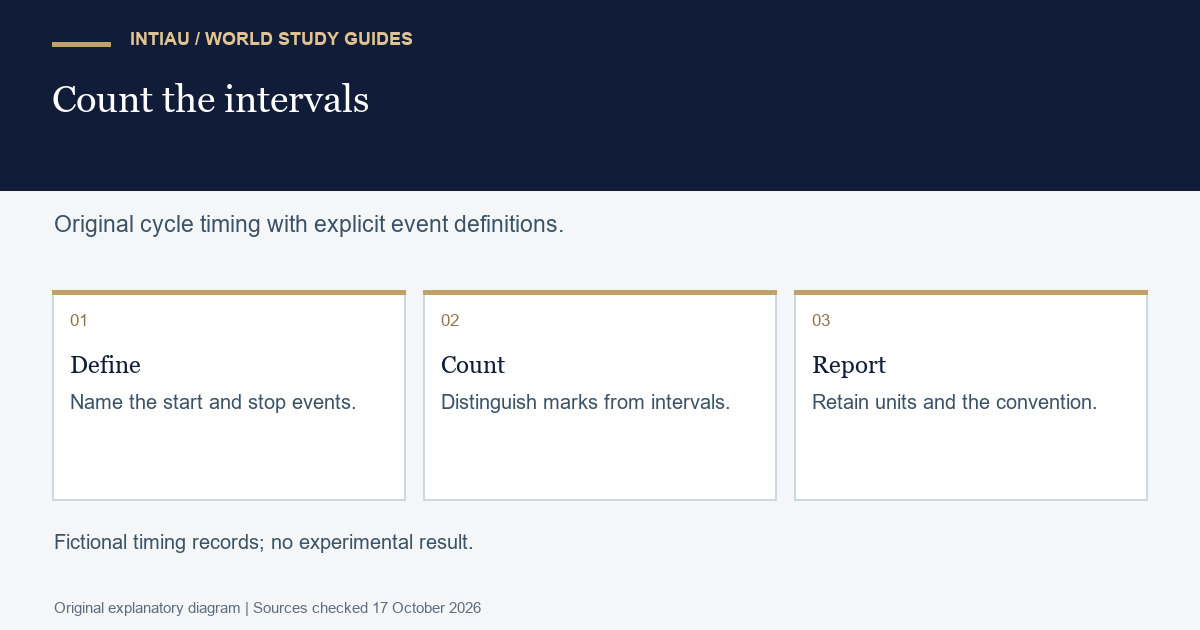
This fictional timing exercise is independent of UAM’s teaching. Define one cycle as a complete return to the chosen starting condition. Suppose an invented record reports twenty seconds across ten complete cycles. Under that definition, the mean period is 20/10=2 seconds per cycle, and the corresponding frequency is 1/2=0.5 cycles per second.
Now compare a separate invented observation reporting 2.3 seconds for one complete cycle. It does not match the mean period from the first record. Preserve both observations instead of averaging them automatically: you need to know whether they concern the same system, conditions and timing convention before combining them.
A common counting ambiguity can be tested without new data. If a timer starts at the first marked return and stops at the tenth marked return, only nine intervals lie between them. A twenty-second duration would then imply 20/9, or about 2.22 seconds per cycle, rather than two. Draw the ten marks and count the spaces between them.
Write two possible descriptions of the first record, one using ten intervals and one using ten observed marks. Explain which additional note would resolve the ambiguity. Then record an explicit start event, stop event, number of intervals and unit for your preferred convention.
Finish with a short result that reports the stipulated definition as well as the arithmetic. Do not describe either invented observation as a precise physical constant. This is a reporting and counting task, not a real experiment, uncertainty analysis or official assessment.
Practical questions
Does an annual offer contain every detailed teaching rule?
No. Use the individual guide for the selected course and retain its edition when discussing assessment or practical arrangements.
Why count intervals rather than marks?
The stipulated timing question concerns elapsed complete cycles. Ten successive event marks have nine intervening intervals.
Does the exercise establish an admission result?
No. It illustrates careful definition and reporting; it is not a university entry assessment.
For INTIAU’s own services, see course information and the contact page.
Official source index
- Degree: identity and language.
- Offer: selected progression.
- Admission: applicant route.
- Department: location.
Related guides
View the study diagram