Nanjing University’s 大气科学, Atmospheric Sciences, is an undergraduate major in its School of Atmospheric Sciences at Xianlin. This independent university programme is not an INTIAU course or partnership.
Understand the programme’s practical orientation
The school’s undergraduate education page distinguishes Atmospheric Sciences from Applied Meteorology. It describes broad foundations and research-oriented learning, supported by campus practice, external teaching bases and fieldwork. These are programme aims and teaching arrangements, rather than a promise about employment.
For a useful comparison, separate the degree’s governing plan from evidence about particular classes. The published examples below show what students have actually been taught; they do not supply a complete current credit total, award classification or registration timetable. Request those details for the intended cohort directly from the school.
Selected subjects and a documented stage of practice
A September 2025 teaching announcement names Dynamic Meteorology, Geophysical Fluid Mechanics, Principles and Experiments of Synoptic Meteorology, and Radar Meteorology among the school’s undergraduate teaching. The selections below connect that course evidence with a separately documented practical course.
| Published component | Selected subject or stage |
|---|---|
| Theoretical teaching | Dynamic Meteorology; Geophysical Fluid Mechanics |
| Weather analysis | Principles and Experiments of Synoptic Meteorology |
| Observation theme | Radar Meteorology |
| Documented second-year summer course | Comprehensive Experiments in Atmospheric Science (I),2 credits in the 2023 report |
The announcement concerns course development and recognition. It is not a new full programme plan, and these names alone do not establish prerequisites, assessments or semester availability.
What the actual experimental course covers
The school’s 30 June 2023 course report explains that Comprehensive Experiments in Atmospheric Science (I) grew from the 2021 curriculum reform. It was designed as a required second-year summer course after examinations. Its experimental directions include weather forecasting, atmospheric observation, boundary-layer meteorology, hydrometeorology, radar and satellite meteorology. Students worked in groups with manuals and experiment notebooks. In that documented first delivery,72 students formed two classes, each divided into six groups. The report dates the teaching to 26 June–2 July 2023 and describes preparation for the content, field safety and routes.
That evidence identifies actual teaching themes and a documented point in study. It does not establish unchanged arrangements for a student entering in 2027.
Original exercise: compare forecast errors fairly
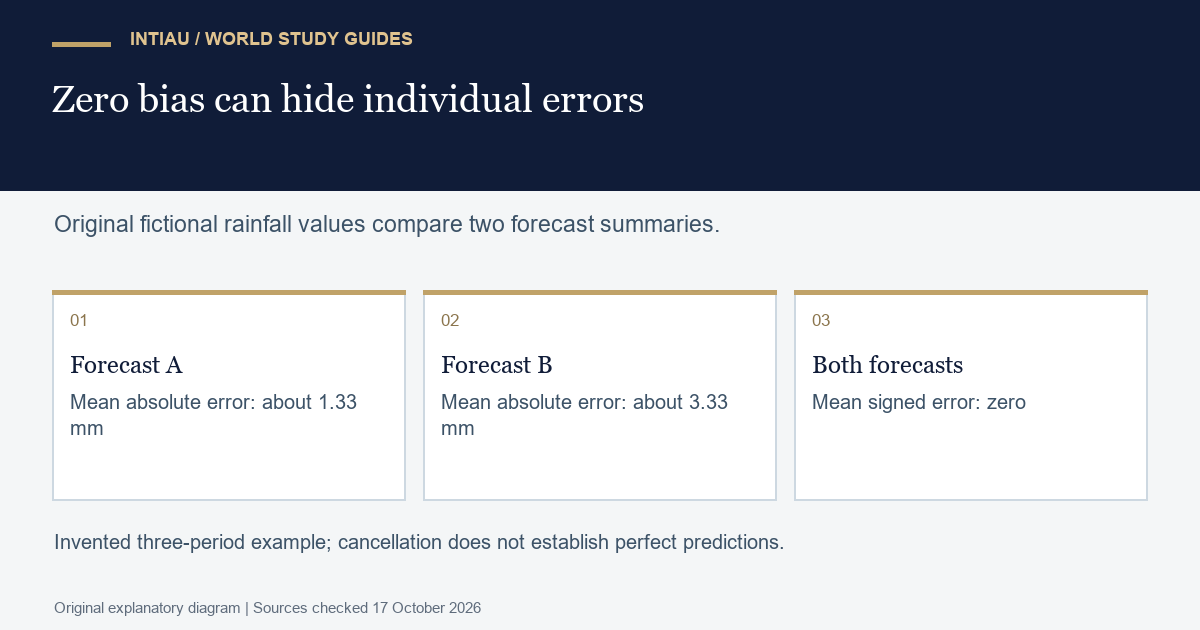
Use these invented rainfall values, in millimetres, for three equal reporting periods. Observations are 0,10 and 20. Forecast A gives 2,8 and 20; forecast B gives 0,5 and 25. A’s absolute errors are 2,2 and 0, so its mean absolute error is 4/3, approximately 1.33. B’s are 0,5 and 5, averaging approximately 3.33.
Now inspect signed errors. Each forecast has a mean signed error of zero: overprediction and underprediction cancel. Thus a zero average bias does not mean every prediction is accurate. Write one sentence reporting both the absolute-error result and the cancellation. Keep the observation periods and units fixed. These stipulated numbers support a small calculation only, not a claim about operational forecast skill or a task assigned by Nanjing University.
Check whether the applicant route offers this major
The university’s international bachelor’s guide describes Chinese instruction, high-school completion, language evidence and CSCA reporting from the 2026–2027 academic year. Its 15 May 2026 score-submission deadline is past on 17 October. General university eligibility does not establish that every departmental major is open through that route.
In particular, Atmospheric Sciences is not listed in the linked three-page 2026 international undergraduate catalogue reviewed here. Do not infer an international place or a 2027 application window from the existence of the school.
Use INTIAU’s Courses for broader subject exploration or Contact for general enquiries.
Three questions to keep separate
Is the table a complete current plan?
No. It selects documented teaching, not every graduation requirement.
Were experimental learning themes actually published?
Yes. The 2023 report specifies the course’s observational and forecasting directions.
Is international admission to this major confirmed?
No. The reviewed 2026 international catalogue does not list it.
Official sources checked 17 October 2026 are linked beside their claims.
Related guides
View the study diagram