POSTECH is a separate institution; its Chemical Engineering undergraduate major is not an INTIAU programme or partnership. At its Pohang campus in South Korea, the department connects energy and environmental systems, biotechnology, materials, and computation. Those four areas make a useful starting point for comparing this major with a chemistry degree: examine the engineering decisions and process questions, rather than treating similar subject names as interchangeable.
Understand the common entry route first
The Spring 2027 admissions guide places all international undergraduates in the Mueunjae School of Undergraduate Studies, initially without a declared major. Students explore subjects for three semesters and declare before the fourth. Chemical Engineering is among the available majors. This is therefore a guide to a later major choice, not a promise of direct departmental admission. The same guide describes foundational and major courses as offered in English; it requires an English proficiency result for the international route.
Checked on 17 October 2026, the published Spring 2027 application period was 25 August–2 September 2026 and had already ended. The schedule describes Fall 2027 applications as expected in March–April 2027, with guidelines to follow in early 2027. An expectation is not a confirmed future deadline: consult the current international admissions calendar before planning an application.
The university’s published English academic regulations identify Chemical Engineering with the Bachelor of Science in Engineering and specify a four-year normal minimum, with an early-graduation exception. That English document contains older amendments; confirm current award wording with POSTECH. It is not the authority for this guide’s 2026 course map.
Read the dated curriculum in stages
The 2026 departmental curriculum guide, printed pages 169–179, specifies 131 credits overall, including 30 required and 25 elective major credits. The selected progression below follows its table for students enrolled in 2024 and later; it is not a complete registration plan.
| Stage | Published example | Reading task |
|---|---|---|
| Freshman | Introduction to Chemical Engineering | Identify a question that interests you. |
| Sophomore | Chemical Engineering Thermodynamics; Chemical Engineering Lab | Compare a theoretical model with a measurement. |
| Junior | Reaction Engineering; Programming and AI in Chemical Engineering | Separate a physical assumption from a computational method. |
| Senior | Chemical Engineering Capstone Design | Ask what evidence supports the conclusion. |
A real course example is CHEB305, Reaction Engineering: its description covers reaction rates, heat and mass transfer, and ideal-reactor performance. The senior capstone is taken once and accompanies a thesis requirement. These are catalogue descriptions, not a verified weekly syllabus or a guarantee of a particular supervisor.
Prepare for the transition into university study
POSTECH’s welcome and curriculum guidance says first-semester general and basic required courses are automatically registered, with additions possible during adjustment. It also describes academic advisers and student and residential assistants in the Mueunjae support structure. Use those channels to discuss an actual timetable. The welcome page includes dated 2026 activities; those dates should not be copied into a Spring 2027 preparation schedule.
The official Chemical Engineering overview connects mathematics, physics, chemistry and biology. Its research areas help organise questions: studying materials differs from modelling an entire process. Research descriptions supply context; they do not establish undergraduate access to every laboratory or project.
Worked exercise: check a fictional process balance
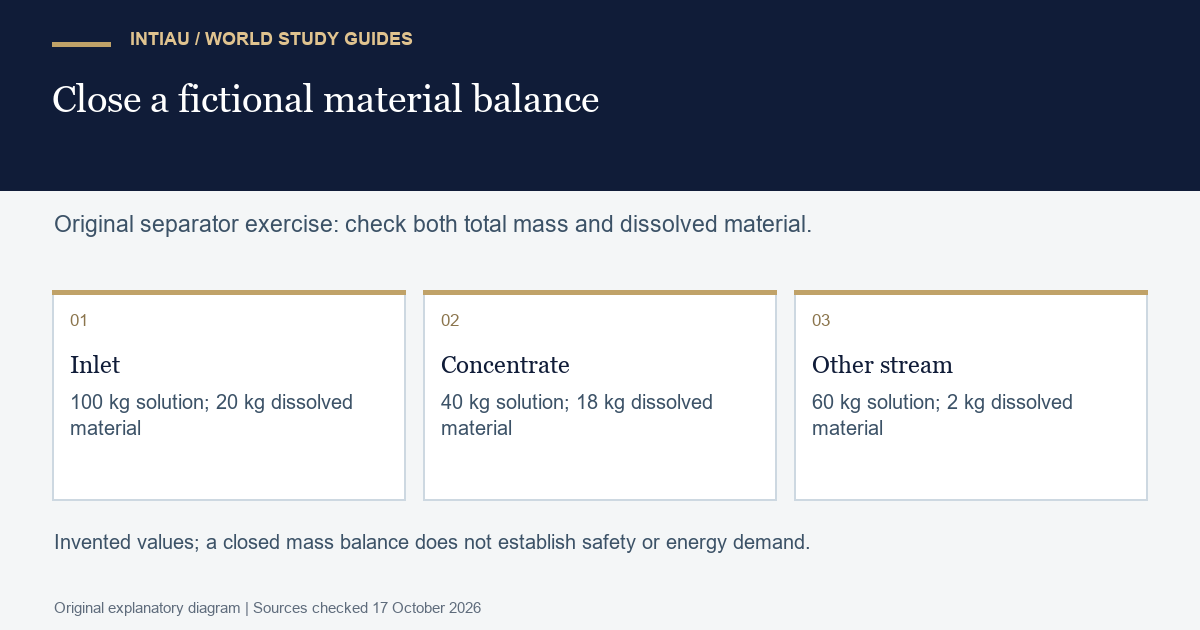
Imagine a completely fictional separator receiving 100 kilograms of solution containing 20 kilograms of dissolved material. It produces a concentrated stream of 40 kilograms containing 18 kilograms of that material. Assume no reaction, accumulation or unrecorded loss. Calculate the other stream’s mass and composition, then state what this calculation cannot establish.
The other stream weighs 100 − 40 = 60 kilograms. Its dissolved material is 20 − 18 = 2 kilograms, so its mass fraction is 2 ÷ 60 = 0.0333, approximately 3.33%. The concentrate’s fraction is 18 ÷ 40 = 45%. Both component and total balances close. A tempting wrong answer divides the remaining 2 kilograms by the original 100; that uses the wrong stream denominator. These balances alone establish neither energy demand nor product safety. Your output should be two labelled streams, the assumptions, and one additional measurement you would request. This original exercise is not a POSTECH assessment.
Questions to settle before choosing the major
Is international entry directly into Chemical Engineering?
No. The published route begins in Mueunjae with major selection after three semesters.
Does the capstone appear twice because it must be repeated?
No. The table lists both semesters but says to take it once.
Does the worked balance prove the process is viable?
No. It checks the stated fictional mass assumptions; costs, energy and safety need other evidence.
For broader study exploration, visit INTIAU Courses. Use INTIAU Contact for questions about INTIAU’s own information.
Related guides
View the study diagram