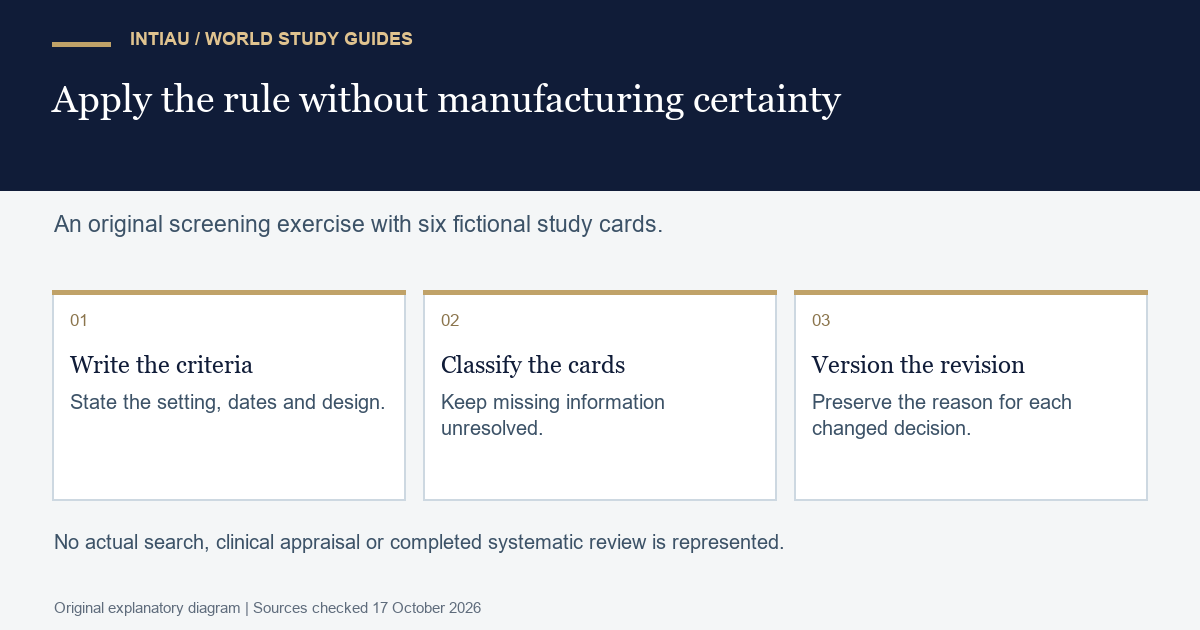
This self-study workshop applies a written eligibility rule to six invented study cards. The aim is to make inclusion, exclusion and unresolved decisions reproducible before anyone knows whether the reported result looks favourable. No actual review search, real study appraisal or participant data is involved.
The Cochrane eligibility chapter calls for prespecified, justified criteria. It distinguishes whether an outcome was measured from whether results were reported; missing reported results alone should not routinely decide eligibility.
Write the fictional rule precisely
Our imaginary evidence map concerns computer simulations comparing two recycling-bin layouts in indoor corridors. The model’s outcome of interest is contamination mass fraction. The exercise includes comparative simulation studies dated 2019 through 2025, inclusive. It excludes outdoor-only models and opinion pieces without a comparative simulation.
The measured-outcome requirement is stipulated for this teaching map, not offered as a universal rule for clinical reviews. When a card does not say whether the outcome was measured, record unresolved and name the missing information. Do not convert silence into a confident exclusion.
| Card | Supplied description | Decision and reason |
|---|---|---|
| A | 2021 indoor comparison; contamination fraction measured | Include |
| B | 2018 indoor comparison; outcome measured | Exclude: outside date range |
| C | 2024 outdoor-only comparison; outcome measured | Exclude: setting |
| D | 2022 opinion essay; no simulation | Exclude: design |
| E | 2025 indoor comparison; outcome measured, result omitted | Include; result availability unresolved |
| F | 2023 indoor comparison; measured outcomes unspecified | Unresolved: seek measurement information |
The date interval includes both boundary years. A 2019 card would not be excluded merely because it is the earliest eligible year; a 2025 card is not beyond the range. Write inclusivity explicitly so two screeners do not apply different endpoint rules.
Explain the complete worked answer
A meets every stated condition. B fails the date condition even though its design and setting fit. C fails the setting condition. D fails the design condition. These decisions use the written rule, not the apparent quality or attractiveness of a finding.
E is especially important. Its card says the required outcome was measured. The missing numeric result affects what can be extracted or synthesised, but does not undo the supplied eligibility information. Keep an included-study decision separate from an extraction-status field.
F remains unresolved because a required characteristic is not supplied. A useful follow-up question is whether contamination mass fraction was measured in that simulation. “Send more details” is less precise: it does not identify what would change the decision.
The final count is two included cards, three excluded cards and one unresolved card. These total six. Reporting only two included and three excluded would silently lose F; forcing F into an excluded category would manufacture certainty that the card does not support.
Make disagreements informative
Imagine one reader includes E and another excludes it because the result is absent. Compare their stated reasons with the protocol. The conflict concerns eligibility versus result availability, not whether the readers calculated the same number. Resolving the definition is more useful than voting on a label.
Now add a second invented report that explicitly describes the same simulated study as A. Do not count it as a second independent study. Link it to A in the exercise record and note what additional information it supplies. Record identity and study eligibility are separate bookkeeping decisions in this fictional map.
For a revision exercise, broaden the setting to include outdoor corridors. State the reason, give the rule a new version and rescreen every affected card. C changes to include under the revised setting condition; B and D still fail their own conditions. A transparent revision retains the old decisions instead of rewriting history.
Prepare a decision log with card identifier, protocol version, each criterion, final status, reason and outstanding question. The log should allow someone else to reproduce the result from the supplied cards. It should not imply that the fictional screening has appraised bias, established effectiveness or completed a systematic review.
Questions and completion criteria
Submit the rule, all six decisions, the count check and the revised-setting comparison. Success means consistent application and explicit uncertainty, rather than the largest possible included set.
Is an unreported result the same as an unmeasured outcome?
No. The cited guidance distinguishes those situations.
Why does E remain included in the fictional map?
Its card confirms measurement and meets the other stipulated criteria.
How is F classified?
Unresolved until the missing measurement information is supplied.
This is an original INTIAU editorial self-study activity; no qualification is awarded. See Courses or Contact for institutional information.
Related guides
View the study diagram