Banaras Hindu University lists Bachelor of Science (Honours) in Agriculture as a four-year, eight-semester programme. This guide concerns that university’s award in India and does not imply an INTIAU programme, admission role or partnership.
Identify the award and the applicant route
BHU’s 2026 undergraduate information bulletin names B.Sc. honours Agriculture in its programme information. That current identity should be kept separate from the spelling and arrangements in older downloadable syllabuses. This guide uses the indexed official bulletin for programme identification; its full PDF was unavailable during the direct retrieval, so no detailed score combination or seat allocation is inferred from unseen pages.
The international-applicant guide gives a 31 May 2026 deadline for its 2026-27 application route. That date is past on 17 October 2026; it does not establish domestic CUET or 2027 dates. Follow the instructions for your applicant category. Read the international route.
An effective comparison begins with a precise question: do you want broad agricultural science, a particular crop discipline, or a different food-related award? Put the official degree name at the top of your notes. Do not use a postgraduate specialisation list as if every first-year undergraduate enters directly into one of those specialisations.
Use the older syllabus as a labelled learning example
The published semester syllabus provides detailed teaching content but its older file is not established here as the complete 2026 cohort plan. It moves from Principles of Agronomy to later breeding, biotechnology and field-related study. The table selects actual entries and preserves their place in that document.
| Published stage | Selected actual entry | Document scope |
|---|---|---|
| Semester I | Principles of Agronomy; Statistics and Applied Mathematics | Foundation subjects |
| Semesters III–V | Principles of Plant Breeding; Breeding of Field Crops; Introductory Plant Biotechnology | Selected later subjects |
| Semester VIII | Rural Agricultural Work Experience | Older syllabus placement, not a new-cohort promise |
Principles of Agronomy links crop production with soil preparation, sowing, water and nutrients. Its practical work includes identifying crops and inputs, planning rotations, and calculating fertiliser requirements. Read the full published outline.
See the subject as a connected system
BHU’s academic-programmes information places agricultural study among disciplines including agronomy, genetics and plant breeding, horticulture, plant pathology, plant physiology, soil science and agricultural chemistry. That breadth explains why choosing Agriculture is different from choosing only a laboratory topic or only farm management. The page is a broad programme reference, not a semester-by-semester teaching guarantee.
For your reading exercise, connect one proposed crop decision with three kinds of evidence: the physical site, the biological material and the method used to assess a result. Ask what was measured, over what area, and with which comparison. This creates a useful bridge between a course title and the reasoning you would need to practise, without pretending that a short guide replaces university instruction.
Original practice: output and yield
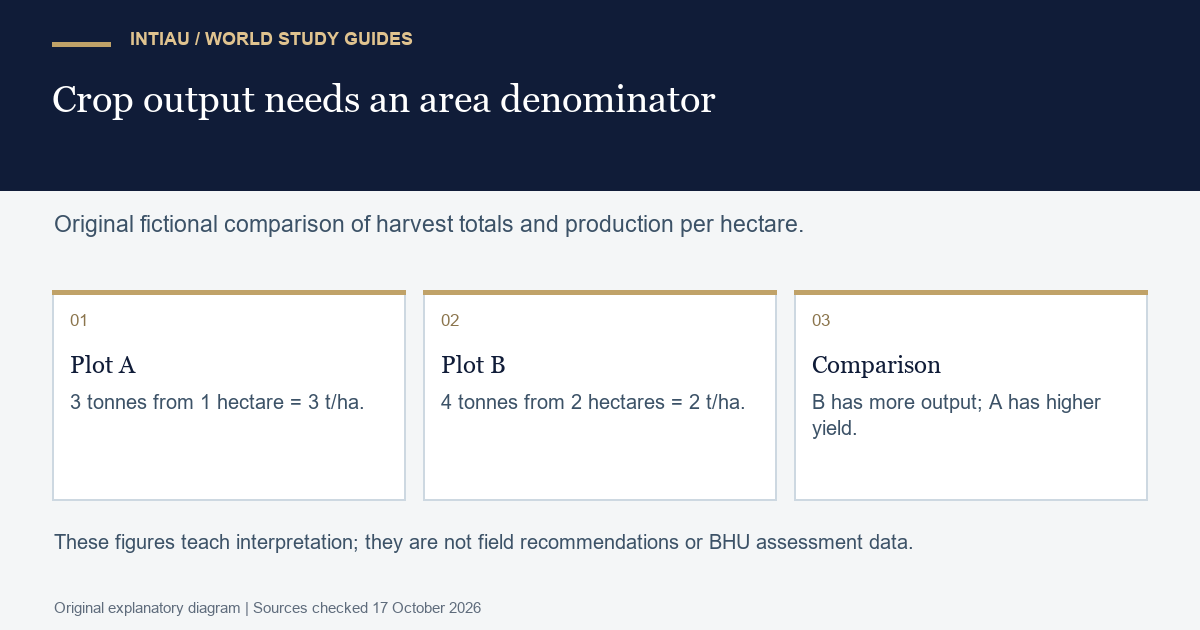
Consider two fictional plots. Plot A produces three tonnes on one hectare. Plot B produces four tonnes on two hectares. B has the greater total output, but A yields three tonnes per hectare while B yields two. The ranking changes because the question changes.
Now suppose a note reports only “B produced one tonne more.” Add the missing areas and rewrite it as two accurate statements: B produced more in total; A produced more per hectare. Neither statement proves that a seed, fertiliser or farming method caused the difference. Weather, soil and other conditions have not been controlled. Your worked answer should retain the units and explain that limitation. This fictional calculation is preparation for careful comparison, not an agronomic recommendation or an official BHU exercise.
Questions to settle
Is this the four-year Agriculture award?
Yes. The reviewed international programme listing gives four years and eight semesters.
Is the older syllabus a verified current timetable?
No. It is a labelled source of selected real teaching examples.
Does the May deadline apply to every applicant?
No. The cited date belongs to the 2026-27 international process and is already past.
Official reading
- International applicant guide (2026-27)
- Agriculture syllabus (older published file)
- UG information bulletin (2026)
- Academic programmes (undated)
For other study topics, browse INTIAU Courses; use Contact for questions about INTIAU services. University applications belong with the institution named above.
Related guides
View the study diagram