Tecnológico de Monterrey’s IBT26 catalogue describes Ingeniería en Biotecnología in Mexico. This independent guide concerns that institution’s engineering programme, not an INTIAU award or partnership. The catalogue expects upper-secondary education or equivalent and an interest in applying biology, chemistry, physics and mathematics to biological systems.
Follow the published sequence, then confirm your campus
| Published stage | Selected real courses, translated |
|---|---|
| Semesters 1–2 | Biology and Sustainability; Chemistry; Statistics |
| Semesters 3–4 | Material and Energy Balance; Molecular Biology and Genetic Engineering |
| Semesters 5–6 | Transport Phenomena in Bioprocesses; Biorreactores; Bioseparations |
| Semesters 7–8 | Professional options; Biotechnology Innovation Project |
The English route is campus- and capacity-dependent. Its additional Bachelor constancia accompanies the Spanish professional title and transcript; it is not a second degree. The programme page warns that its course listing can change. Check the programme sequence and language conditions.
Use the sequence to distinguish three interests: understanding a biological mechanism, turning it into a technically workable process and judging a proposed product. Someone who enjoys only one of those activities should investigate how the other two appear in the actual programme. A laboratory preference and an engineering-process preference can overlap, but they are not identical reasons for choosing a degree.
What the verified learning outcomes establish
The IBT26 learning outcomes explicitly combine molecular tools with bioethical criteria, engineering solutions to chemical and biological problems, technically efficient and sustainable process design, and management of biotechnology innovation. These are programme-level outcomes. A separate current Biorreactores module outline was not publicly verified, so this guide does not invent its weekly topics, assessment or laboratory procedures. Read the actual catalogue outcomes.
A useful comparison notebook can turn those outcomes into questions without pretending to supply the missing syllabus. What evidence would show that a process is efficient? Which constraints would remain even if its biological component worked? How would a project justify a design choice to someone concerned with cost, resources or ethical use? Ask for an actual assignment or module guide when assessing those questions, rather than assuming a course title answers them.
Admission includes a profile and tests
The professional admission page distinguishes applicant routes and requires an application record, essay and experience résumé, plus the applicable tests and documents. The Prueba de Aptitud Académica evaluates mathematical and verbal skills. First-language English applicants may use SAT or ACT under the stated conditions. An English placement requirement is separate from that admission test. Current information includes August 2027 entry, but campus, programme and route affect the applicable process; no universal IBT deadline is asserted here. Use the professional admission instructions.
For the experience record, select examples you can substantiate. Describe your contribution, the decision you made and what the result taught you. An activity’s impressive name is less informative than a precise explanation of your own work. Check the language route at the same time as campus availability: do not wait until after choosing a location to discover that your intended delivery option differs.
Original exercise: calculate two kinds of performance
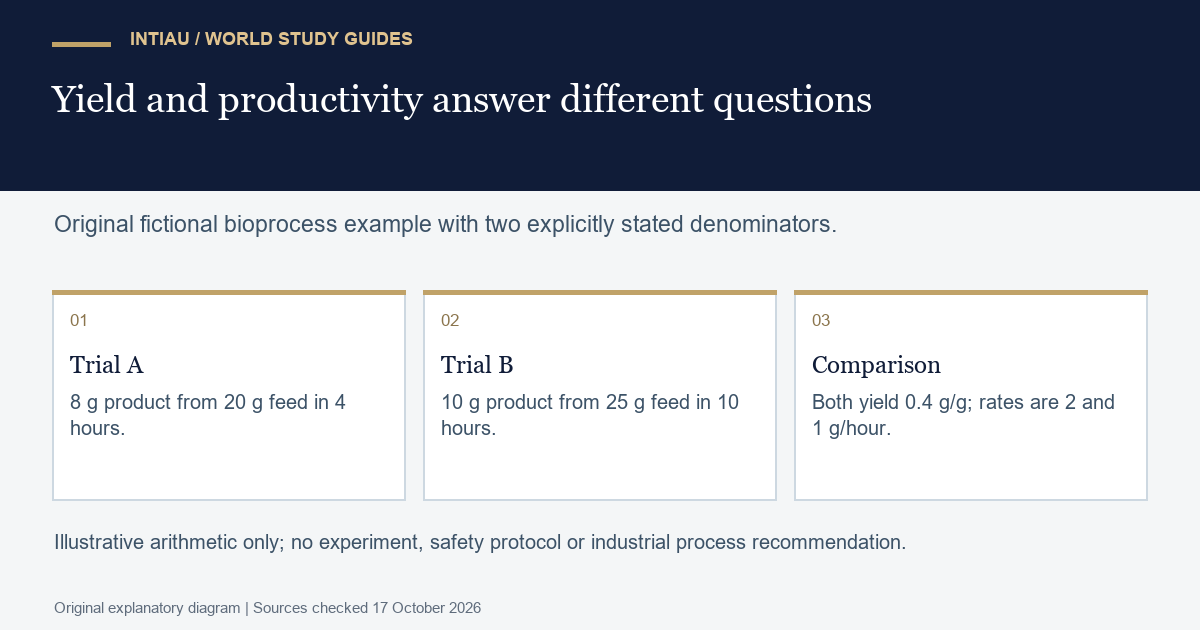
Imagine two fictional trials. A produces 8 grams of product from 20 grams of feed in four hours. B produces 10 grams from 25 grams of feed in ten hours. Product per feed is 8/20 and 10/25, so both yield 0.4 grams per gram. Product per hour is different: A gives 2 grams per hour, while B gives 1.
The statement “B produces more product” is true for the batch total but incomplete as a performance comparison. Write separate sentences about batch amount, feed yield and hourly rate. Then identify a missing condition, such as vessel size, before making a wider productivity comparison. Do not infer purity, safety or commercial viability from these three calculations. This original arithmetic exercise illustrates careful denominators; it is not an actual bioprocess protocol or Tec assessment.
Questions to settle
Is the English-route constancia a second degree?
No. The programme describes an additional certificate accompanying its Spanish professional award.
Was a complete Biorreactores syllabus verified?
No. Only the named course and the separately identified programme outcomes were verified.
Is an English placement test the admission aptitude test?
No. The admission page treats those requirements separately.
Official reading
- IBT26 catalogue (2026 plan identifier)
- Programme and course sequence (published listing)
- Professional admission process (current 2027 information)
For other study topics, browse INTIAU Courses; use Contact for questions about INTIAU services. University applications belong with the institution named above.
Related guides
View the study diagram