Universidad Autónoma Metropolitana offers Hidrobiología at Unidad Iztapalapa, Mexico. This independent programme guide describes that university’s route, not an INTIAU award or partnership. Its published structure connects biological foundations, professional aquatic science, optional orientation and research integration.
Use the revised total and the correct teaching period
The official s547 plan names the award Hidrobiólogo or Hidrobióloga, specifies 12 trimesters and requires at least 511 credits. It also requires social service. These are trimesters, not 12 semesters. The revised document should take precedence over older linked plans carrying a different credit total. Read the revised full plan.
| Selected stage | Actual examples, translated |
|---|---|
| I–III | General Biology; General Chemistry; Experimental Scientific Method; Cell Biology |
| IV–VII | Genetics; Molecular Biology; Biometry; Limnology |
| VIII–X | Oceanography; Estuarine Systems; Aquatic Pollution; Aquatic Systems Management |
| X–XII | Research Projects I–III and selected orientation units |
The departmental description explains the purpose of these levels: common biological and chemical foundations, mathematical and biological processes, evaluation of aquatic environments and organisms, chosen orientation subjects, and a research project that integrates earlier learning.
Read a progression table as a chain of capabilities. Identifying an organism, analysing a dataset and evaluating a management proposal are different tasks. When comparing this route with a general biology degree, ask where each task is introduced, practised and brought together. Do not compare national credit numbers as though a unit always represents the same workload in every system.
A named course connects science with management
The official indexed outline for Manejo de Sistemas Acuáticos, code 2351090, identifies a compulsory nine-credit unit in trimester X. Its themes include Mexican wetlands, the interaction of human and aquatic processes, cumulative effects and preparation of a management plan. The PDF’s rendered pages were unavailable during this review; these are indexed outline details, not a claim that a complete current weekly syllabus was inspected. Consult the named course document.
That theme makes a useful distinction for a prospective student. A management proposal needs both an account of the system and a reason for choosing an intervention. A list of species is valuable evidence, but does not by itself explain which action is feasible, who bears a cost or how an outcome will be monitored. Prepare questions that connect the scientific observation with the decision it is intended to inform.
A current calendar can contain a past registration window
On 17 October 2026 the admission site describes a third, extraordinary 2026 selection process for Winter 2027 entry. Registration ran from 5 to 11 October and is therefore past. Selection examinations are scheduled between 29 October and 15 November. The site requires completed upper-secondary study before the requested term and a minimum average of 7.0. Applicants must check the actual call’s programme availability and conditions; the calendar alone does not establish an available Hydrobiology place.
Keep registration, sitting the examination and admission separate in your planning. A future examination date does not reopen a completed registration period. For an international school record, use the university’s applicable instructions rather than assuming that the domestic certificate format or an informal translation will satisfy document requirements.
Original exercise: keep unlike outcomes visible
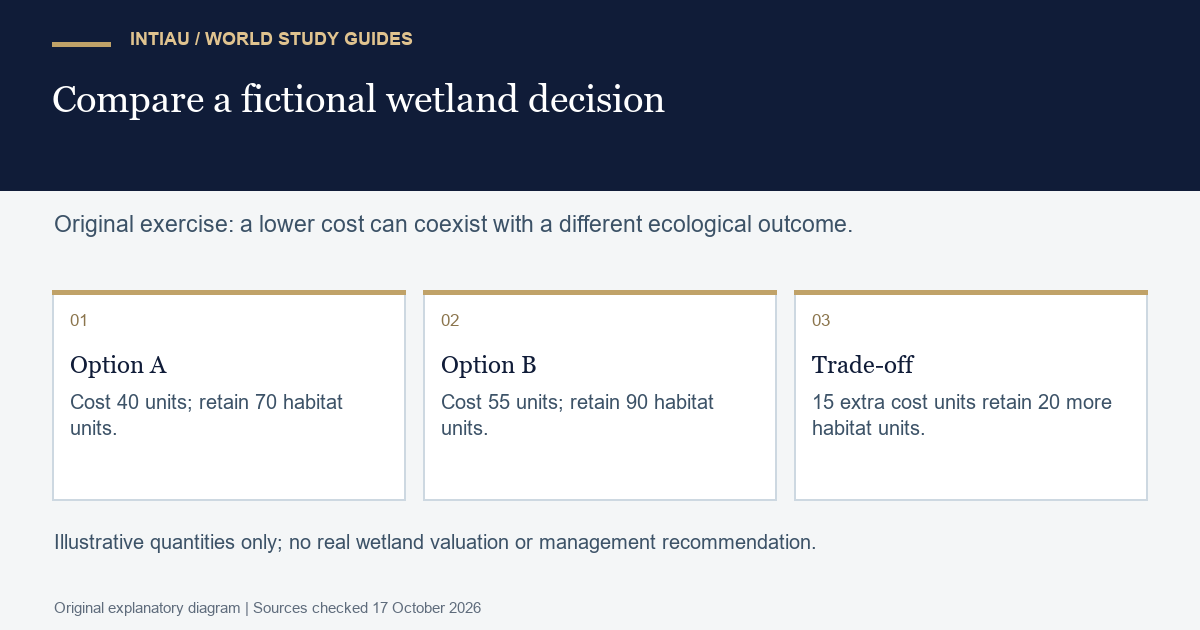
Imagine two fictional wetland options. Option A costs 40 planning units and retains 70 habitat units. Option B costs 55 and retains 90. Moving from A to B costs 15 extra units and retains 20 more habitat units. You can state that trade-off clearly without pretending that a cost unit and a habitat unit are the same quantity.
Now add a constraint: the available budget is 50. B no longer fits that constraint, although it retains more habitat. Explain whether your next step is to redesign B, seek a different budget or compare other options. Do not announce A as universally “best”: it is feasible under this invented budget, while the wider decision remains unspecified. This original exercise illustrates transparent reasoning; it is not an actual wetland appraisal or UAM assessment.
Questions to settle
Does this guide use an older credit total?
No. The revised s547 plan requires at least 511 credits.
Is optional orientation the same as the common core?
No. The programme description distinguishes chosen orientation subjects from its common foundations.
Can a later examination date mean registration is open?
No. The third-process registration dates ended on 11 October 2026.
Official reading
- Programme structure (published description)
- Revised study plan (s547; published plan)
- Aquatic-systems outline (posted course document)
- Admission calendar (third process 2026)
For other study topics, browse INTIAU Courses; use Contact for questions about INTIAU services. University applications belong with the institution named above.
Related guides
View the study diagram