Université libre de Bruxelles is separate from INTIAU. Its 2026–2027 political science bachelor is a three-year daytime programme at Solbosch, with French identified as its teaching language.
Follow the published progression
The department’s bachelor page, updated in December 2025, specifies 180 credits and identifies monolingual and multilingual routes.
| Block | Examples |
|---|---|
| 1 | Introduction au droit; Politique mondiale. |
| 2 | Droit public; Eléments de statistique. |
| 3 | Global Public Policy; Analyse quantitative. |
The table deliberately gives a small route map rather than assigning every political subfield to a particular semester. When comparing a political science degree, ask whether you want to explain institutions, evaluate arguments or investigate behaviour with data. A course title may be relevant to more than one of those aims. Build your comparison around the kind of evidence you would enjoy working with, then check the actual course record for the required method.
A multilingual route also raises a practical preparation question: can you discuss a difficult reading precisely in the language used for the class? Try summarising an argument without replacing its central terms with vague synonyms. Then identify which sentence supplies evidence and which sentence expresses a conclusion. This is a more revealing preparation task than simply counting how many foreign-language course titles appear in a catalogue.
Inside a real introductory course
The 2026–2027 POLI-D101 Introduction à la science politique record describes five ECTS, taught in French. Topics include political power and the state, political regimes, electoral systems, parties, ideologies and participation. The aim includes using appropriate methods to interpret political questions. Its published assessment is a written essay-style examination with four questions, three about the course and one about a separately read book.
That outline suggests a useful way to inspect your own interest in the subject. Choose a short political claim and break it into a concept, a comparison and a proposed explanation. Keep these distinctions visible in every comparison that follows. If the concept is “participation”, define whether you mean voting, membership or another activity. If you compare two places, state the period and the population. An explanation should then identify what evidence would distinguish it from a plausible alternative.
Keep equivalence and university admission separate
ULB’s foreign-diploma equivalence guidance says first-cycle applicants with foreign secondary credentials generally need an equivalence decision, with specified exceptions including European School and International Baccalaureate credentials. The competent decision-maker is the Fédération Wallonie-Bruxelles equivalence service. ULB says an admission request can be submitted before the equivalence is received, while the required decision must subsequently be supplied.
The registration page for 2026–2027 separates preparing the file, submitting the application and finalising registration. Its displayed 30 September deadline for European-nationality applications is already past on 17 October 2026. It now links to a late-registration procedure between 1 October and 15 February; eligibility for that procedure must be checked separately. This is not a verified 2027 application calendar.
An original electoral reading exercise
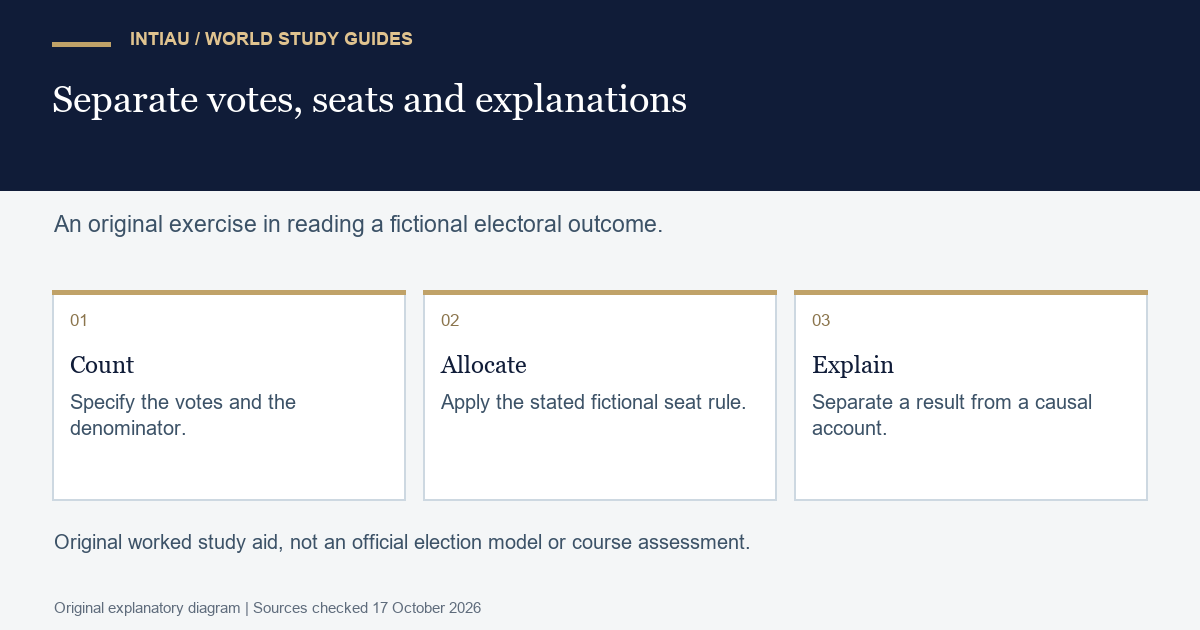
Suppose a fictional district has 1,000 valid votes: A receives 460, B 340 and C 200. Under a deliberately simplified rule awarding one seat to the largest vote total, A obtains the seat with 46% of valid votes. The result does not establish that a majority supported A, because 46% is below 50%.
Now add 200 registered people who did not cast a valid vote. A’s votes represent 460 of 1,200 registered people, or about 38.3%. Neither denominator alone explains why people voted as they did. A good answer distinguishes the seat winner, the proportion among valid votes and the proportion among registered people. To explain motivation, you would need a different kind of evidence. This exercise is invented for prospective students and does not describe a real election or a university assignment.
Questions about the bachelor
Where is the programme taught?
The catalogue identifies Solbosch campus.
Is the selected introductory course only a list of institutions?
No. Its outline also covers electoral behaviour, ideologies, participation and methodological interpretation.
Does ULB itself decide foreign secondary equivalence?
The guidance identifies the Fédération Wallonie-Bruxelles equivalence service as the competent body.
Browse INTIAU Courses to compare subject interests, or use Contact for INTIAU information-service enquiries.
Related guides
View the study diagram