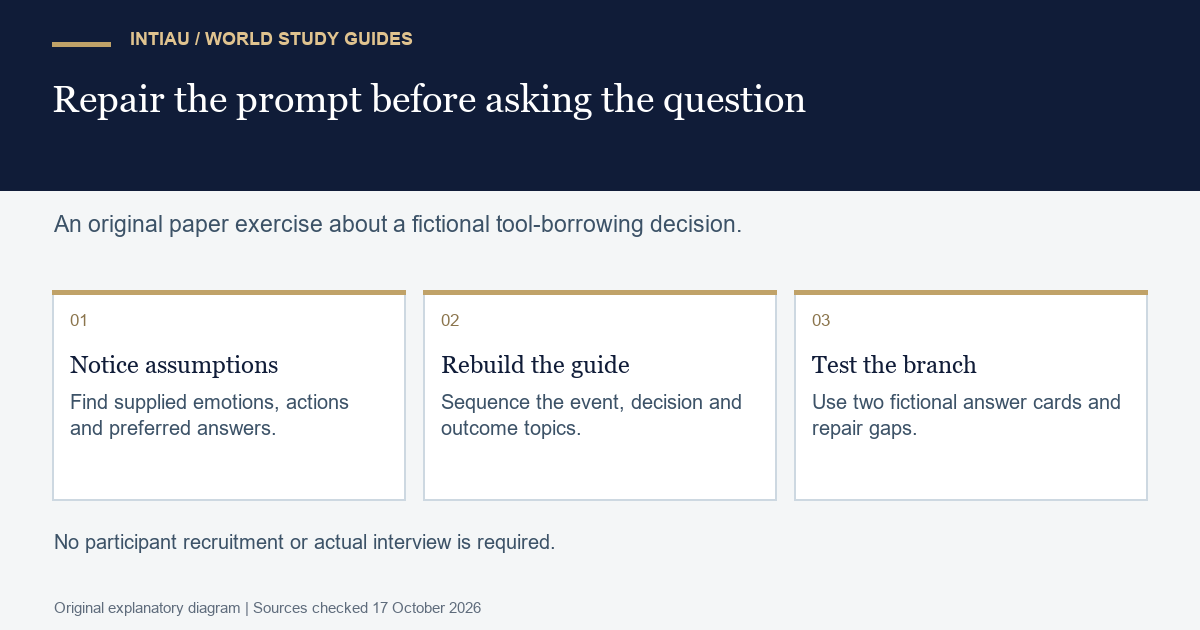
This self-study workshop turns five biased interview prompts into a usable discussion guide. You will practise asking about a sequence of events without supplying the explanation you expect to hear. The finished output is a short guide with starter questions, optional probes and a paper audit of its assumptions.
Use a method reference, then work on paper
The GOV.UK guide to in-depth interviews recommends organising topics around research questions, preparing starters and follow-ups, and using open, neutral questions about specific experiences. It treats a discussion guide as support for a conversation rather than a rigid script.
Here, you will not interview anyone. The fictional service is a lending cupboard for model-making tools. The research question is: “How does a borrower decide what to do when the item label and the cupboard list differ?” Your task is to prepare questions that could reveal the sequence, information used and unresolved decisions. You are not trying to establish whether a particular interface is popular.
Diagnose the draft prompts
The table contains original fictional prompts. For each row, circle the words that narrow the answer prematurely. Then write the least assumptive opening that still addresses the research question. Do this before reading the worked replacements.
| Draft prompt | Problem to repair | Worked replacement |
|---|---|---|
| Why was the confusing list so frustrating? | Supplies confusion and frustration | Tell me about the last time the list and an item label differed. |
| Did you ask the helpful assistant? | Suggests an action and evaluates a person | What did you do next? |
| Would an app solve this? | Moves from an event to an imagined solution | What information were you looking for at that point? |
| Was the list wrong or the label wrong? | Restricts possible explanations to two | How did you decide which information to use? |
| Everyone checks the return date, right? | Signals a preferred answer | What, if anything, did you check before borrowing? |
Build the complete guide
Write a one-sentence introduction that states the topic without naming a preferred solution. A suitable practice version is: “This discussion concerns how a tool-borrowing decision unfolds when two pieces of information differ.” It explains the subject without describing the service as broken or promising a redesign.
Use three topics in order. First establish the event: “What were you trying to borrow?” Follow with “What did you notice on the item and the list?” Next explore the decision: “What did you do next?” and “What information helped you choose that action?” Finally explore the outcome: “What happened after that?” and “Was anything still unresolved?” These are the complete starter sequence for this exercise.
Add optional probes beneath the relevant starter: “Which part are you referring to?”, “What happened immediately before that?” and “Can you give an example from that occasion?” A probe should clarify an answer already offered. Do not automatically ask every probe; a fictional answer that already supplies the sequence needs no repeated request for the same detail.
Test the guide against two fictional answers
Answer card A says: “I borrowed the ruler because both labels matched.” The first draft assumes a mismatch happened. Add a screening branch: “Have you encountered a difference between the list and a label? If not, describe how you normally check the information.” Record that the main event was absent rather than inventing a contradictory memory.
Answer card B says: “I checked the printed list, asked a colleague, and left without borrowing.” A useful follow-up is “What led you to leave without borrowing?” A poor follow-up is “So the colleague could not help?” The card does not establish that. It also does not tell you whether the list, colleague or another constraint determined the decision.
The worked answer therefore contains an event branch, three ordered topics and clarification probes. It does not contain an app preference question. If solution preferences are a separate research aim, they need their own justified activity; adding one at the end does not make it evidence of the earlier event.
Score the output and keep a revision trail
Award one point for each of five checks: no supplied emotion; no praised or blamed actor; no forced either-or answer; a route for “this did not happen”; and a probe attached to an actual answer. A guide scoring four can be repaired by naming the missing check and replacing the exact offending prompt. Keep the old and new wording so the improvement is observable.
Is every yes-or-no question leading?
No. In this exercise, a short screening question establishes whether the event occurred. The problem is a question that supplies an expected evaluation or excludes relevant answers.
Must the guide include every possible follow-up?
No. The worked guide provides a small set of optional probes. Its test is whether the sequence can be clarified without repeatedly asking for information already supplied.
Should I recruit someone to complete this workshop?
No. Use the two fictional answer cards and inspect the wording on paper. Real interviewing, permissions and data handling are outside this activity.
This is original INTIAU editorial self-study practice; no qualification is awarded. Browse Courses for general study navigation or use Contact for an editorial enquiry.
Related guides
View the study diagram