The University of Cambridge is separate from INTIAU; this guide describes Cambridge programmes, not INTIAU programmes or a partnership.
Checked 17 October 2026. Admissions information is for 2027 entry. Curriculum descriptions reflect the official material available at the check date and should be checked again for your teaching year.
Cambridge’s course is named Computer Science, BA (Hons) and MEng. The three-year route leads to a BA honours degree; the optional fourth year leads to the MEng as well as the BA. The award’s name should be distinguished from the academic content: this is a computing course covering theory and practical systems. Consult the official course page.
Read the four parts as a progression
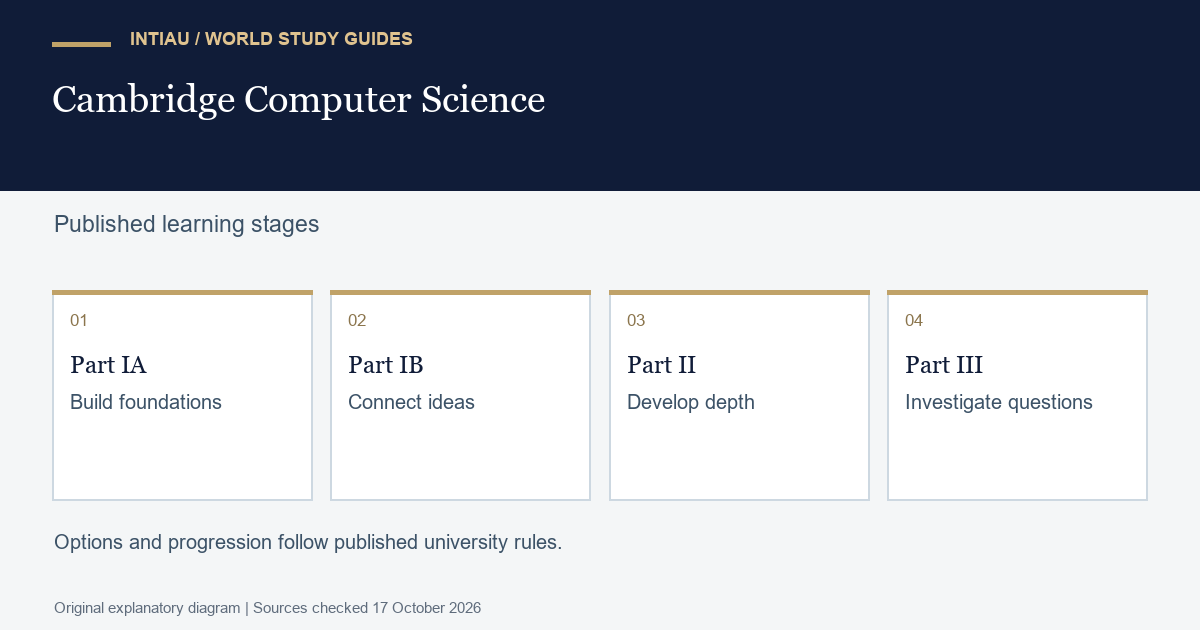
Cambridge calls its years Part IA, Part IB, Part II and Part III. Its departmental course overview links to the papers and modules within each part. The early years establish breadth before later options and substantial projects. Progression into the fourth year depends on achieving a sufficiently high standard in the third year; it is not an unconditional extra year.
| Part | Learning emphasis | Practical development |
|---|---|---|
| IA | Computing and mathematical foundations. | Programming and hardware exercises. |
| IB | Further theory, systems and applications. | Regular practical work and a group project. |
| II | Options in areas of personal interest. | A substantial individual project. |
| III | Advanced optional modules. | A more research-oriented project. |
This is a reading map, not a semester timetable. When opening a paper description, separate its learning goals, prerequisites and assessment. A topic name alone will not tell you whether the work involves mathematical argument, implementation, experimentation or a combination. For your shortlist, record one example of each kind of work that you would like to learn to do.
Check the academic requirements before the test timetable
For 2027 entry, Cambridge lists a minimum A-level offer of A*A*A, or IB 41–42 with 776 at Higher Level. Mathematics is required. Applicants should take Further Mathematics to AS or A level if their school offers it; those unable to do so should contact shortlisted colleges. College requirements can differ, so the course requirements must be read alongside college advice.
For this entry cycle, Computer Science applicants must register for the TMUA. Applicants to Peterhouse or Trinity also need the CSAT. These are distinct requirements; completing a UCAS application does not itself register you for an admissions test. Cambridge’s admission-tests guidance identifies the relevant assessment and college-specific addition.
The 2027 application timeline gives the main UCAS deadline as 15 October 2026 at 6pm UK time and My Cambridge Application as 22 October at 6pm. The main UCAS deadline has already passed at this guide’s check date. The later additional-form date does not extend it. Applicants considering a special application route should check its eligibility directly; later entry cycles need their own published dates.
Prepare evidence of how you think
For an independent preparation exercise, choose a small problem with more than one possible solution. Write down an approach, explain why it should work, test it on awkward inputs and compare it with an alternative. For example, a simple search task can become a discussion of correctness, representation and efficiency. Keep the explanation intelligible to someone who has not seen your code.
Use this exercise to identify gaps rather than to manufacture an admissions portfolio. If you cannot explain a result without naming a library, revisit the underlying idea. If you enjoy the proof but struggle with implementation, practise turning an argument into a working procedure. Conversely, working code can be the starting point for asking which assumptions make it reliable. This is a course-comparison exercise, not a Cambridge assessment prescription or a promise of admission.
Frequently asked questions
Does the three-year course award a BSc?
No. Cambridge names the award BA (Hons). The optional fourth-year route adds the MEng.
Is progression to the MEng year automatic?
No. The department says it depends on a sufficiently high standard in the third year.
Does every applicant need CSAT as well as TMUA?
The published additional CSAT requirement applies to applicants to Peterhouse or Trinity; TMUA applies to Computer Science applicants generally.
For INTIAU’s own educational information, visit Courses. Questions about INTIAU’s own services can use Contact; Cambridge controls its application process.
Compare the programme structure with the Oxford Computer Science guide and the Edinburgh Artificial Intelligence and Computer Science guide, then use the curriculum-comparison workshop to distinguish compulsory study, options and application requirements.
View the curriculum diagram