
The University of Edinburgh is separate from INTIAU; this guide describes an Edinburgh programme, not an INTIAU programme or a partnership.
Checked 17 October 2026. Application information concerns 2027 entry. The detailed curriculum example uses Edinburgh’s published 2026–27 degree regulations and course catalogue; it is not a promise of an unchanged future syllabus.
The degree is Artificial Intelligence and Computer Science BSc (Hons), a four-year programme with UCAS code GG47. The combination joins the study of intelligent behaviour with the design and understanding of computing systems. The official programme page is the starting point for comparing its scope with single-subject AI or Computer Science.
Read the degree programme table before choosing options
The 2026–27 degree programme table separates compulsory courses from option groups and gives progression conditions. It also warns that third-year choices can be prerequisites for fourth-year study. This means an appealing advanced topic should be traced back through the earlier preparation it requires, rather than considered as an isolated final-year choice.
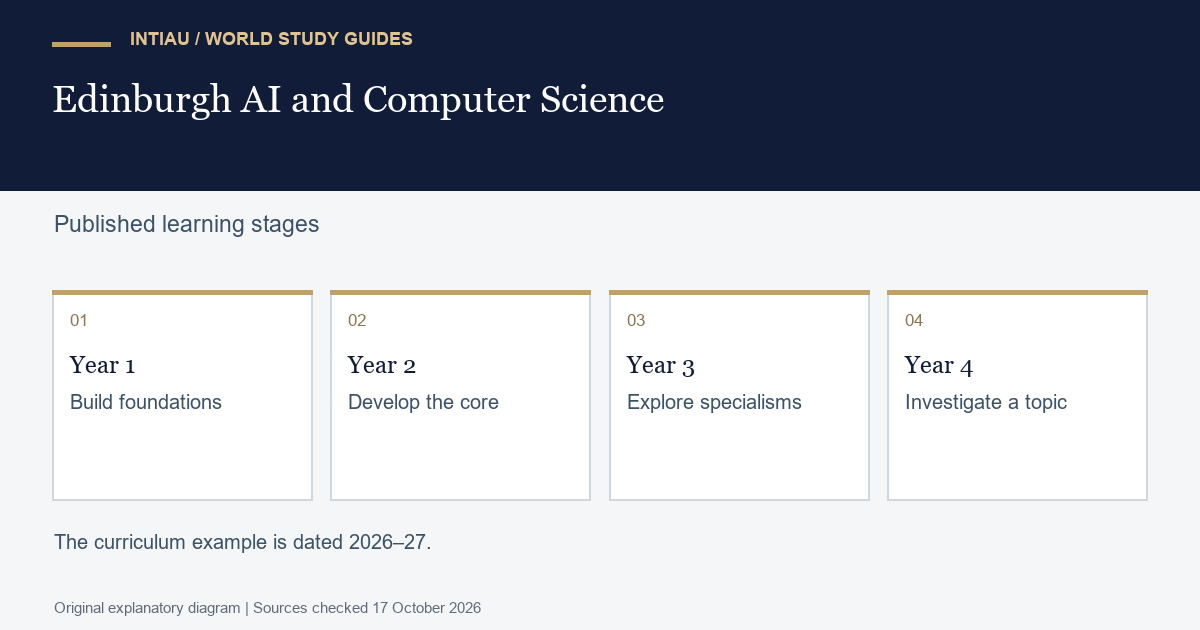
| Year | Published emphasis | Planning point |
|---|---|---|
| 1 | Computing foundations, professional practice and mathematics. | Check required preparatory courses and progression rules. |
| 2 | Data, algorithms, systems, software and reasoning. | Build the shared technical core. |
| 3 | Further required work and specialist options. | Plan later prerequisites alongside practical projects. |
| 4 | Advanced AI and computing choices plus an honours project. | Check the permitted option-group combination. |
Use the table as a map for reading official requirements. It does not assign new modules to semesters or turn all listed options into compulsory study. When comparing two degrees, keep separate columns for what every student must complete and what a student may choose. That small distinction can change your view of how much room there is for a particular interest.
Why foundations remain important in an AI degree
The current Foundations of Computing course description connects logic, computational models, architecture and programming concepts. Its purpose is to help students reason about computation and the practical limits of systems. This provides context for the degree’s mathematical foundation: using an AI system and understanding what a computing system can represent or execute are different learning tasks.
For your own comparison exercise, consider a small classifier or search problem. Ask how the input is represented, what counts as a good answer and which mistakes matter. Then ask how you would test a change without confusing a better result with a lucky example. These are prompts for investigating your interests, not claims about a specific Edinburgh assessment or a list of prerequisites for admission.
See the honours project as an investigation
The 2026–27 Honours Project description sets out individually supervised substantial work. It involves understanding background material, investigating a problem, making and evaluating design decisions, and communicating the result. A proposed specification requires approval. Reading that description helps distinguish a research-informed project from simply following a tutorial to reproduce a known application.
When exploring possible topics, write down the question before the tool you hope to use. A strong personal comparison can ask what evidence would change your conclusion and what limitations you would need to report. If you enjoy both building a system and explaining its behaviour, the project structure may be especially worth discussing with the programme team. Your interests can guide those questions without presuming that a particular supervisor or topic will be available.
2027 applications and qualification checks
The 2027 programme listing directs applicants through UCAS and gives a deadline of 13 January 2027 at 6pm GMT. It asks applicants to select the country and qualification to view the applicable entry requirements. It also says to apply to only one Computer Science degree. Do not turn a grade requirement for one qualification into an unofficial conversion for another.
Edinburgh’s selection guidance explains that meeting the requirements enters an applicant into selection; it does not guarantee an offer. The university considers the application’s academic and English-language qualifications, statement, reference and relevant additional information. Match your evidence to those instructions, and make sure the required subjects are covered before treating a predicted overall grade as sufficient.
Frequently asked questions
Must I already have studied programming at school?
The programme page says prior Computer Science or programming study is not required; mathematics preparation is important.
Does meeting the entry requirements guarantee an offer?
No. Edinburgh explicitly distinguishes entry to its selection process from receiving an offer.
Is the final project completed individually?
The current honours-project description specifies individual work with staff supervision and an approved project specification.
Use INTIAU Courses for its own educational information and Contact for INTIAU services. Edinburgh governs the programme described above.
Compare the subject combination with the Cambridge Computer Science guide and the NUS Computer Science guide. Use the curriculum-comparison workshop to record the exact programme, teaching year and difference between required and optional study.
View the curriculum diagram
Edinburgh Artificial Intelligence and Computer BSc: essential questions and answers
Edinburgh Artificial Intelligence and Computer BSc is the subject of this page, presented for international readers who need a clear, official route through the material. The University of Edinburgh is separate from INTIAU; this guide describes an Edinburgh programme, not an INTIAU programme or a partnership.. Application information concerns 2027 entry. The guidance below explains what the page records, how the process works in 2026, and how it connects to the wider services of Azad University International. Every statement is grounded in the published content of this website, so the original page remains the authoritative source.
What This Page Covers
This page about Edinburgh Artificial Intelligence and Computer BSc is organised so that a reader can orient quickly and then return to the original text for the controlling detail.
The page is organised around the following subjects: Read the degree programme table before choosing options; Why foundations remain important in an AI degree; See the honours project as an investigation; 2027 applications and qualification checks; Frequently asked questions.
Each section of the original page keeps its own place and wording; this summary exists so that visitors arriving from search can orient themselves before they read the full text. Where a step depends on a form, a portal or a member of staff, the route named on the original page is the route to follow.
For applicants comparing options, the practical value of this page is that it gathers the route, the responsible service and the expected preparation in one continuous explanation.
The Process in Plain Terms
The detailed curriculum example uses Edinburgh’s published 2026–27 degree regulations and course catalogue; it is not a promise of an unchanged future syllabus..
The degree is Artificial Intelligence and Computer Science BSc (Hons) , a four-year programme with UCAS code GG47.
The combination joins the study of intelligent behaviour with the design and understanding of computing systems.
The official programme page is the starting point for comparing its scope with single-subject AI or Computer Science..
Read the degree programme table before choosing options.
The 2026–27 degree programme table separates compulsory courses from option groups and gives progression conditions.
Read the original sections in order: the early paragraphs define the scope, the middle sections describe the procedure, and the closing notes state the limits, the prerequisites and the official points of contact. Nothing on this page replaces those instructions; it only makes them easier to navigate.
Context and Background
Check the permitted option-group combination. .
Use the table as a map for reading official requirements.
It does not assign new modules to semesters or turn all listed options into compulsory study.
When comparing two degrees, keep separate columns for what every student must complete and what a student may choose.
That small distinction can change your view of how much room there is for a particular interest..
Why foundations remain important in an AI degree.
The current Foundations of Computing course description connects logic, computational models, architecture and programming concepts.
Its purpose is to help students reason about computation and the practical limits of systems.
This provides context for the degree’s mathematical foundation: using an AI system and understanding what a computing system can represent or execute are different learning tasks..
For your own comparison exercise, consider a small classifier or search problem.
Ask how the input is represented, what counts as a good answer and which mistakes matter.
Then ask how you would test a change without confusing a better result with a lucky example.
These are prompts for investigating your interests, not claims about a specific Edinburgh assessment or a list of prerequisites for admission..
See the honours project as an investigation.
The 2026–27 Honours Project description sets out individually supervised substantial work.
It involves understanding background material, investigating a problem, making and evaluating design decisions, and communicating the result.
A proposed specification requires approval.
Reading that description helps distinguish a research-informed project from simply following a tutorial to reproduce a known application..
When exploring possible topics, write down the question before the tool you hope to use.
A strong personal comparison can ask what evidence would change your conclusion and what limitations you would need to report.
If you enjoy both building a system and explaining its behaviour, the project structure may be especially worth discussing with the programme team.
Your interests can guide those questions without presuming that a particular supervisor or topic will be available..
2027 applications and qualification checks.
The 2027 programme listing directs applicants through UCAS and gives a deadline of 13 January 2027 at 6pm GMT.
It asks applicants to select the country and qualification to view the applicable entry requirements.
It also says to apply to only one Computer Science degree.
Do not turn a grade requirement for one qualification into an unofficial conversion for another..
Edinburgh’s selection guidance explains that meeting the requirements enters an applicant into selection; it does not guarantee an offer.
The university considers the application’s academic and English-language qualifications, statement, reference and relevant additional information.
Match your evidence to those instructions, and make sure the required subjects are covered before treating a predicted overall grade as sufficient..
Must I already have studied programming at school?
The programme page says prior Computer Science or programming study is not required; mathematics preparation is important..
Visitors often ask whether the summary changes the underlying procedure; it does not.
The responsible unit reviews each enquiry against the published criteria only.
Deadlines and required documents are exactly those stated on the original page.
Where translation is needed, the original English wording remains controlling.
The service does not charge for reading the public guidance on this website.
Personal data should only enter the official channels named by the University.
A complete first submission avoids most follow-up correspondence later.
The published route is the same for applicants inside and outside Iran.
Branch-specific details are confirmed through the worldwide units directory.
Course-level expectations are summarised on the education levels page.
Visitors often ask whether the summary changes the underlying procedure; it does not.
How It Connects to University Services
This topic sits inside the service family of Azad University International, the international student service of Islamic Azad University. When a step requires identity confirmation, the same record can support Azad University Verification through the official verification portal, and routine correspondence is handled through the addresses published under Azad University Email.
If the question is personal — an application, a record, a deadline — the right route is Azad University Contact: the contact page names the responsible unit and the expected form of enquiry. General orientation, such as levels, branches and study routes, is public on this website.
Practical Preparation
Before acting, prepare the reference numbers, dates and identifiers the original page asks for. Then follow the named route once, in full; repeating a submission through several channels slows the responsible unit rather than speeding it up.
Keep copies of what was submitted and note the date. Where a receipt, acknowledgement or tracking reference is offered, keep it with the prepared documents so that any later question can be answered quickly.
Official References
Two official references frame the international context of this page. The central organisation publishes institutional information at the first reference, and the encyclopaedia article at the second summarises the University's history and scale for readers who are new to it.
Related University routes: the admission process, the University contact route, the degree verification portal, the course search portal and the education levels guide.
Official references: Islamic Azad University central organisation and the University overview article.