The University of Canterbury is an independent New Zealand institution; its Bachelor of Engineering with Honours in Software Engineering is not an INTIAU programme. The BE(Hons) requires 480 points and normally takes four years full time.
A useful comparison starts with the kind of work a student wants to practise. Writing a working function is one task; maintaining a shared application while requirements change is another. This guide focuses on the route from engineering foundations into increasingly substantial software projects, rather than treating a degree title as a list of programming languages.
Entry and progression are separate decisions
The Cambridge qualification route requires mathematics and physics at A-level D or AS-level A; chemistry is not required for Software Engineering. Applicants whose first language is not English must meet undergraduate language requirements. Consult the degree entry page for other qualifications.
The Engineering First Year guidance, dated 14 September 2026, identifies COSC122 Introduction to Computer Science and MATH120 Discrete Mathematics as compulsory for Software Engineering. It also distinguishes recommended electives from compulsory courses. Use that distinction when planning an initial enrolment.
Entry to the specialist years is limited and depends on first-year performance and available places. The published annual deadline for applying to years two to four is 1 November. This is a progression deadline for existing engineering students, not a universal first-year application deadline.
A compact map of the published curriculum
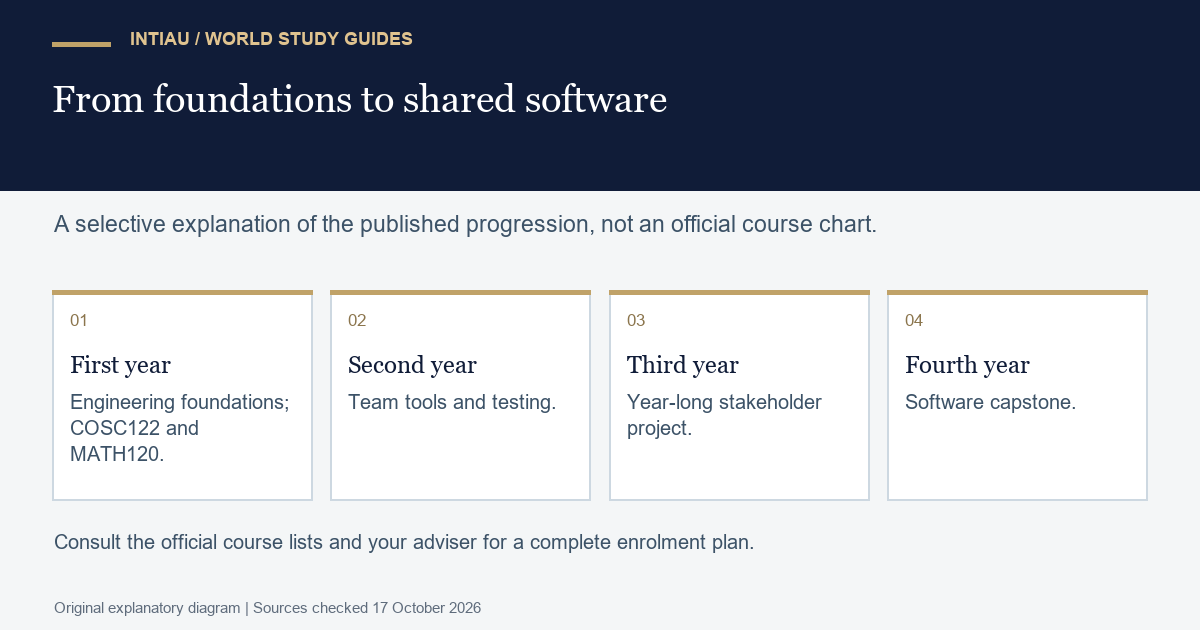
The following is a selective reading map, not a replacement for a personalised enrolment plan. The official degree regulations and subject page remain the sources for complete requirements.
| Stage | Published emphasis | What to compare |
|---|---|---|
| First year | Engineering foundations; COSC122 and MATH120 for this discipline. | Compulsory preparation versus elective choice. |
| Second year | A team project develops testing and configuration or build-management practice. | How an individual contribution becomes shared work. |
| Third year | A year-long project includes customers and other stakeholders. | How requirements are discussed and revised. |
| Fourth year | A capstone applies software-engineering skills. | How design decisions are justified and evaluated. |
Specialist topics include databases, operating systems, interfaces, web systems, design and testing. See the official subject and course links.
What a real project course involves
SENG202 Software Engineering Project Workshop is a 15-point Semester Two 2026 course. Its published description combines individual work and small teams developing a medium-complexity application. It builds on SENG201 and requires approval into the BE(Hons) Software Engineering programme; SENG199 is a co-requisite. Learning outcomes cover design and testing, project planning and documentation, teamwork and communication with non-technical audiences.
In that offering, three project iterations and demonstrations account for 15%, 25% and 40%; quizzes account for 15% and an empathy video activity for 5%. These are dated assessment details, not promised weightings for a later offering. The official course outline provides the full conditions.
A small exercise in changing requirements
Imagine a fictional equipment-booking application. Its first rule allows one active booking per person. A later request allows two bookings, but never overlapping times. Write three checks before changing the implementation: two separate bookings should succeed; overlapping bookings should fail; cancelling one booking should release only its own interval.
Now divide the task between two people. One changes validation while the other changes the display. Agree on a shared example record and the meaning of a cancelled status before either starts. Otherwise, both parts can appear correct separately while disagreeing when combined. A useful review explains the rule, shows the checks and records a rejected alternative. This original exercise illustrates a study habit; it is not a Canterbury assignment or admissions task.
When comparing programmes, look for the evidence that survives a demonstration: tests, design notes, issue history and explanations of trade-offs. A polished screen alone does not show whether a team can safely accommodate a changed rule. For further comparison, read the Gothenburg software-engineering guide and the observable-behaviour testing workshop. The Courses directory provides other study guides.
Questions about this route
Does first-year admission secure the specialist place?
No. Specialist entry is limited and considers first-year performance and available places.
Is SENG202 a fully remote course?
The 2026 outline requires campus attendance while campus is open; it does not offer ordinary off-site support.
Are the project stages a complete syllabus?
No. They highlight progression; use the linked official course lists and regulations to check every requirement and the edition relevant to your enrolment.
Related guides
View the curriculum diagram