Worcester Polytechnic Institute (WPI) is an independent institution from INTIAU; its Bachelor of Science in Robotics Engineering is the programme discussed here. WPI describes an undergraduate experience organised around seven-week terms. That calendar matters when comparing its courses with a university using conventional semesters.
A robotics degree is best compared through the connections it requires: sensing, computation, electronics, mechanics and control. A list containing a robot project is less informative than a curriculum showing how students acquire the tools to build and test that project. This guide reads those connections through the published major requirements and two course descriptions.
Read the major in WPI units
The 2026–2027 catalogue uses units, including one-third-unit courses. Its Robotics Engineering requirements include mathematics, basic science, engineering science and design, entrepreneurship and the social implications of technology. Required robotics study names RBE 2001, 2002, 3001 and 3002, or equivalents. Computing includes object-oriented programming and software engineering; electronics includes embedded systems.
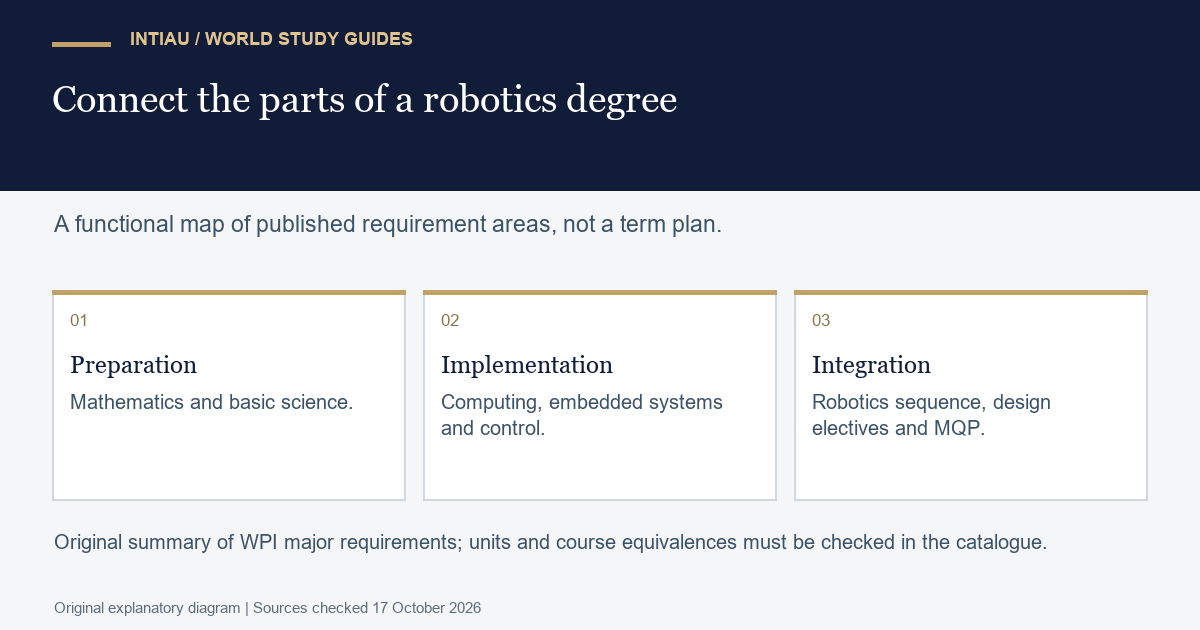
The following table groups requirements by function rather than inventing a term schedule. The official major requirements remain the authority for the full degree audit.
| Requirement area | Published role in the major |
|---|---|
| Mathematical preparation | Calculus, differential equations, linear algebra and probability |
| Physical and digital systems | Basic science, computing, embedded systems, statics and classical control |
| Robotics integration | Specified RBE sequence and engineering design electives |
| Capstone | A Major Qualifying Project in robotics engineering |
What sensing and embedded-systems courses contain
RBE 2002, Unified Robotics II: Sensing and Perception, is a one-third-unit course. Its description covers sensor operation, integration and selection; uncertainty, signal conditioning, filtering and calibration; and combining sensor information. Team laboratory work includes specifying and testing sensors. Embedded-systems study is recommended background, rather than a prerequisite invented by this guide.
RBE 2020, Robotics Engineering Foundations: Embedded Systems, connects microcontrollers and circuits with interrupts, state machines and event-driven programming. Its topics include analogue-to-digital conversion, communication interfaces and motor control. The catalogue also states restrictions on receiving credit alongside certain equivalent courses; applicants planning transfer credit should read those restrictions before assuming both courses will count.
These descriptions support a useful comparison question: does another robotics programme teach sensor reliability and embedded implementation explicitly, or mention them only inside a broad project? Neither arrangement automatically makes a degree better. It changes how you should inspect its prerequisite chain and the amount of independent preparation a project may require.
A small original sensor-selection exercise
Imagine a mobile robot must detect an obstacle within 0.50 metres. Sensor A returns 0.46 metres with a stated uncertainty of ±0.02 metres. Sensor B returns 0.48 metres with ±0.06 metres. Treat these as simplified bounds for this exercise, not statistical confidence intervals. A spans 0.44–0.48 metres; B spans 0.42–0.54 metres. Only B’s range crosses the decision boundary.
The correct response is not to average the two numbers and forget their uncertainty. First ask whether the sensors share a failure mechanism, whether calibration conditions match the robot’s environment, and what action is safe when evidence straddles the boundary. Then specify a test with known obstacle distances. This illustrates why choosing a sensor, conditioning its output and defining control behaviour are different engineering tasks.
Application route and comparison checklist
WPI’s first-year application page directs applicants to the Common Application. It distinguishes binding Early Decision from Early Action and Regular Decision. The displayed annual deadline table is not labelled as a particular entry cohort, so this guide does not convert its dates into a promised 2027 schedule. Check the route and current materials when submitting.
For a structured comparison, pair this guide with the MIT EECS pathways guide and the prerequisite-map exercise. Record units, equivalent-course restrictions and the work expected before capstone study. The Courses directory provides other study guides.
Three questions answered
Is the table an official term-by-term schedule?
No. It groups the catalogue’s requirements by purpose. Use the linked major record and advising for an individual term plan.
Does RBE 2002 cover sensor calibration?
Yes. Calibration is among the published sensing topics, alongside uncertainty, filtering and integration.
Does applying Early Decision create a commitment?
Yes. WPI describes Early Decision as binding upon acceptance. Read its conditions before selecting that application route.
Related guides
View the curriculum diagram