The University of Cape Town is a separate South African institution; its Bachelor of Commerce specialising in Information Systems is not an INTIAU programme.
Information systems sits at the point where an organisation’s activities meet its data and software. A useful programme comparison therefore asks two questions together: what technical work will a student learn, and what business problem will that work help explain? This guide follows UCT’s published BCom course list, while distinguishing it from a complete individual course syllabus.
Start with the correct Commerce application route
UCT’s Commerce guidance states that applications for undergraduate study in 2027 closed on 31 July 2026. That deadline is already past as of this guide’s 17 October 2026 check. The page says 2028 applications will open in April 2027. It also explains that most applicants select a broad Commerce option, with the final degree or specialisation choice made at the end of orientation. Actuarial Science is an exception. The ordinary BCom is three years; the BBusSc is four.
Read the actual application option before composing a statement about a specialisation. Choosing an academic interest for research is different from selecting a field that a live application form offers. An applicant should retain the relevant year’s instructions, qualification evidence and any eventual offer conditions together, rather than assuming the course list itself establishes eligibility.
How Commerce and computing develop together
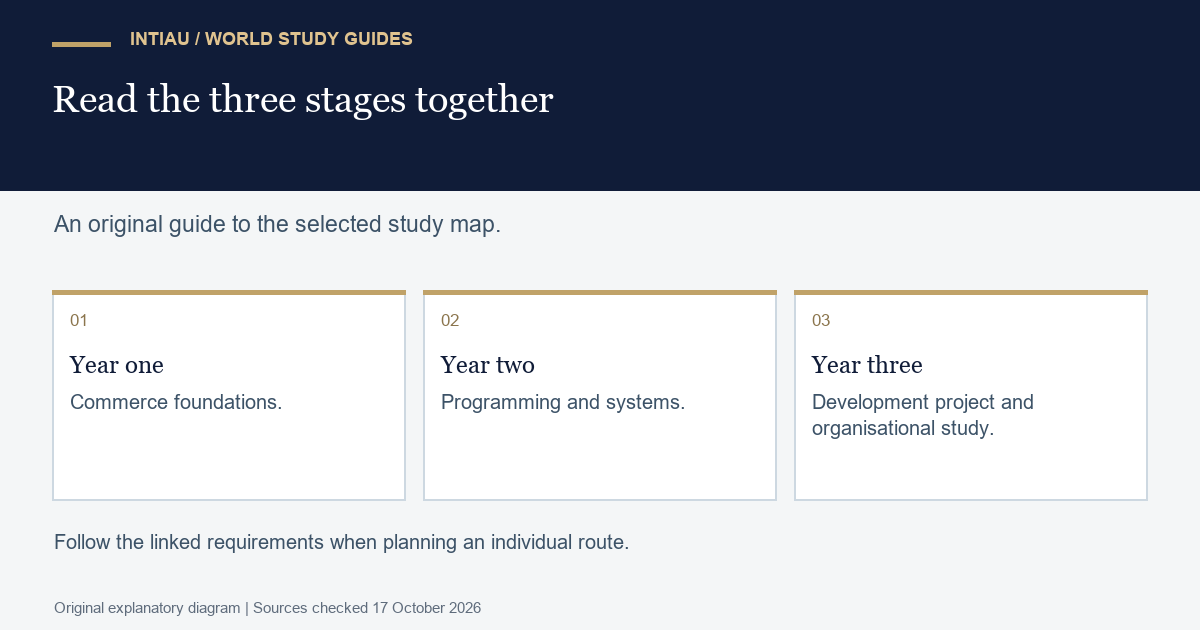
The official programme list supplies year-by-year units. The table selects examples rather than reproducing every compulsory and approved option.
| Year | Selected published components | Comparison question |
|---|---|---|
| One | Accounting, economics and introductory computing. | How will commercial vocabulary support later technical decisions? |
| Two | Commercial Programming; Database Systems; Business Intelligence and Analytics; Systems Analysis. | How do requirements become a data structure and an implementation? |
| Three | Systems Development Project; Business Process Management; Business Ethics. | How is an information system evaluated in its organisational setting? |
A course title identifies an area of study, but not the software version, weekly tasks or marking scheme. Keep those layers separate when comparing this list with another institution’s programme. A superficially similar database title may sit within a very different balance of business, mathematics and development work.
A named unit and the evidence boundary
INF2006F is listed as Business Intelligence and Analytics. INF3003W is the Systems Development Project. Those are actual curriculum components, not suggested additions.
The department describes information systems through people, business processes, information and technology. Its published teaching overview says courses through honours include practical project work using development tools; major courses also involve interaction with clients outside the university. This is department-level teaching context. It does not establish a specific INF2006F assessment or promise a particular client’s project.
The 2026 Commerce handbook is linked from the official handbook directory, but its full course description could not be retrieved for this check. Accordingly, this guide does not invent an INF2006F weekly syllabus, credits or examination weighting. Consult the current handbook and errata before making detailed module-equivalence decisions.
UCT also separates full-degree international study from semester study abroad. Its international Commerce guidance explains that F and S identify first- and second-semester courses, while H and W courses span both semesters. An exchange visitor therefore should not interpret a year-long project as an ordinary one-semester elective.
Try a business-process comparison
Consider a fictional library that records requests in a spreadsheet. Staff report 120 requests, but 15 are duplicate submissions. A dashboard showing 120 completed services would confuse recorded rows with distinct requests. First define an identifier and a rule for duplicates. The corrected request count is 105; whether all 105 were completed is a different question requiring status evidence.
Sketch three connected objects: request, borrower and item. Then state which person may change a request’s status and what record should remain after a correction. This original exercise connects data quality with responsibilities. It is not an official UCT task. For comparison, read the SMU Information Systems guide and practise a prerequisite-map audit. More subjects are available in the Courses directory.
Questions about this BCom
Is the BCom the four-year Business Science degree?
No. UCT distinguishes its three-year BCom from the four-year BBusSc.
Is INF2006F’s detailed assessment reproduced here?
No. The unit is identified, but its complete current outline was not retrieved.
Does department-level project teaching identify my project client?
No. The department describes client interaction in major courses, not a guaranteed individual placement or named project.
Related guides
View the curriculum diagram