Carnegie Mellon University is independent from INTIAU; this guide concerns its BS in Artificial Intelligence.
An AI degree is easier to assess when “building a model” is separated into several abilities: representing a problem, selecting a method, testing its behaviour and explaining consequences. CMU’s published requirements make these layers visible. This guide reads the 2026–2027 catalogue as a curriculum document and uses the separately dated fall 2027 instructions for first-year applications.
Apply to the school, then declare the major
Students enter the School of Computer Science and may declare BSAI in spring of year one. AI minors and additional majors are separate routes. See the programme overview.
For fall 2027, the university catalogue directs first-year applicants to the Common Application. It lists binding Early Decision with materials due 2 November, and ordinary Regular Decision with materials due 4 January. It also states that the School of Computer Science requires SAT or ACT scores. These are the dated instructions read on 17 October 2026; the application’s current requirements should control a submission.
Choose the school and programme fields carefully, and distinguish an indication of interest from admission to a specific major. The university’s central application instructions and the programme’s declaration route answer different questions. Neither a sample study plan nor completion of an online AI exercise establishes eligibility or guarantees selection.
Read requirements by area before reading the sample sequence
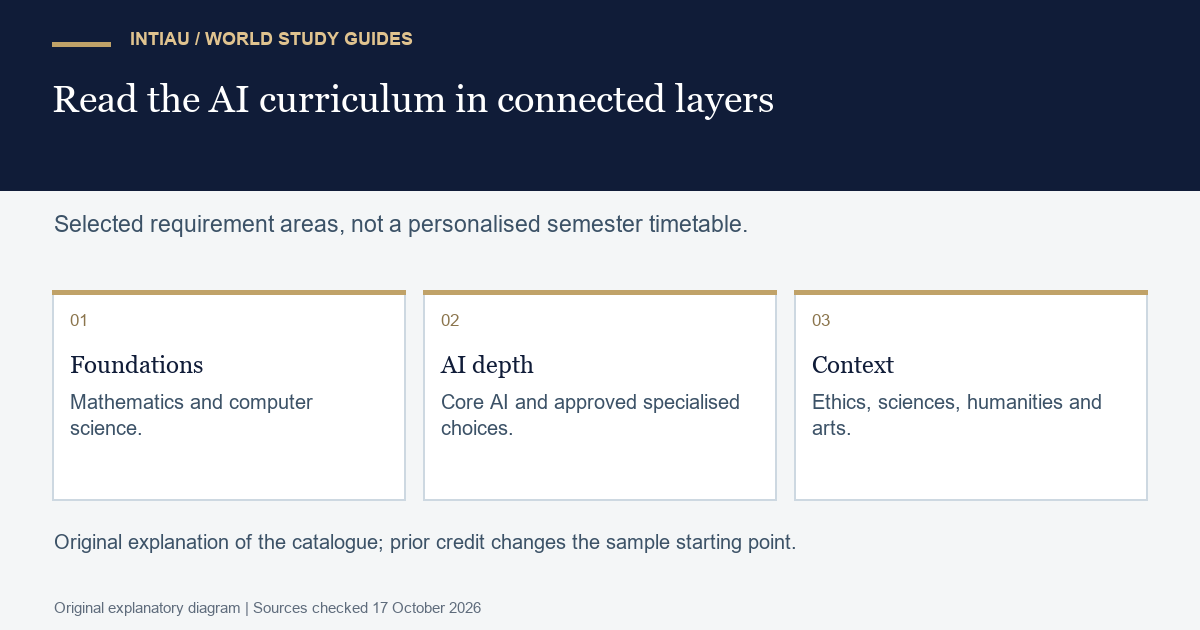
The catalogue summarises a 360-unit degree. Mathematics, computer science, AI, ethics, general education and electives all contribute. Its sample sequence assumes prior credit for introductory programming and calculus; students without that credit start differently.
| Requirement area | Selected catalogue evidence | What it contributes |
|---|---|---|
| Mathematics | Calculus, linear algebra, probability and Modern Regression. | A language for describing uncertainty and model behaviour. |
| Computer science | Imperative and functional programming; algorithms; computer systems. | Implementation and reasoning about computation. |
| AI core | 07-280 and 07-380, plus Natural Language Processing or Computer Vision. | Depth beyond a single introductory technique. |
| Wider study | Ethics, science or engineering, humanities and arts. | Context for judging how a system is used. |
The table groups requirements; it does not assign every component to a semester. Use the complete degree catalogue to distinguish required courses from approved alternatives. A long elective list creates choices, not a promise that every listed course fits every timetable.
A real introductory course and a deeper core
The catalogue describes 07-180 Concepts in Artificial Intelligence as a five-unit spring course covering representation, heuristic search, probabilistic reasoning, decision making and machine learning. Programming and written work accompany applications and ethical questions. Its prerequisites include 15-122 or 15-112.
By comparison, 07-280 Artificial Intelligence and Machine Learning I is a 12-unit course that combines foundational methods with implementation of influential systems, including AlexNet, GPT-2 and AlphaZero. The description explicitly connects technical work with responsible development. These are distinct courses, not interchangeable names. Consult the official course descriptions.
When comparing introductory modules, ask whether the assessment requires implementation, written explanation or both. A small introductory survey can orient a student without representing the depth of a later core course. Conversely, a demanding implementation does not remove the need to justify the problem definition.
Practise checking an AI result
Suppose a fictional document classifier labels 90 of 100 items correctly. That headline is incomplete. If only ten items belong to a rare category and the classifier misses all ten, its accuracy conceals a serious weakness. Construct the two-category confusion table before deciding whether the result is useful.
Then change the decision rule: a false negative costs five times as much as a false positive. You cannot conclude which classifier is preferable from accuracy alone; you need both error counts. State the assumptions, calculate the weighted errors and explain whom each type of mistake affects. This original exercise illustrates the link between technical measurement and judgement; it is not a CMU assignment.
For another curricular perspective, compare MIT’s computing pathways and the Oxford Computer Science guide. The Courses directory offers further comparisons.
Questions about the AI degree
Is this the same as taking an AI minor?
No. The BSAI is a primary degree route; CMU also lists a minor and additional major.
Does the sample first semester apply to every entrant?
No. Its starting point assumes introductory programming and calculus credit.
Does a five-unit introductory course replace the 12-unit AI core?
No. The catalogue describes 07-180 and 07-280 separately, with different scope and unit values.
Related guides
View the curriculum diagram