Deakin University is a separate Australian institution; the Bachelor of Cyber Security discussed here is not an INTIAU programme.
Security study involves more than learning attack names. A prospective student should look for a connection between computing foundations, investigation, defensive development and the ability to explain a decision. Deakin’s published course rules and a real project-unit outline make that connection more concrete. This guide uses the 2026 handbook for the curriculum and identifies the separate date scope of admissions information.
Read the award and course rules together
The S334 handbook lists three years full time, with Burwood, Waurn Ponds and online study options. Completion requires 24 credit points: 13 core, three capstone, a four-point minor and four open electives. There are also compulsory zero-credit units. The handbook also imposes level requirements.
Those totals serve different purposes. An elective slot creates choice, while a level requirement limits which choices will count. When comparing a proposed study plan, mark both the category and level of each unit. Counting to 24 without checking the distribution is not enough to demonstrate completion.
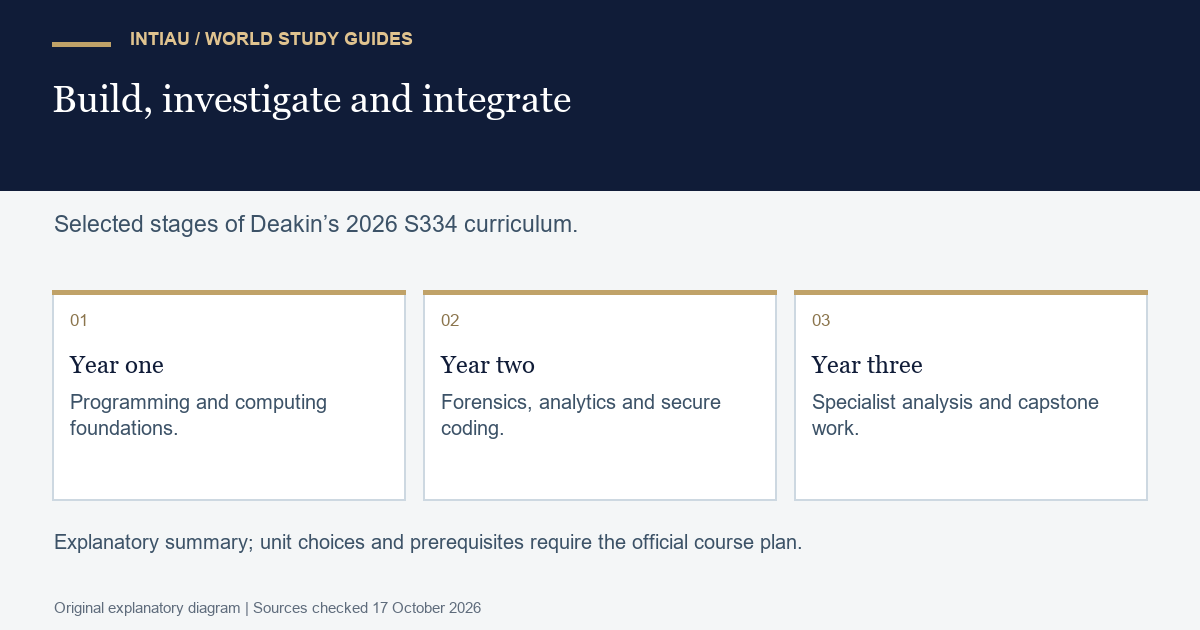
Selected stages in the published sequence
| Stage | Selected 2026 units | Useful distinction |
|---|---|---|
| Year one | Introduction to Programming; Computer Systems; Discrete Mathematics; Computer Networks and Communication. | Build the computing concepts needed to understand a security failure. |
| Year two | Computer Forensics and Investigations; Cyber Security Analytics; Secure Coding. | Compare investigating an event with preventing a software weakness. |
| Year three | Malware Analysis; Network Forensics; Team Project A; Ethical Hacking. | Connect specialised analysis with a shared deliverable. |
The table is selective. Check the official handbook for capstone alternatives and prerequisites. A unit appearing later in the model sequence is not evidence that it can be taken without its stated preparation.
What Team Project A actually assesses
SIT374 Team Project (A) – Project Management and Practices is a one-credit-point unit in the 2026 handbook. It requires 16 completed credit points, including SIT223 or SIT209. Students join an ongoing project, work with students from Team Project B, and use an agile approach to requirements, solution design and progress review.
The assessment is a learning portfolio worth 100%, covering iteration plans, progress, reflection, documentation and deliverables. The outline includes a showcase video and learning summary. It also states that portfolio milestones must be met. See the unit description for the full conditions.
A portfolio should make the contributor’s reasoning visible. “The team delivered the feature” is less informative than explaining which requirement you investigated, what evidence changed your approach and how you checked the result. This is a way to read the assessment’s purpose, not a supplied answer to a university task.
Application information has its own year
Deakin’s public course page labels its current admissions information for 2027. It lists a direct-application closing date of 7 February 2027 for Trimester One, and a timely VTAC date of 28 September 2026, which is already past. These are distinct routes; international applicants should use the international version of the page. Published minimum requirements do not guarantee admission.
Keep the course code, campus or online mode, chosen intake and evidence of qualification equivalence together when requesting advice. An admissions answer for a combined degree or a different applicant category may not resolve the same question for S334.
Practise explaining a security decision
For a fictional booking service, suppose a team proposes placing all diagnostic logs in one shared folder. List two different risks: unauthorised reading of personal information and accidental deletion of evidence. A single “secure folder” label does not answer either problem. Propose separate permissions for reading and deletion, specify a retention rule, and describe one check for each permission.
Now record a rejected alternative and why it was rejected. That short decision record can connect implementation, investigation and communication without claiming that an exercise proves professional competence. Compare the Melbourne computing major and the observable-behaviour testing workshop, or browse Courses.
Questions about this course
Does the 24-point total consist only of core units?
No. It also includes capstone, minor and open-elective components.
Is the project portfolio a group mark alone?
The published portfolio includes individual planning, progress and reflection alongside project documentation and deliverables.
Are 2026 unit assessments guaranteed for 2027?
No. They are dated examples; check the unit outline for your own offering.
Related guides
View the curriculum diagram