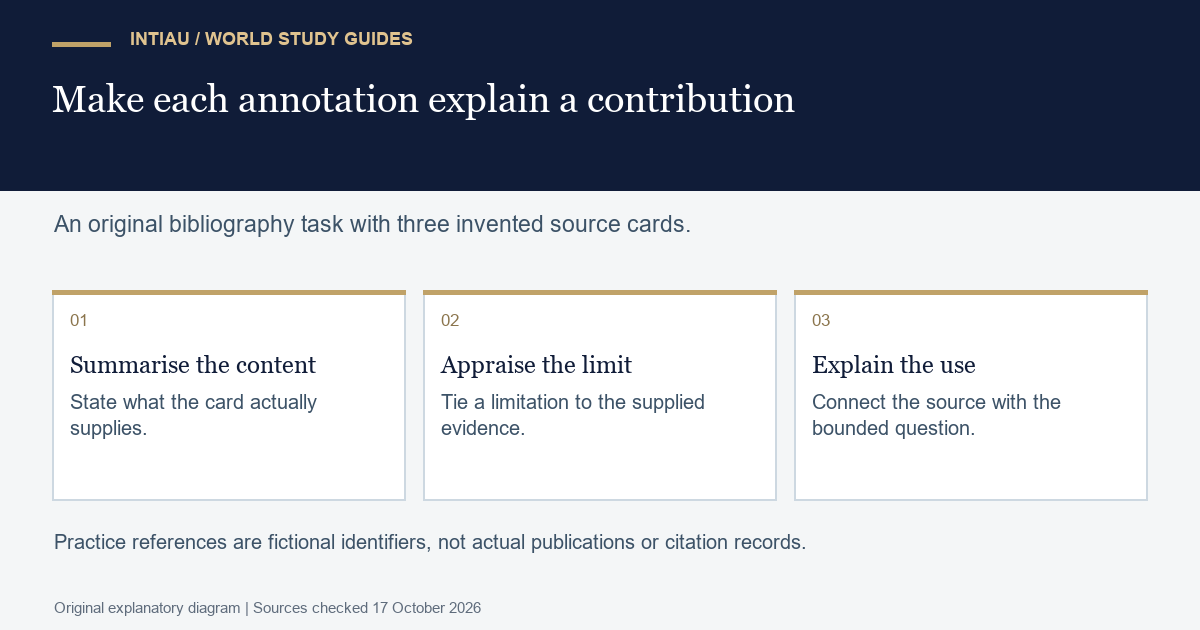
This self-study workshop writes useful annotations for three fictional sources instead of collecting titles and adding vague praise. You will separate summary, appraisal and intended use, then explain how related items contribute different kinds of evidence. All bibliographic labels are invented practice records, not publications to locate or cite in a real assignment.
The Purdue OWL bibliography guidance describes annotations that summarise, evaluate or reflect on a source’s role. It also makes format and length dependent on the task rather than one universal template.
Read complete source cards before annotating
Our imaginary question asks how a corridor layout might affect a simulated queue, with cost considered separately. Source A, labelled Ibis Simulation Group, 2024, “Two aisle layouts”, reports forty model runs with the same arrival inputs. Its mean model delay is eighteen time units for layout A and fourteen for layout B. Only the layout changes in the stipulated model comparison.
Source B, labelled Reed, 2025, “Why layout B looks promising”, is an opinion essay citing A. It has no additional model runs. Source C, labelled Orchid Town, 2025, “Layout cost memorandum”, assigns fictional installation costs of eighty credits to A and 120 to B. It contains no queue-delay observations.
| Source | Direct contribution | What it cannot add |
|---|---|---|
| A | Stipulated simulated delay comparison | Real corridor outcomes |
| B | Interpretation and argument based on A | Independent replication |
| C | Fictional cost comparison | Evidence of reduced delay |
Three complete worked annotations
A — practice reference: Ibis Simulation Group, 2024, “Two aisle layouts”. This fictional model report compares two layouts using forty runs and the same arrival inputs. Its reported mean delay is four time units lower for B. That comparison is useful for discussing the model’s layout assumption, but the card supplies no real-world validation or uncertainty analysis. I would use it as the simulated comparison, keeping its scope distinct from practical effectiveness.
B — practice reference: Reed, 2025, “Why layout B looks promising”. This fictional essay argues in favour of B using source A. It adds an interpretation of the model result rather than another set of observations. Its dependence on A matters because counting both items as independent tests would overstate the evidence. I would use it to identify an argument to evaluate, not to increase the number of model runs.
C — practice reference: Orchid Town, 2025, “Layout cost memorandum”. This invented memorandum lists B at 120 credits and A at eighty. It supplies a forty-credit cost difference, but no delay measurements. Its value is therefore in the decision’s cost dimension. I would place it beside A while avoiding an unsupported conversion from model time units into money or a claim that the more expensive layout is automatically preferable.
Each annotation includes a content statement, a limitation tied to the supplied card and an intended use. None relies on calling the source excellent or objective without an explanation. The annotations are not quotations or adaptations of real publications.
Diagnose weak critical notes
“This is useful because it is reliable” is circular. Replace it with the actual evidence relationship: A supplies the model comparison, B supplies an interpretation and C supplies a cost input. If reliability cannot be established from the card, state what information is missing rather than inventing credentials or a review process.
Another weak note merely repeats the title. The purpose of the annotation is to preserve what you learned from reading and how the item fits the question. A title may suggest a topic without revealing the design, dependency or limitation that matters to your argument.
Check the numerical claims. Eighteen minus fourteen equals four model time units. 120 minus eighty equals forty fictional credits. Those differences use different units. Dividing forty by four gives ten credits per model time unit as arithmetic, but the cards do not provide a decision model that makes that quotient a justified valuation.
For an extension, remove A’s matched-arrival assumption. Revise only the affected annotation sentence and explain why the comparison is now harder to interpret. Keep the original version beside the revision, so the reader can see which supplied condition supported the earlier wording.
Questions and completion criteria
Submit all three annotations, the two checked differences and a dependency arrow from B to A. For any real assignment, use its required citation style and actual verified bibliographic details; the practice labels here are deliberately incomplete fictional identifiers.
Must every annotation have one fixed length?
No. The cited guidance makes length depend on purpose and instructions.
Does B add forty more simulation runs?
No. It comments on A without additional runs.
Which source supplies the fictional installation costs?
C, the cost memorandum.
This is an original INTIAU editorial self-study activity; no qualification is awarded. See Courses or Contact for institutional information.
Related guides
View the study diagram