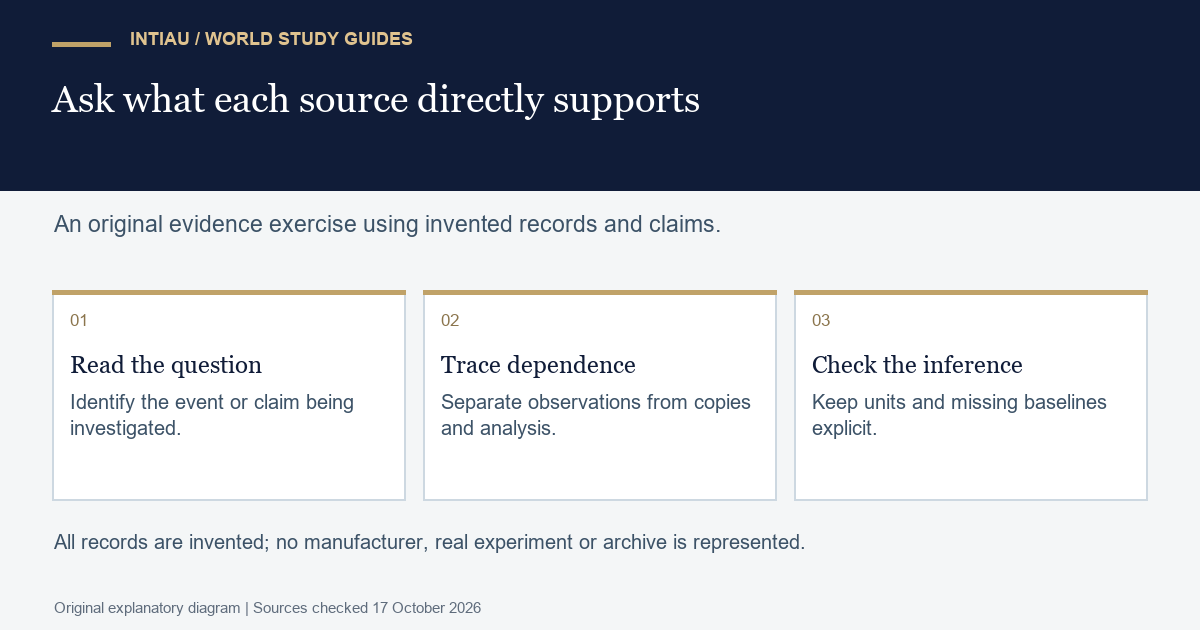
This self-study workshop distinguishes an original record from commentary without treating the first as automatically correct or the second as automatically useless. You will classify four invented documents for two different questions, check a unit conversion and identify dependence between sources. No real archive, manufacturer or experimental system is represented.
The Library of Congress source explanation distinguishes first-hand original information from later summaries, interpretations and criticism. It notes that primary material varies by discipline and can appear in many formats.
Read the fictional source cards
The imaginary project concerns a water-control model. Card A is its original event log: four recorded pulse counts are three, five, three and five. The exercise stipulates a conversion of one quarter litre per pulse. Card B is a later blog that quotes A but calls the total sixteen litres. Card C is an original manufacturer leaflet claiming that the model halves water use. Card D is a later analysis that corrects B’s conversion using A.
| Card | For the question about recorded pulses | Important limitation |
|---|---|---|
| A: event log | Original record | Recording accuracy and context still need examination |
| B: later blog | Commentary using A | Not another independent pulse observation |
| C: leaflet | Promotional claim, not a pulse record | No comparison baseline supplied |
| D: later correction | Analysis using A | Depends on A but may improve its interpretation |
Do not classify solely by medium. A website can publish an original log or a later interpretation. A printed document can make an unsupported claim. The task asks what relationship the item has to the event or question, not whether its format looks scholarly.
Complete worked interpretation
The pulse total in A is three plus five plus three plus five, or sixteen. Under the stipulated quarter-litre conversion, the corresponding model quantity is four litres. B’s sixteen-litre statement confuses pulse count with litres. D can be secondary analysis and still provide a useful correction.
Now change the research question to “What did the fictional manufacturer communicate?” C becomes direct original evidence that the leaflet made a particular claim. It still does not establish that water use was actually halved. The evidence supports a statement about communication, not a measured effectiveness result.
A model answer therefore distinguishes three conclusions. A records sixteen pulses. The stipulated conversion gives four litres within this exercise. C records a promotional claim for which no comparison data is supplied. Combining those statements does not produce a valid before-and-after water-saving estimate.
Suppose B is copied into two additional blogs. Those copies do not create three independent measurements. Draw arrows from the copies to B and from B to A. A dependency diagram shows why counting web pages can exaggerate the apparent amount of evidence.
Separate source type from evidential quality
The original log might have missing entries, an incorrect clock or an undocumented counting rule. Calling it primary identifies its relationship to the fictional event; it does not resolve those possible defects. A useful appraisal asks how the record was produced and what checks would establish its completeness.
Likewise, the correction in D should be examined rather than accepted because it criticises another source. Its arithmetic is reproducible here: sixteen multiplied by one quarter equals four. If it additionally claimed a fifty-percent saving, that extra conclusion would still lack a supplied baseline.
Make a worksheet with columns for source identifier, creator role, relation to the event, direct statement, inference, dependency and missing evidence. For C, the direct statement is the fictional advertised promise; the missing evidence is the comparison needed to evaluate performance. For A, record the pulse-count unit explicitly.
For a final extension, imagine A’s conversion factor were missing. You could still report sixteen recorded pulses, but not four litres. Identify which conclusion survives the removed assumption. This is a practical way to stop an interpretation from quietly importing a convenient unit or context.
Questions and completion criteria
Submit the four-card classification, the corrected calculation, the changed-question classification of C and the source-dependency diagram. Success means stating what each item supports while keeping unsupported conclusions visible.
Is commentary limited to one publication format?
No. The cited explanation describes several possible formats.
What quantity follows from sixteen pulses at one quarter litre per pulse?
Four litres under the fictional conversion.
Does C prove that water use was halved?
No. It proves only that the invented leaflet communicated that claim.
This is an original INTIAU editorial self-study activity; no qualification is awarded. Use Courses or Contact for institutional information.
Related guides
View the study diagram