The University of Galway is an Irish institution separate from INTIAU. Its 2027 course guide lists GY303, the Bachelor of Science in Biomedical Science.
The programme page lists four years, on-campus delivery, NFQ Level 8 and September 2027 intake.
Biomedical study can be compared through the questions it asks about evidence. A result is not self-explanatory: you need to know what was measured, how observations were obtained and which alternatives could explain them. For your course comparison, record both a scientific area that interests you and a method you want to understand. This helps distinguish enthusiasm for a topic from interest in the daily work of investigating it.
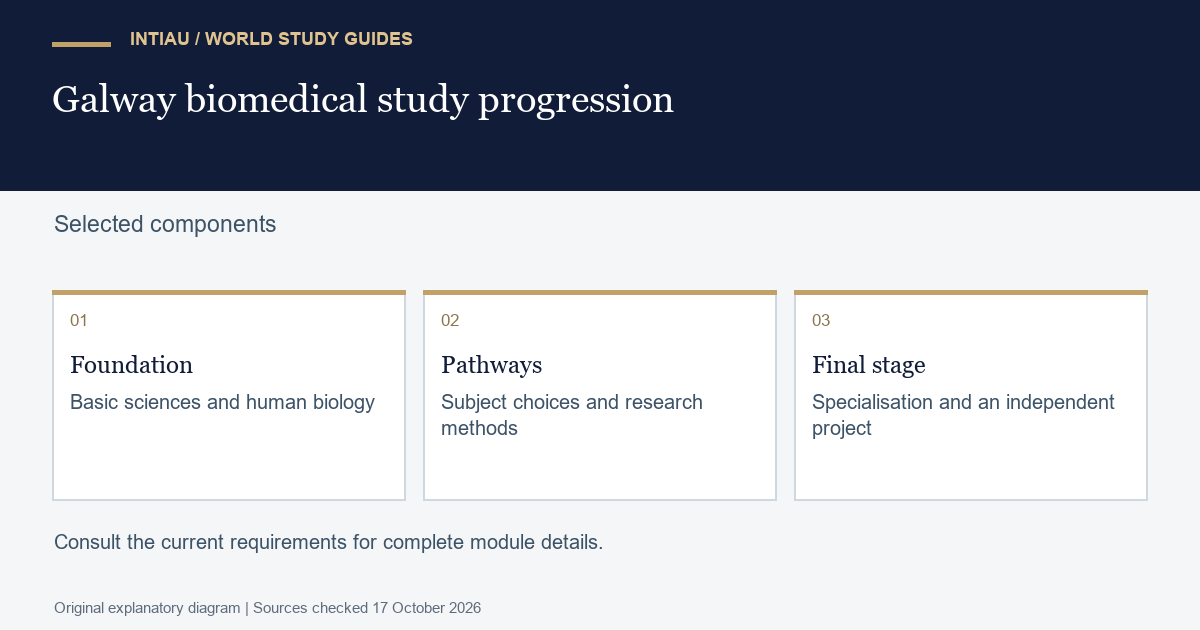
Selected stages, increasing focus
| Year | Selected components |
|---|---|
| 1 | Biology, chemistry, physics and human biology |
| 2 | Two main pathways and an elective |
| 3 | One pathway, biostatistics and research methods |
| 4 | Specialist study and an independent research project |
Read a pathway as a sequence of choices with consequences. Compare what you would need to understand before narrowing your focus, and which questions remain shared across different areas. An interest in a particular organ system, for example, is not yet a research question. You still need an observable phenomenon, a defensible comparison and a way to recognise an inconclusive result.
A published module example
A selected five-credit module is BM3101 Research Methods in Biomedical Science.
Worked exercise: readings are not always independent samples
This original exercise concerns fictional instrument data, not a clinical test. A student measures one stored sample four times and obtains 8, 9, 8 and 9 units. Another student measures four separately collected samples once each and obtains the same four numbers. Both arithmetic means are 8.5 units. However, the two sets of observations answer different questions about variation.
The repeated readings of one sample can help you examine variation in measurement under those conditions. They do not provide four independently collected samples. The second set contains differences between samples as well as any measurement variation. Calling both datasets “four samples” hides a difference in their design, even though the averages match exactly.
Draw a small record sheet with columns for sample identity, collection identity and reading number. For the first dataset, enter the same sample identifier in all four rows and reading numbers one to four. For the second, enter four sample identifiers and reading number one each time. The sheet exposes the structure before any statistical calculation begins.
Now imagine comparing a condition labelled A with one labelled B. If every A reading came from a single collection and every B reading from a different collection, collection conditions could be mixed up with the intended comparison. Write a design question rather than announcing a discovery: what independent collections and repeated measurements would help distinguish those sources of variation? Do not invent a required sample size from this tiny example.
A concise conclusion might say that the first mean summarises repeated readings of one sample, while the second summarises readings across four samples. Neither establishes a biological effect. List one missing detail, such as how samples were selected or whether the instrument was checked consistently. Explaining that limitation is part of the exercise, rather than a reason to discard the data.
Use the task to assess your interest in meticulous records and cautious interpretation. If you enjoy the biological topic but dislike examining how a number was produced, note that tension in your comparison. You can then ask a more precise question about research training instead of relying on the broad degree title alone.
For your comparison sheet, write the unit of observation beside every proposed result. A clear label such as “one reading of one collection” can prevent an impressive-looking row count from becoming an unsupported claim about independent evidence.
Application route and date scope
The university’s application guide distinguishes CAO applicants from international full-degree routes and links the relevant admissions offices. Follow the instructions for your residence and educational category, including language evidence. Check the intended entry-year calendar; recurring undated dates are not presented here as confirmed 2027 deadlines. Sources were checked on 17 October 2026.
Questions about this programme
Are two pathways retained throughout?
No. Later study narrows to one pathway.
Are repeated readings automatically separate samples?
No. The collection and measurement design determines that distinction.
Is the numerical example a clinical recommendation?
No. It is fictional data for a study-comparison exercise.
For INTIAU’s separate information, use Courses or Contact.
Related guides
View the study diagram