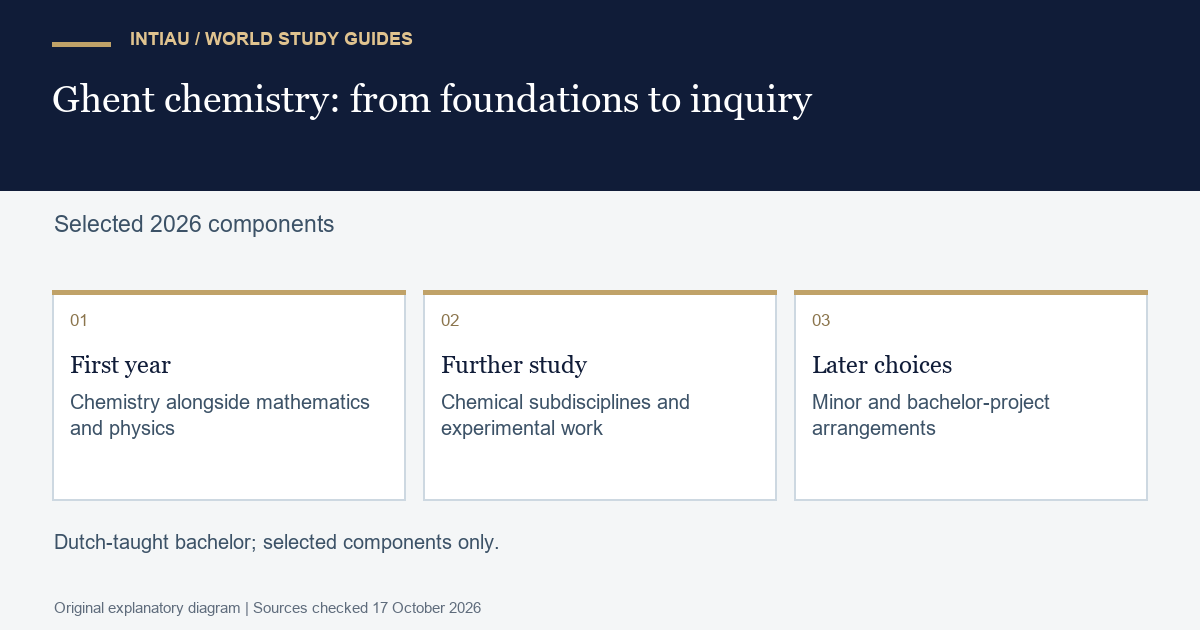
Ghent University is a Belgian institution separate from INTIAU. Its Chemistry bachelor, formally Bachelor of Science in de chemie, is a three-year, 180-credit programme taught in Dutch. This English-language guide does not describe an English-taught bachelor.
A useful chemistry comparison connects explanation with measurement. A molecular model may explain a pattern, but the quality of an observation still depends on how it was obtained. Record whether you enjoy both parts: reasoning about matter and examining the evidence behind a numerical result. This is a more precise starting point than choosing between a degree described as “theoretical” and one described as “practical”.
Selected published progression
| Stage | Selected components |
|---|---|
| Year 1 | General chemistry, structures, mathematics, physics and experimental chemistry |
| Year 2 | Chemical subdisciplines, analytical methods and further experimental work |
| Year 3 | Advanced chemical topics, minor choices and bachelor-project arrangements |
The detailed programme supplies the full requirements.
When comparing later choices, investigate how a project fits the selected route rather than treating every line in a catalogue as a universal requirement. A project title can conceal important differences in scope and context. Write down which version of the programme you are reading and which option it belongs to before adding it to a comparison spreadsheet.
A real first-year example
A real four-credit first-year course is Algemene chemie I: opbouw van de materie, concerning the structure of matter.
For a prospective student, that title can prompt a concrete question: how do models of matter help explain observations at a different scale? Use the linked programme as a starting point for checking the full course record. Do not infer a particular experiment, assessment format or reading list from a translated title alone.
Worked exercise: more digits do not settle accuracy
This original paper exercise uses fictional instrument readings and involves no chemical handling. Instrument A displays a mass as 1.2 grams, while instrument B displays 1.24 grams. B shows a finer increment, but the extra digit does not by itself establish that its result is closer to the true value. Separate display resolution from the question of measurement accuracy.
First, round 1.24 to one decimal place. It becomes 1.2, so the two displayed values need not conflict merely because they look different. Record both original readings and their units rather than replacing one with a rounded value immediately. Premature rounding can remove information you may need when comparing later calculations.
Now add fictional check data. When B measures a reference object assigned a mass of 1.00 gram, it reports 1.05 grams under the same stated conditions. That is a positive difference of 0.05 gram. If you explicitly assume the same additive offset applies to the unknown object, subtracting it from 1.24 gives 1.19 grams. The correction depends on that assumption; one check does not establish how the instrument behaves over every range.
Make a three-column note: observation, calculation and assumption. Place “reference displayed as 1.05 grams” in the first; “difference is 0.05 gram” in the second; and “offset applies unchanged to the unknown object” in the third. Mixing these categories can turn a tentative correction into an unjustified claim of certainty.
Finally, ask what additional evidence would help: repeated checks, another reference value or information about the conditions of measurement. Do not invent a confidence interval from the few numbers provided. A careful answer identifies why the evidence is incomplete while still completing the arithmetic correctly. Use the exercise to assess whether you enjoy this combination of calculation, record-keeping and qualification.
In a course comparison, this distinction gives you a useful question about laboratory learning: how are raw observations, instrument checks and interpreted results recorded separately? Keep that question alongside your interests in particular chemical topics.
Admission route and language
Ghent’s bachelor admission guidance distinguishes listed qualifications with direct admission from qualifications requiring an individual evaluation. Language requirements and any applicable positioning-test obligations also matter. Check the intended entry year’s instructions; this guide, checked on 17 October 2026, does not convert an undated deadline into a confirmed 2027 date.
Questions about this Chemistry bachelor
Does the English overview mean English teaching?
No. The bachelor is taught in Dutch.
Is the table a complete module list?
No. Full requirements are in the linked programme.
Does the exercise prove that instrument B is more accurate?
No. A finer display alone cannot establish that conclusion.
INTIAU’s own information remains separate: see Courses and Contact.
Related guides
View the study diagram