Hokkaido University is a separate institution; the Chemistry route within its Integrated Science Program is not an INTIAU programme or partnership. The ISP normally comprises a four-year bachelor’s degree followed by a separate two-year master’s component. Advanced graduation can shorten those stages for eligible students; it is not the default duration.
ISP courses are given in English, with Japanese courses also offered for daily life in Sapporo. The initial six months emphasise general education before later specialisation in physics, chemistry or biology. Mathematics supports the programme but is not an ISP major.
A chemistry comparison should begin with how explanations are tested. A model of a material or reaction is useful because it connects observations, not because its diagram looks complete. Write one example of a pattern you would like to explain, then ask which scientific foundations and analytical habits would help you distinguish competing interpretations.
Read the chemistry groups as a progression
| Group | Examples from the ISP list |
|---|---|
| General education | Chemistry I and II; Laboratory Exercises in Natural Sciences. |
| Common chemistry | Physical Chemistry; Organic Chemistry; Inorganic Chemistry; Analytical Chemistry; Biological Chemistry. |
| Specialised work | Literature Survey in Chemistry; Research Work in Chemistry; Laboratory Work in Chemistry. |
The table selects groups, not the full credit requirements or a semester-by-semester enrolment plan. Keep prerequisites and annual offerings beside the list. When comparing a broad science programme with direct entry to a single subject, ask how and when the scientific focus is chosen. Similar final interests do not make the early structure identical.
Inspect the introductory chemistry example
The Chemistry I/II page places the courses in the first six months. Chemistry I addresses atoms, bonding, states of matter, energy and reaction kinetics. Chemistry II introduces organic structure and reactivity with connections to other fields. The public description does not provide a future weekly assessment schedule.
Use that scope to construct questions for the actual syllabus. What mathematical background is expected? Which observations are interpreted? How do practical and theoretical work relate? Leave an unpublished assessment weight blank rather than filling it from a past course or a different institution. A concise record with visible limits is a stronger basis for comparison than a detailed invented account.
Worked exercise: distinguish two explanations
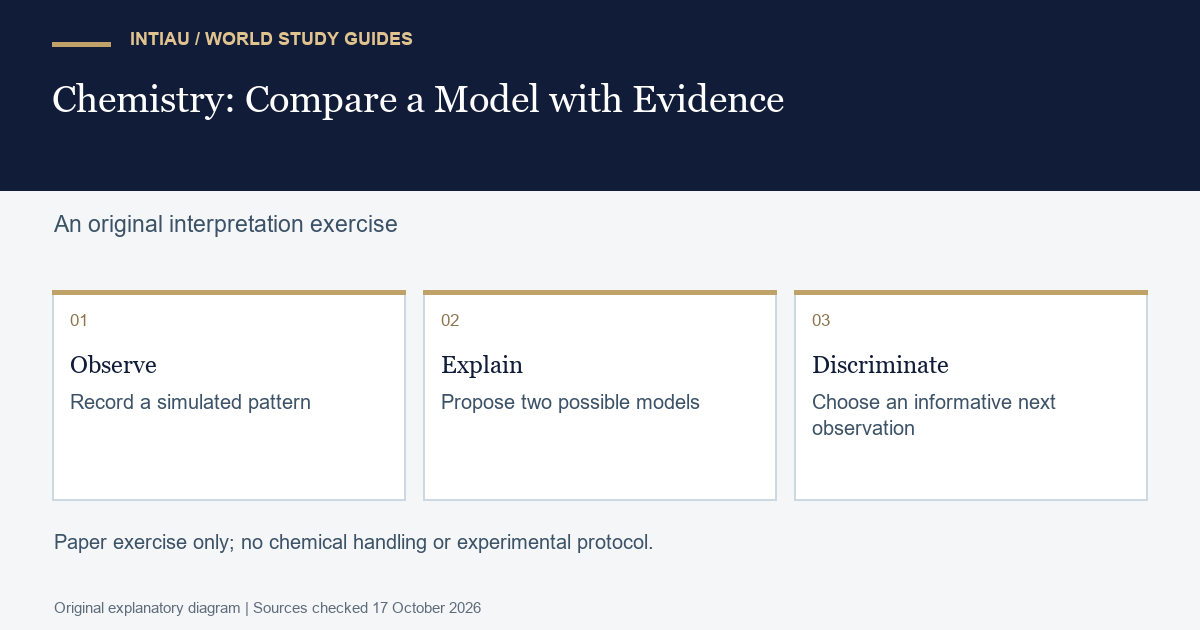
Create a fictional graph showing the amount of an imaginary substance recorded over time. Use abstract units and three invented observations: 2, 4 and 6 at equally spaced times. Propose model A, a constant increase, and model B, a curve that happens to pass through the same three points. Sketch both. No chemicals, equipment or experimental procedure are needed.
Choose a later observation time at which the models predict clearly different values. Explain why that observation could be more informative than measuring again near a point where the models almost agree. Add an invented measurement uncertainty and draw a range around the predicted result. Ask whether the proposed difference would remain visible within that range.
Now suppose a fourth fictional observation disagrees with both models. Write two responses: reconsider the model assumptions, and investigate whether the observation method could have changed. Do not discard the awkward result simply to preserve the preferred curve. State what additional information would help distinguish a modelling problem from a recording problem.
Your output is the labelled graph, two models and a next-observation memo. Ask a peer whether the data actually require the conclusion you first wrote. Revise any sentence that treats a possible explanation as a demonstrated mechanism. This original exercise develops a way of reading scientific claims; it is not an ISP assignment or a simulated chemical safety test.
Check the October 2027 calendar
As checked on 17 October 2026, online registration for October 2027 entry runs from 10:00 JST on 12 November to 17:00 JST on 20 November 2026. Recommendation letters have a separate arrival deadline of 17:00 JST on 4 December. Read the full application guide for eligibility and required evidence.
Keep the application edition separate from the course-description date. Record the normal bachelor’s route before considering any accelerated option, and do not assume that the master’s component is an automatic award attached to undergraduate admission. Ask the university to resolve any individual progression or eligibility question.
Three science-route questions
Is accelerated bachelor’s completion automatic?
No. It is an option for students meeting the relevant academic conditions.
Can Mathematics be the ISP major?
The course-structure page says it cannot, while emphasising its supporting role.
What should the model exercise produce?
Two explicit explanations and a reasoned choice of evidence that could distinguish them.
Official source trail
- 2027 ISP admission policy
- ISP course structure
- Chemistry course groups
- Chemistry I and II
- 2027 application schedule
For INTIAU information, visit INTIAU Courses or INTIAU Contact. These links do not apply to the separate institution discussed above.
Related guides
View the study diagram