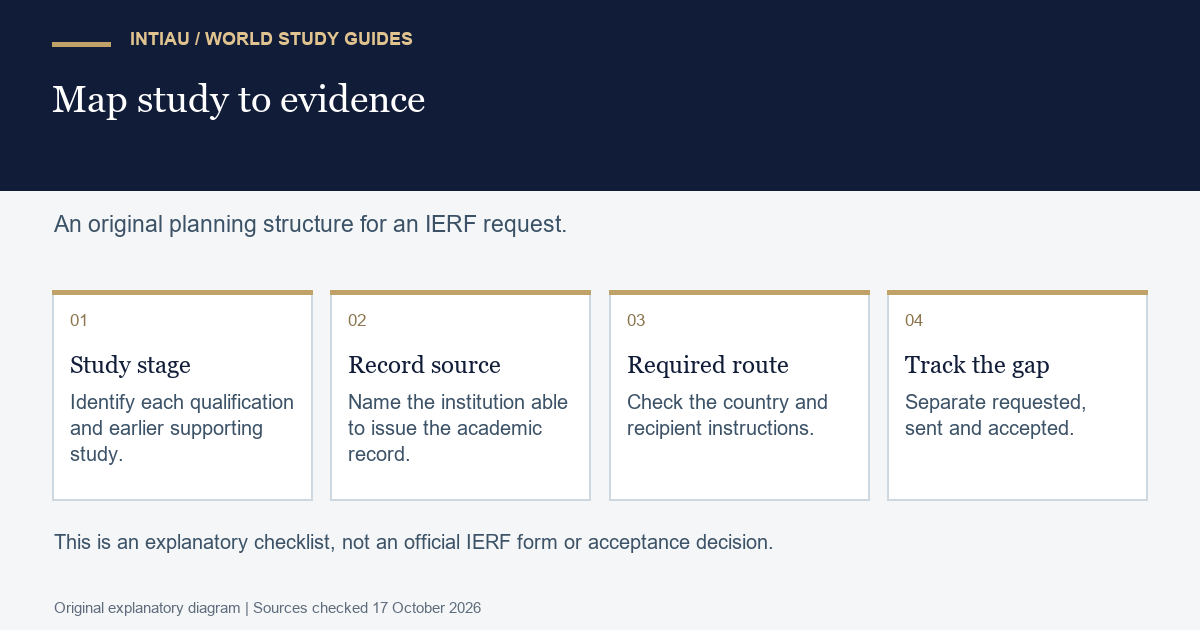
Preparing an IERF application is a document-mapping task before it becomes a delivery task. A degree certificate, a transcript and a translation answer different questions. Start by making the route from each period of study to its supporting record visible. This guide concerns an external evaluator; it does not describe an INTIAU partnership or promise acceptance of a report.
Separate the application from the recipient’s decision
IERF’s application guidance distinguishes its standard application from several specialist routes and directs applicants to check acceptance with the intended institution or board. Its application also asks for both current and educational-record names when they differ.
Write the recipient’s request at the top of a private planning sheet. Identify the application it supports and the question the report is expected to answer. “An evaluation is needed” is incomplete: it leaves open the required detail, the delivery destination and any condition about the underlying records. Resolve those points before choosing a service by its name alone.
The WES preparation guide offers a useful comparison of recipient instructions and report selection. It should not be used as IERF’s document checklist. Procedures belong to the provider that issued them.
Map the complete study history
IERF requires official academic records and country-specific checks. Its guidance includes undergraduate supporting records for graduate study and identifies the awarding institution as the record source for transnational programmes.
Create one row per institution and qualification, including unfinished study that you intend to have considered. Record the dates privately, the award title as printed and who can issue each document. Distinguish the place where teaching occurred from the institution named on the award. A study centre’s name alone may not identify the office able to issue the authoritative academic record.
| Fictional situation | Planning action | Question left open |
|---|---|---|
| Master’s award with earlier bachelor’s study | List both stages separately. | Which records must the issuing offices provide? |
| Teaching centre and awarding university differ | Identify the award issuer. | Who holds the authoritative academic record? |
| Current name differs from the certificate | Record both names privately. | Which supporting evidence is requested? |
Distinguish official status from possession of an original
IERF’s original-document requirements can depend on the country and recipient. Translations accompany the original-language records rather than replacing them; additional documents or direct institutional delivery may be requested.
Label the item you possess precisely: an original award, an institution-issued transcript, a personal scan or a translation. Avoid using “official” as a catch-all for every file with a logo. Next to it, record the exact instruction that applies and the date you checked it. A mismatch is an enquiry to resolve, not permission to relabel a copy.
For example, imagine an applicant who holds an original master’s certificate and scans of both transcripts. The planning sheet is not complete simply because four files exist. It must show whether those items meet the stated route and whether an issuing office must supply anything. Keep the question visible until there is a clear answer.
Build a handover that survives follow-up
Use separate columns for requested, issued, sent, received and accepted. These are different milestones. A dispatch receipt answers a transport question; it does not by itself show that an evaluator has accepted the contents. Add the responsible person or office and the next action to each unresolved row.
Keep names, reference numbers and scans in your own secure records rather than a public worksheet. If clarification is needed, ask one bounded question and identify the relevant instruction. Do not send multiple conflicting versions merely to appear thorough. Preserve the reply with the checklist so the next action follows the actual answer.
The ECE report and document guide explains a related planning distinction between documents held and documents required. Browse further independent credential evaluation guides.
Questions about the planning process
Should I merge undergraduate and postgraduate study into one checklist row?
Separate rows make gaps easier to see. They preserve the relationship between the later award and its supporting study without implying that a single certificate proves every earlier stage.
What if the teaching centre cannot issue my transcript?
Identify the institution named on the award and ask which office holds the authoritative record. Treat an unanswered custody question as open; do not create a substitute transcript.
Does completing this checklist establish acceptance?
No. It organises the work and records unresolved questions. The evaluator decides whether evidence meets its requirements, and the receiving organisation decides how to use the report.
Official references
Checked 17 October 2026: IERF documentation and application guidance. Recheck the relevant country and recipient instructions before sending records.
Related guides
View the process diagram