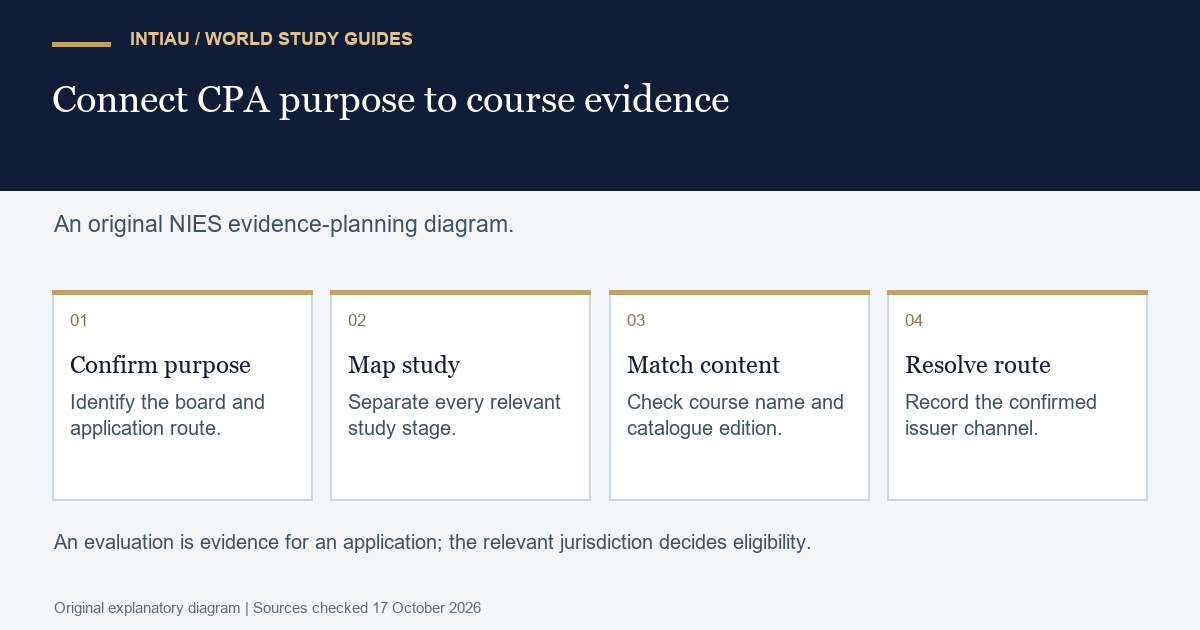
An academic evaluation for a CPA application starts with a defined professional purpose. It should not be planned as a general university-admissions evaluation with an accountancy label added later. This guide develops a records-and-course-evidence plan for NASBA International Evaluation Services, known as NIES, while keeping the selected jurisdiction’s decision separate.
Confirm the purpose before collecting documents
NIES does not evaluate foreign education for general academic admission, immigration or U.S. employment. Its policies allow issuer verification and requests for additional documents before an evaluation is completed.
Identify the board or application route that will receive the evaluation and record its current instruction. Use a separate question for whether the chosen service meets that requirement. A report can describe education without deciding whether an applicant satisfies every examination or licensing condition.
The ECE report guide illustrates why purpose matters when choosing an academic assessment. It does not establish that ECE and NIES are interchangeable for a particular board.
Account for every stage of postsecondary study
NIES requests records for each year of international postsecondary education; a higher degree does not prove earlier study. It may request official accounting and business syllabi or course descriptions for a CPA examination evaluation.
Build a study timeline before listing files. Include transferred study as a separate question about its original source. Do not assume that the institution issuing the final award can answer every question about work completed elsewhere. Preserve the distinction between an entry on a transcript and the underlying course content that an evaluator may need to examine.
| Fictional record | What it establishes | What remains to check |
|---|---|---|
| Transcript lists Accounting II | The printed course entry and result. | The content corresponding to that study period. |
| Current catalogue describes Accounting II | Today’s published description. | Whether it represents the applicant’s edition. |
| A transfer entry appears | That credit was recorded by the later institution. | The authoritative source for the original study. |
| Translation accompanies a record | An English rendering for comparison. | Its correspondence with the complete record. |
Match course descriptions to the correct period
Use the year or edition of the course as a matching field. An identical title does not prove that the syllabus remained unchanged. If the available description is from a different period, state that limitation and ask the institution whether an archived description is available. Do not silently edit a current outline to resemble an older course.
For a fictional three-course file, imagine that two descriptions match the transcript year and the third comes from a later catalogue. The sensible result is two matched items and one unresolved edition question. It is not three confirmed matches. Keep the unresolved item visible in the handover and identify the office able to clarify it.
Resolve delivery instructions for the actual route
The NIES requirements page discusses official electronic delivery and sealed institutional records. It also provides an Education Verification option when an institution cannot issue the needed official documents. Route-specific instructions should be confirmed for the actual application.
Do not turn those alternatives into a blanket instruction to email every file yourself. Ask which route applies to the specific record and board, then record the answer. Distinguish requesting a transcript, institutional dispatch, verification and acceptance. These actions may involve different offices and should have separate status entries.
The qualification-verification guide helps distinguish confirmation of evidence from a recipient’s decision. Browse further independent credential evaluation guides.
Questions about CPA record planning
Does an accounting course title establish how its content will be classified?
No. A title is an index to the course, not a complete content description. Match the relevant syllabus or course description and leave classification to the responsible evaluator or board.
Can a current catalogue stand in for an archived course description?
Record the edition difference and seek clarification. Do not present current content as confirmed historical content merely because the course name matches.
Does a completed evaluation guarantee examination or licensing eligibility?
No guarantee follows from this planning guide. The selected jurisdiction applies its own requirements and decides how the evaluation fits the application.
Official references
Checked 17 October 2026: NIES requirements and NIES policies. Check the board-specific purpose and current delivery route before acting.
Related guides
View the process diagram