The Bachelor of Computing in Computer Science belongs to the National University of Singapore, a separate institution; it is not an INTIAU programme, branch or partnership. This guide examines the computing degree rather than treating a second major as the same qualification.
Checked 17 October 2026. The curriculum reference is the 2026/27 cohort. Admissions information is labelled by its own cycle, so readers can distinguish the academic structure from a deadline that has already passed.
Understand the degree’s building blocks
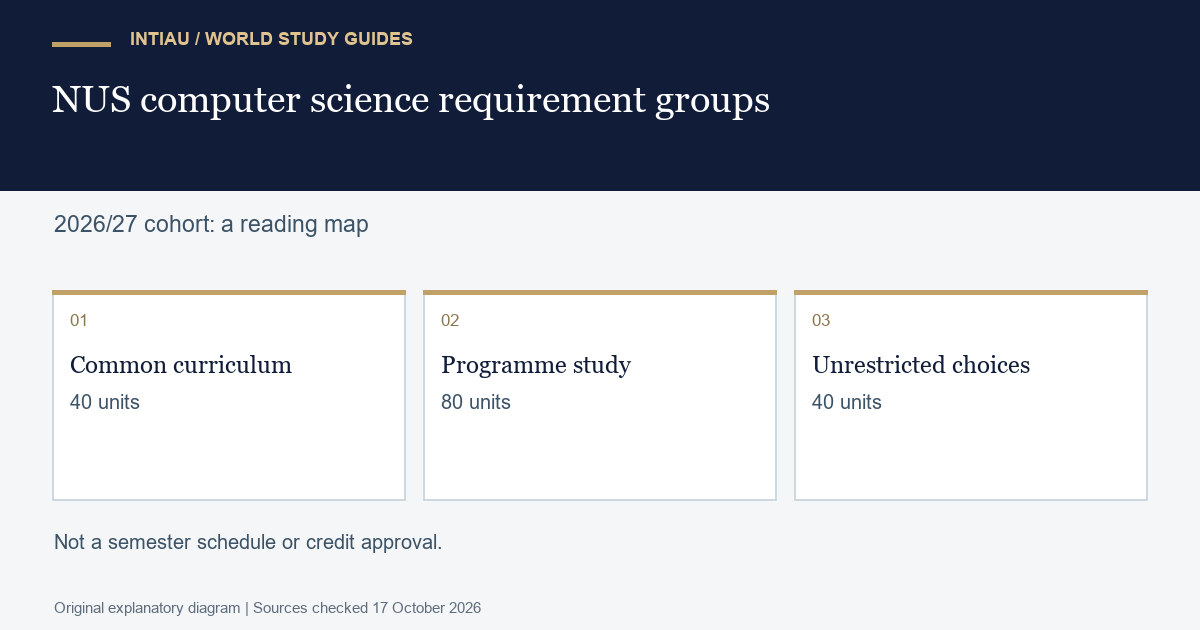
The 2026/27 cohort requirements specify at least 160 units. The following table groups its requirements; it does not prescribe a semester-by-semester timetable.
| Group | Units | What to examine |
|---|---|---|
| Common curriculum | 40 | University and interdisciplinary learning. |
| Programme requirements | 80 | Computing foundations, depth, mathematics and sciences. |
| Unrestricted electives | 40 | Choices within the applicable rules. |
Foundation examples include discrete structures, software engineering, operating systems and algorithms. Depth requirements include a focus area and an industry-experience component, with specified alternatives and conditions in the full rules.
The Computing admissions FAQ describes a usual four-year, eight-semester programme. It also explains that the balance of projects and tests varies by course.
Start your comparison by separating breadth from specialisation. A course on a fashionable topic is not enough to describe an entire degree. Make one column for common foundations, one for the area you hope to pursue, and one for the choices that remain genuinely flexible. Record prerequisites beside attractive advanced courses so that your plan shows the steps needed to reach them.
Look inside one computing syllabus
The official instructor’s CS2040S course page identifies a 2026/27 offering. It describes Java-based data structures and algorithms, including linked structures, trees, graphs, searching, sorting and algorithm analysis. Its lesson plan is marked tentative.
To investigate whether this style of study appeals to you, create an original exercise comparing two ways to store a waiting list. Write a few operations, test them on a small example, and explain how the work changes as the list grows. Keep a note of assumptions, such as whether entries can repeat. The value is in the explanation and testing process, not in reproducing any university assignment.
When inspecting another module, ask what the learner must actually do: construct a proof, implement an algorithm, analyse an experiment, communicate a design or coordinate a project. These activities can require different preparation even when two modules share a broad subject label. Keep your notes about learning separate from your notes about the admission threshold.
Choose the correct admissions category
The Office of Admissions directs applicants to qualification-specific categories, including IB and international qualifications. Applications and supporting documents are submitted through the university’s stated online process.
The international-qualification programme prerequisites document, accurate as of December 2025, lists a Year-12-or-higher mathematics pass for Common Computer Science Programmes. That requirement alone is not an admission guarantee.
The 2026/27 admissions announcement gives 3 December 2025–23 February 2026 for international qualifications. That historical window is closed as of this guide’s check date. It must not be reused as the next intake’s deadline.
The international undergraduate prospectus identifies English as the university’s instructional language.
Build an application evidence sheet using your exact examination name, subjects, levels and final-result date. Check whether the guidance refers to your qualification, nationality category and intended intake. If two pages appear inconsistent, ask the admissions office for clarification before interpreting an application-status label. A date in a search result is not evidence that an application form is currently available.
For each achievement you plan to describe, write down the problem, your own contribution, the evidence and what you learned. A modest project that you can explain clearly is more useful for honest self-assessment than a long list of tools you have barely used. This is planning advice, not a statement about selection weightings or the kind of portfolio that will secure admission.
Frequently asked questions
Is the table an official semester schedule?
No. It reorganises the requirement groups for reading and comparison; use the full cohort rules to build an individual plan.
Does meeting the mathematics prerequisite guarantee admission?
No. A prerequisite and an admission decision are different. Use the complete instructions for your applicant category.
Can I apply using the 2026/27 deadline?
No. That cycle’s stated window has passed. Check the intake-specific official guidance before taking action.
Read related educational guides in INTIAU Courses. Use INTIAU Contact for article feedback; NUS remains responsible for its admissions.
Compare the computing foundations with the MIT EECS guide and ETH Zurich Computer Science guide. The curriculum-comparison workshop helps keep cohort requirements and applicant-category evidence separate.
View the curriculum diagram