The University of Porto’s Licenciatura em Ciências da Nutrição is a separate institution’s programme, not an INTIAU programme or partnership.
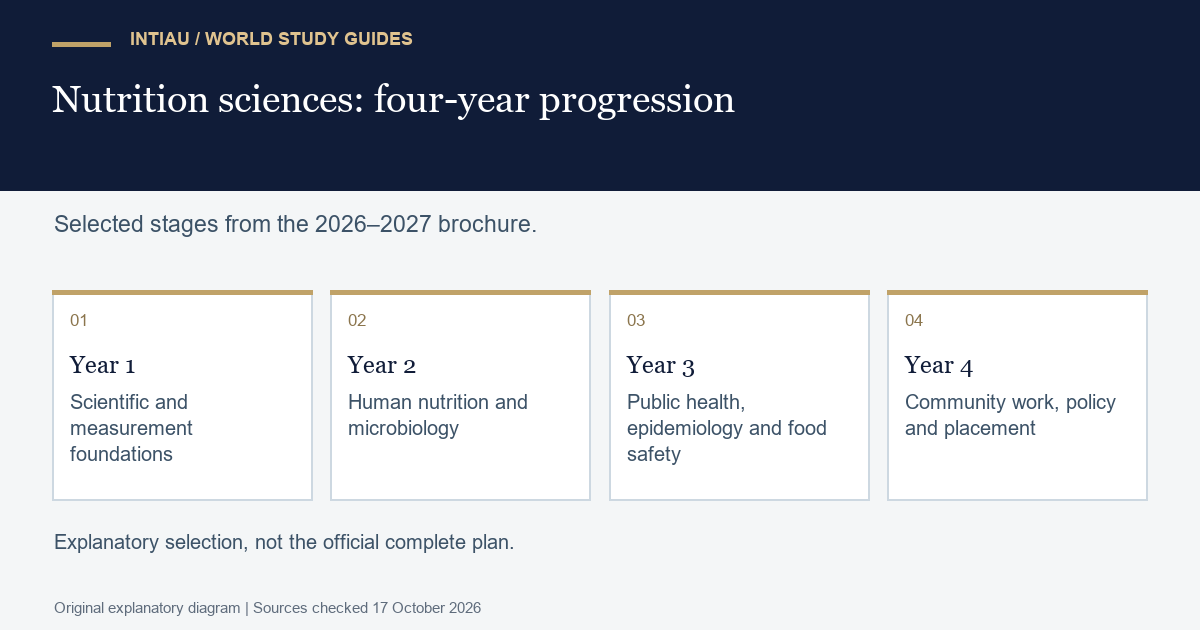
The faculty’s 2026–2027 brochure presents a four-year route, moving from scientific foundations towards applied nutrition and a final placement.
Programme comparison here means looking beyond the word “nutrition”. Ask how the degree connects biological science, food, population evidence and supervised work. This guide selects actual curriculum examples and keeps them separate from personal dietary advice or professional registration decisions.
Read the four-year map as a progression
| Year | Published examples | Question to investigate |
|---|---|---|
| 1 | Anatomy, biochemistry and assessment of food intake | How are measurements grounded in scientific concepts? |
| 2 | Human nutrition and microbiology | How do food and biological systems interact? |
| 3 | Public health nutrition, epidemiology and food safety | How do individual and population questions differ? |
| 4 | Community nutrition, policy and a final placement | How are decisions made in a supervised setting? |
For a detailed example, the published 2025–2026 entry for LCN2104, Microbiologia Básica, identifies Portuguese as its working language. It covers major microorganism groups, their relationships with people and applications to nutrition and food, including laboratory learning.
The module edition is older than the brochure. It provides a real content example, not a promise of unchanged assessment or laboratory arrangements for a later intake. The separate study-plan page is headed “Plano Oficial da Licenciatura 2025”; its appearance under a 2026 academic-year selector should not erase that plan date.
When comparing another nutrition degree, look for the connection between the measurement of intake, food composition and the setting in which findings are interpreted. A laboratory component and a placement are different educational experiences. Confirm both the required progression and the supervision arrangements instead of inferring them from a course title.
Choose the applicable admission competition
The faculty distinguishes national entry, an international-student competition and other school-based routes. Its 2026–2027 page gives Biology and Geology plus Physics and Chemistry for the national route, while separately linking international conditions. The displayed third international application phase ended on 22 July 2026.
That date was already past when this guide was checked on 17 October 2026. Do not copy it as a forthcoming 2027 deadline. Identify the competition that applies to your qualification and status, then consult its actual notice for evidence requirements. The national-route subjects should not be transferred automatically to every international applicant.
Worked exercise: compare the same amount of food
This original fictional exercise concerns reporting, not a dietary recommendation. Product A’s invented label lists 6 grams of a nutrient per 150-gram portion. Product B lists 5 grams per 100-gram portion. A draft says that A contains more because six is greater than five. Put both figures on the same basis.
A contains 6 ÷ 150 × 100 = 4 grams per 100 grams. B contains 5 grams per 100 grams. On that basis B has the higher concentration, even though A’s stated portion contains the larger absolute quantity. An accurate answer gives the denominator and does not call either product healthier from this one measure.
Your final response should state both concentrations, explain the portion-size issue and name one additional question that would be needed for a different comparison. Score one point for each concentration, one for a labelled common basis and one for limiting the conclusion. No claim about an individual’s requirements follows from the exercise.
Questions about the evidence
Does the brochure show a final placement?
Yes. Its fourth-year second semester is labelled Estágio. Confirm the applicable placement arrangements with the faculty.
Is the detailed microbiology example the 2026–2027 module?
No. The cited detailed entry is explicitly 2025–2026; the newer brochure is used for the programme progression.
Does the food-label exercise identify the better diet?
No. It checks a numerical comparison on a common basis, not dietary suitability.
Official reading and related study
- Official plan and degree identity
- 2026–2027 brochure
- Detailed microbiology example
- Admission competitions
Compare food-focused study with the Cornell food science guide, and use the curriculum-reading workshop to record differences. Browse the course and syllabus archive.
Related guides
View the study diagram