The Universitat Politècnica de Catalunya offers the four-year, 240-credit Grau en Enginyeria Civil through its Barcelona School of Civil Engineering. This independent programme is not an INTIAU qualification or partnership. The university advertises an English-taught group. Official degree record.
The School’s detailed record lists Spanish, Catalan and English across the programme. Confirm the actual group and course; the English route does not mean every group uses English. The current curriculum is the 2020 plan, distinct from routes being phased out. School curriculum and applicant information.
Read the progression and the actual course guide
For a civil-engineering comparison, connect the physical question to the model used to answer it. Record the quantities, geometry and assumptions before applying a formula. A model can be internally consistent while omitting features that matter for a real design. That makes explicit scope part of a useful explanation.
| Stage | Selected published component | Question for comparison |
|---|---|---|
| Year one | Applied Geology; Mechanics I | Which physical quantities define the model? |
| Year two | Hydraulics; Strength of Materials | How are assumptions tested and extended? |
| Year three | Soil Mechanics; Structures | What evidence supports a proposed interpretation? |
Mechanics I is a six-credit component with a 2026/27 guide. Its selected objectives include forces and moments, statics and equilibrium. The guide identifies Spanish groups and an English group. Selected current course guide.
Use that example to prepare a focused comparison. Separate the course’s actual stated theme from your own practice problem. Keep the original course code and edition when asking about detailed teaching. Do not infer a particular laboratory, assessed task or professional entitlement from the presence of a mechanics course.
The programme includes the bachelor’s thesis within its 240 credits. The selected table is only part of the progression and does not reproduce track or elective requirements.
Obtain the applicable admission instructions
The School states that a place is obtained through the Generalitat de Catalunya university pre-enrolment procedure. Follow its linked applicant route; no 2027/28 opening is asserted here.
Prepare an applicant checklist with the qualification held, intended cycle and governing procedure. Keep requesting a place separate from registering after allocation. For language planning, retain the intended group alongside the programme name. This guide’s check date is 17 October 2026; the selected course guide and curriculum plan have their own editions.
When comparing the standalone bachelor’s degree with a combined bachelor-and-master route, use the exact award and programme title from the official record. Do not add the duration or credits of another route to this degree. Any separate professional or further-study question needs its own applicable requirements.
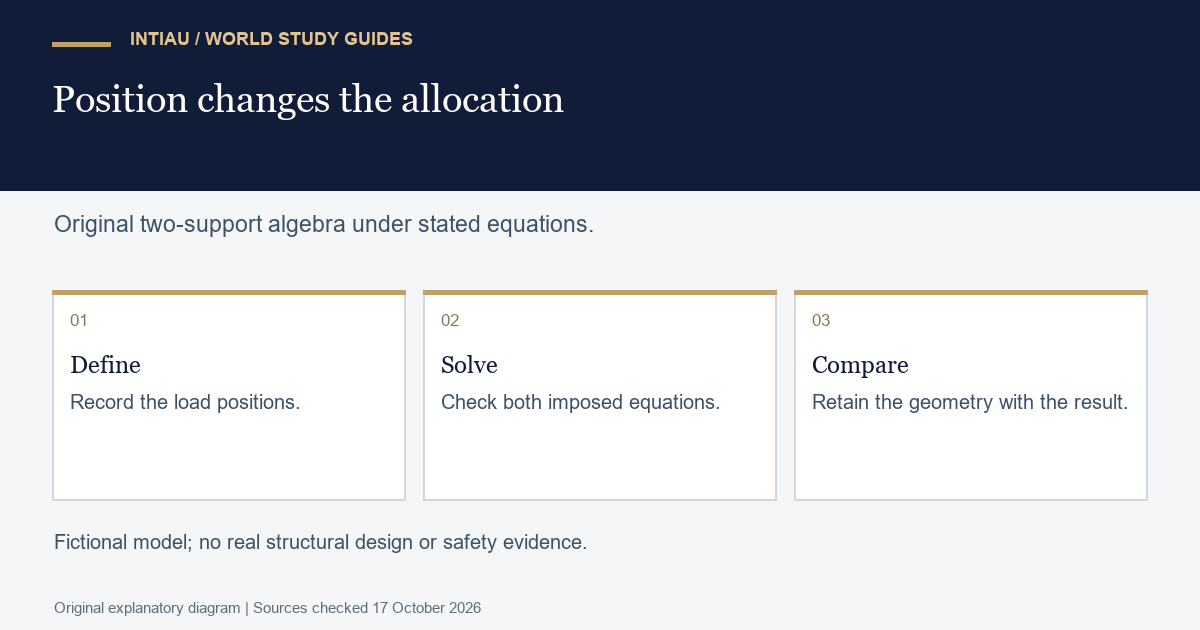
Original worked exercise: position changes the allocation
This fictional paper model is not an engineering design. Stipulate two upward support quantities, L and R, separated by ten arbitrary distance units. A downward load of 100 units acts three distance units from the left support. For this task, impose two equations: L+R=100 and 10 R=100×3.
The second equation gives R=30; substituting in the first gives L=70. Check both equations explicitly. The quantities add to 100, and ten times thirty equals three hundred. The answer follows from the stipulated geometry and equations, not from choosing an even split.
Move the same invented load to seven units from the left, preserving every other assumption. Now 10 R=100×7, giving R=70 and L=30. The total load is unchanged, but the allocation reverses because the position changed. Report the position alongside the result.
For a final comparison, place a load of forty at position two and a load of sixty at position eight. The imposed equations become L+R=100 and 10 R=40×2+60×8=560. Thus R=56 and L=44. An answer of fifty each would miss the location information even though it preserves the total.
Finish by naming the omitted features rather than extending this toy model into a design conclusion. No material, dimensions, connection details or safety assessment is supplied. This is an original algebra-and-explanation task, not a real structural calculation or an official assignment.
Practical questions
Does the English group make every group English-taught?
No. The programme and individual guide distinguish group languages. Check the actual group you intend to take.
Why does an unchanged total give different allocations?
The invented equations also depend on the positions of the loads. The total alone does not determine both support quantities.
Can the exercise be used to approve a structure?
No. It is a deliberately bounded fictional model and contains no real design or safety evidence.
For INTIAU’s own information, see courses and the contact page.
Official source index
- University: degree identity.
- School: selected structure and route.
- Guide: selected mechanics themes.
Related guides
View the study diagram