
Sapienza University of Rome offers Sustainable Building Engineering at its Rieti campus; this guide describes that independent programme, not an INTIAU qualification or partnership. Its catalogue identifies a three-year bachelor in class L-23, advertised in English. Official programme record.
For a useful comparison, separate the performance of a material from the performance of an entire building. A promising component does not settle questions about geometry, construction, maintenance or the conditions in which it is used. Begin with a clearly bounded question, and then identify which observations would be needed to answer it responsibly.
Read the selected 2026 curriculum carefully
The study-plan page explicitly identifies the 2026 curriculum. Its main course rows are marked English, while some subordinate or optional entries carry Italian tags. Confirm the language of the actual selected unit rather than inferring it from the website’s interface. Curriculum and language tags.
| Study layer | Selected published component | Reading question |
|---|---|---|
| First-year analytical tools | Analysis I and II; Physics | Can I describe a model’s quantities? |
| First-year material study | Materials Technology for Sustainable Construction | Which property is being compared? |
| Second-year context | Geohazards | What conditions affect an interpretation? |
| Third-year conclusion | Final Test | How is an investigated problem explained? |
The six-credit materials course connects properties with composition and microstructure, comparing classes of construction materials and their sustainability implications. This selects stated objectives, not a complete laboratory manual or an approved construction specification.
When collecting course evidence, keep a name, year, language tag and a short question together. Do not substitute a broad label such as green construction for a specific measurable claim. A reader should be able to tell whether you are discussing a material property, an operational outcome or a judgement about a wider life cycle.
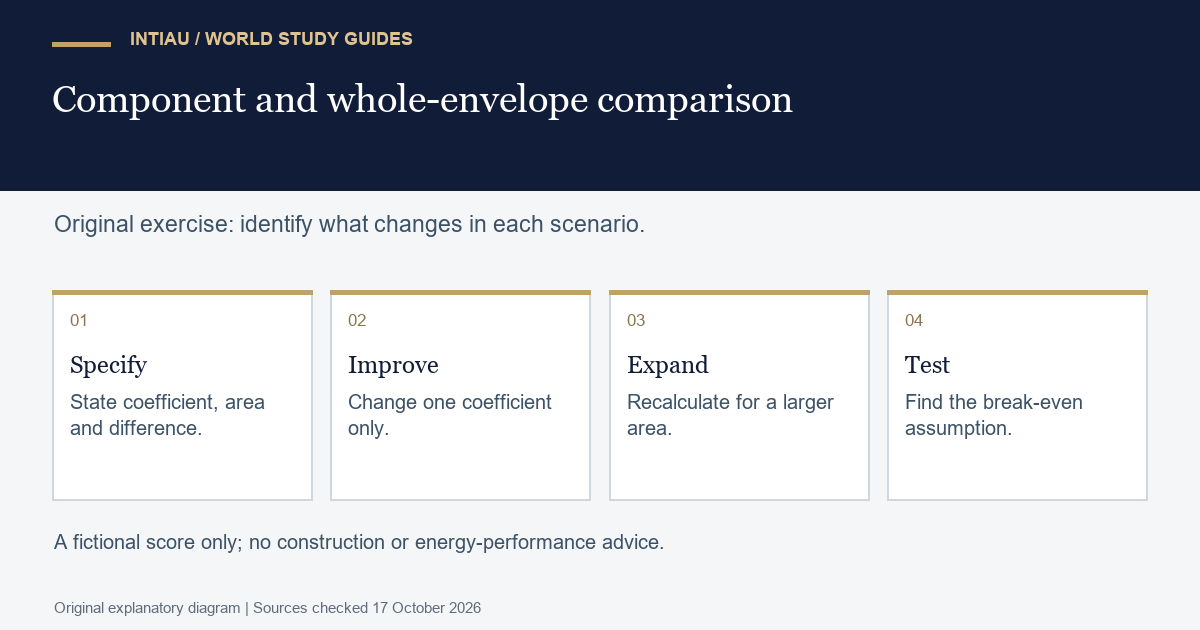
Original worked exercise: a better component, a larger envelope
This invented exercise is independent of Sapienza teaching and involves no real building. Define a deliberately simplified loss score as a coefficient multiplied by an exposed area and a temperature difference. The score is a paper comparison only. Its coefficient values are hypothetical and must not be used to select materials, size equipment or certify performance.
For option A, set the coefficient to three, area to twenty and temperature difference to twelve. The score is 720. For option B, keep the area and temperature difference but reduce the coefficient to two. The score becomes 480. Under these stated assumptions, the score falls by 240, or one third of the original value.
Write what has been held constant before calling B an improvement. The comparison concerns a single simplified score, not comfort, cost, safety or total environmental impact. Explain why a precise percentage does not broaden the claim. A well-labelled calculation is more informative than a general statement that one hypothetical option is sustainable.
Now change the geometry. Suppose a new proposal uses option B’s coefficient but doubles the exposed area to forty. The score becomes 960. Compared with the original option A, that is an increase of 240, or one third. The component coefficient improved, but the total score rose because a different factor changed. Preserve the original and revised calculations side by side.
Next consider uncertainty. If the temperature difference for the larger proposal were ten rather than twelve, the score would be 800. It would still exceed the original 720, although by a smaller amount. Calculate the temperature difference at which the larger proposal would equal the original score: 720/(2 × 40) = 9.
Finish with a four-row comparison showing the coefficient, area, temperature difference and resulting score. Add an assumption column and identify which uncertain quantity you would investigate first. A useful answer explains how new information could change the conclusion, rather than collecting additional numbers without a decision question.
For a further paper task, invent two descriptions of the same result: one emphasising the better coefficient and one emphasising the larger total score. Rewrite them into a single balanced sentence. This tests whether you can communicate a trade-off without hiding the denominator or the boundary of the model. It is not a real energy assessment, building design or environmental certification.
Use the programme’s actual admission route
The enrolment page directs applicants to its official calls. It explains that a knowledge-test result can lead to OFA, additional learning requirements, with thresholds set by the call. A study-plan submission is a separate process from admission. Programme enrolment instructions.
Sources were checked on 17 October 2026. This guide does not infer an unannounced 2027 entry window or an individual eligibility decision. Before following instructions, attach your qualification, applicant category and intended entry year to the question. Keep any request about previous credits separate from the programme comparison.
Frequently asked questions
Is this programme based in central Rome?
The selected catalogue record identifies Rieti campus.
Does an English overview settle every unit’s language?
No. Check individual curriculum tags, including entries marked Italian, and confirm the applicable teaching arrangement.
Does the exercise establish real building performance?
No. Every coefficient and scenario is hypothetical. The task checks arithmetic, model boundaries and sensitivity only.
View the study diagram
Official sources
INTIAU provides its own separate Courses and Contact information. Sapienza determines its academic and admission requirements.