Tilburg University’s International Sociology BSc is a separate institution’s programme, not an INTIAU programme or partnership. The published curriculum combines social questions, research methods and a choice of specialisation.
Its value for comparison lies in the relationship between a question and the evidence used to answer it. Before choosing a degree by its title, check whether you want to explain patterns, design studies and question the limits of a comparison. The fictional exercise below makes that kind of work tangible.
Read the 2026–2027 curriculum, not an invented future plan
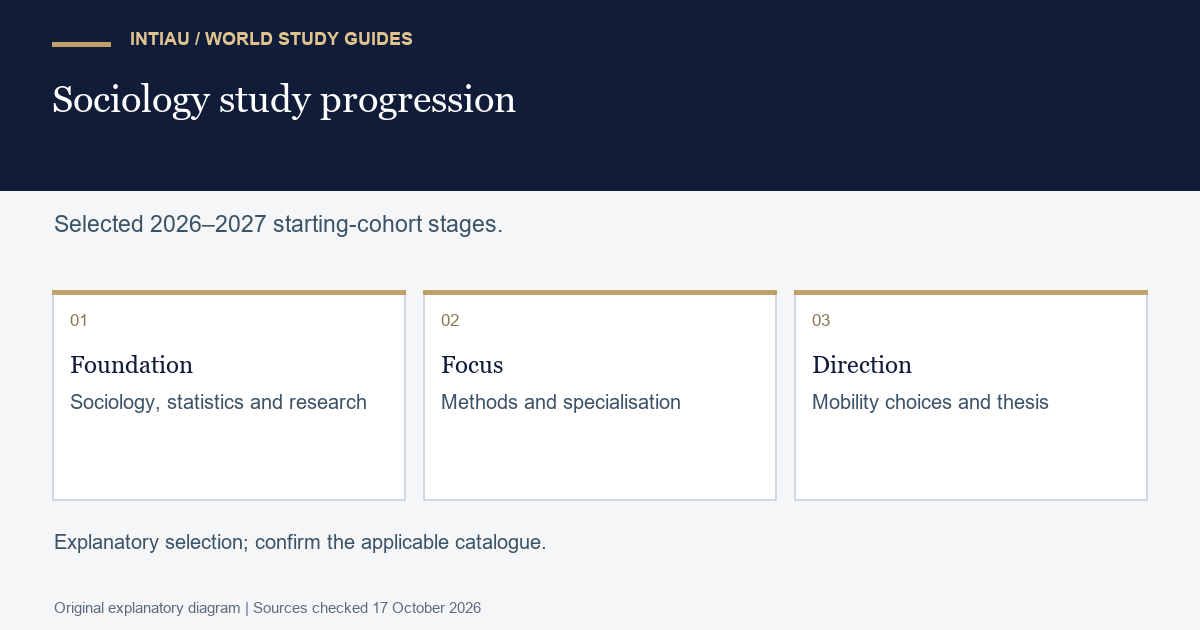
The table covers 2026–2027 starters, progressing from foundations through methods and specialisation to mobility choices and a thesis.
| Stage | Example or allocation | Useful comparison question |
|---|---|---|
| Foundation | Introduction to Statistics; Sociological Research Project 1 | How soon do you work with evidence? |
| Method and focus | Qualitative Research Methods; a specialisation | What can each method establish? |
| Independent direction | Mobility choices, thesis and Social Philosophy for Sociology | Which choices need approval or advance planning? |
The two specialisations are Culture in Comparative Perspective and Social Risks in a Changing World. The programme describes Introduction to Sociology as addressing inequality, social cohesion and rationalisation.
An internship is compulsory if the student does not go on exchange.
The course catalogue link did not expose individual descriptions in the accessible text view used here. Consequently, this guide names actual courses but does not invent reading lists, assessment percentages or weekly seminar activities. Treat the table as a selected map of the published cohort, then open the applicable catalogue before making a final study plan.
Separate the applicant route from the curriculum edition
The application page distinguishes non-Dutch educational backgrounds from Dutch VWO or HBO-P routes. The programme is taught in English. International applicants need appropriate diploma, English and mathematics evidence; application involves both Studielink and OSIRIS Aanmeld. The page lists 1 April for non-EEA and 1 May for EEA applicants and refers to matching information from February 2027.
Those references should not be silently converted into a new course chart. Record your intended intake separately from the curriculum edition. Check the selected deadline, residence-permit branch and exact English-language evidence on the live official page before applying. Avoid using a friend’s nationality alone to select a route: the page also distinguishes the educational background on which the application is based.
Worked exercise: test a comparison between two groups
This original fictional dataset describes responses to a campus travel questionnaire. Among 80 respondents living within two kilometres, 48 usually walk. Among 120 respondents living farther away, 36 usually walk. A draft finding says: “Living nearby makes students walk.” Assess the arithmetic, then the claim.
The walking proportions are 48 ÷ 80 = 60% and 36 ÷ 120 = 30%. The difference is 30 percentage points; the first proportion is twice the second. Those are three different descriptions, so label them carefully. A 30 percentage-point difference is not a 30% relative increase: relative to 30%, the increase to 60% is 100%.
The causal wording goes beyond the supplied records. We do not know how participants were recruited, whether everyone interpreted “usually” alike, or whether timetable and mobility constraints differ between groups. A defensible finding is: “In this fictional respondent sample, reported walking was more common among those living within two kilometres.” It preserves the comparison while identifying its population and measure.
Complete the exercise with one quantitative follow-up and one qualitative question. For example, record the response rate by residential group, and ask volunteers how they decide on transport for an early class. Neither answer should be fabricated. Score your work for accurate denominators, correct difference terminology, a bounded conclusion and questions that address specific uncertainty. This is not a Tilburg assessment or an invitation to survey real students.
Questions to resolve before selecting modules
Can every mobility-window option simply be added together?
No. The published window is an allocation with choices, not permission to add every listed option. The internship condition also depends on exchange participation.
Is registering in Studielink the whole application?
No. The international procedure also requires the application and documents in OSIRIS Aanmeld. Follow the relevant official route to completion.
Does the worked example prove a cause?
No. It establishes a difference within the fictional responses. Recruitment, definitions and competing explanations remain unresolved.
Official reading and related study
- Programme and selected course descriptions
- Cohort curriculum and catalogue links
- Applicant routes and requirements
Compare the Vienna sociology guide for a different programme structure, and practise cautious interpretation with the correlation and causation workshop. Browse the course and syllabus guide archive.
Related guides
View the study diagram